The message came in on a Sunday morning, casual and confident: “Can I get a free trial before I subscribe?”
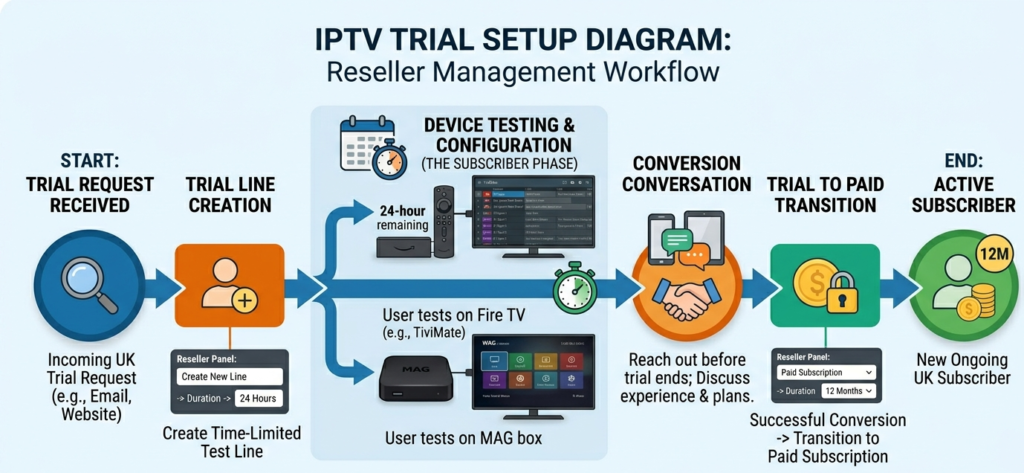
I’d had this conversation hundreds of times by that point. What most resellers don’t realise — and what I’d learned through expensive experience — is that how you handle an IPTV trial request tells a prospective subscriber almost everything about the kind of operator you are. Handle it poorly and you’ve either given away service for free to someone who was never going to convert, or you’ve come across as suspicious and lost a genuine prospect. Handle it well and you’ve turned a cautious enquiry into a paying subscriber who already trusts you before their first payment leaves their account.
The trial conversation is also where resellers make a category of mistake that costs them real money. I’ve watched people hand out unlimited 24-hour trials to anyone who asked, burning through credits on zero-conversion time-wasters. I’ve watched others refuse trials entirely, losing genuine subscribers to competitors who offered a proper test period. And I’ve watched resellers offer trials without any test framework — giving access that told the prospective subscriber nothing useful about peak-demand performance, which is the only thing that actually matters.
Getting the IPTV trial strategy right is more nuanced than most guides suggest. Here’s the complete picture.
Table of Contents
- Why IPTV Trials Matter More Than Most Resellers Think
- The Two Types of Trial: Reseller Testing vs. Subscriber Acquisition
- How to Structure Your Subscriber Trial Offer
- What Prospective Subscribers Should Test During a Trial
- The Credit Cost Reality of Running Trials
- Conversion Rate Optimisation: Turning Trials into Paying Subscribers
- Red Flags in Trial Requests: Spotting Time-Wasters Early
- What to Test as a Reseller Evaluating a New Panel
- UK-Specific Trial Testing Requirements
- Trial Abuse and How to Protect Against It
- Common Trial Mistakes That Cost Resellers Money
- Honest Recommendation
Why IPTV Trials Matter More Than Most Resellers Think
In a market where subscribers can’t physically inspect a product before buying, the trial period is the primary trust-building mechanism available to both parties. For the prospective subscriber, it’s risk mitigation — a chance to verify that what you’re offering actually works on their specific device before committing money. For you as the reseller, it’s an opportunity to demonstrate your service quality and your professionalism simultaneously.
The problem is that most resellers treat trials as a necessary evil — something to be minimised, restricted, or avoided — rather than as a strategic asset. This framing produces trial processes that communicate distrust and defensiveness rather than confidence and competence.
The resellers I know who convert trials at the highest rates — consistently above 75% — all share one characteristic: they approach the trial as a demonstration of their service’s quality, not as a cost to be minimised. They actively help prospective subscribers test the right things at the right times. They follow up during the trial period rather than waiting passively for a conversion decision. And they’ve structured their trial offer in a way that makes it genuinely useful as a test while protecting their credit investment.
In my experience, a reseller who handles the trial process well converts prospective subscribers at 70–80%. A reseller who either refuses trials or offers them with zero guidance converts at 30–40%. The difference, across a year of subscriber acquisition, is hundreds of pounds in revenue from the same level of enquiry volume.
Pro Tip: When a prospective subscriber requests an IPTV trial, your first response should include a specific recommendation for what to test and when. Something like: “I’ll set you up with a 24-hour test line — I’d recommend testing it specifically this Saturday afternoon during the football, that’s when the infrastructure is under real load and it’s the best indicator of what your daily experience will be like.” This response demonstrates confidence in your product and positions the trial as a meaningful quality test rather than an obligatory formality.
The Two Types of Trial: Reseller Testing vs. Subscriber Acquisition
Before getting into trial strategy, it’s worth being clear that “IPTV trial” means two completely different things depending on context — and conflating them creates confusion and poor decision-making.
Reseller panel evaluation trials are test lines you request from panel providers when you’re evaluating a new panel for your business. These are typically 24–48 hour test periods with two to three simultaneous connections, designed to let you verify the panel’s stream quality, EPG accuracy, device compatibility, and support responsiveness before committing credit spend. This is the trial you use before building your business on a panel.
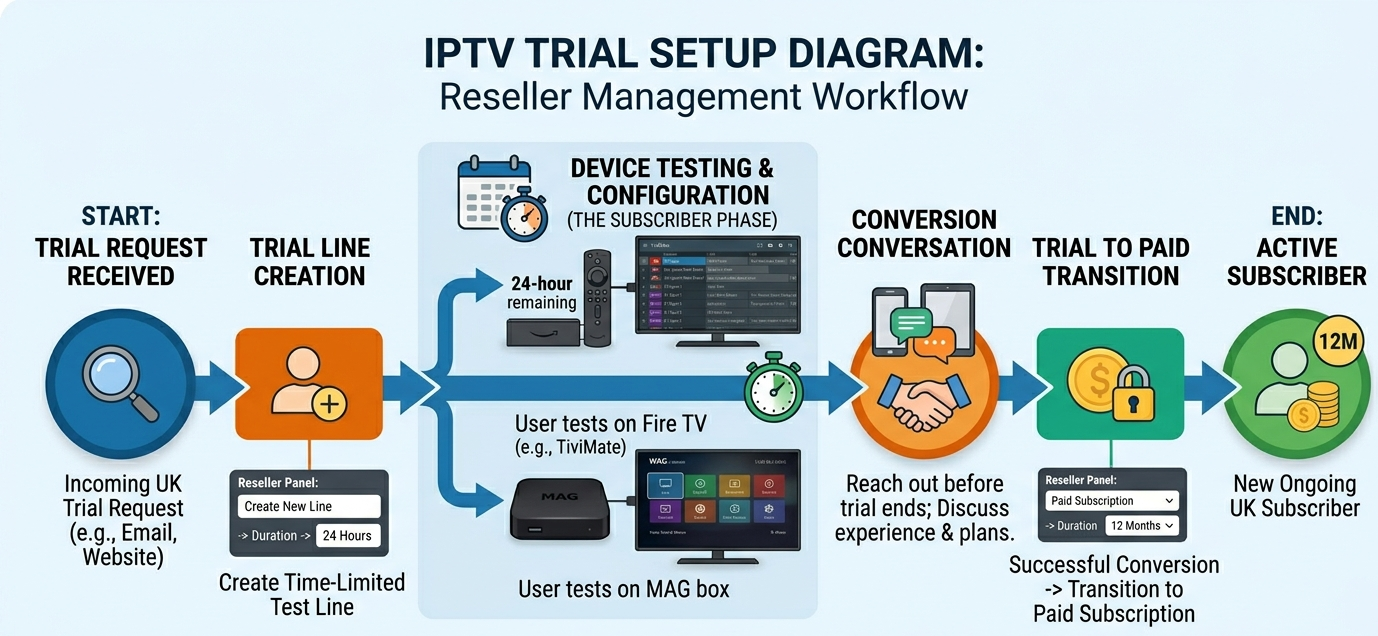
Subscriber acquisition trials are test lines you offer to prospective subscribers to help them verify your service works on their specific device before subscribing. These are typically shorter — 12 to 24 hours — and usually single-connection, designed to give the prospective subscriber confidence in the service without excessive credit cost to you.
Both types require different frameworks, different success criteria, and different follow-up strategies. The rest of this guide covers both — but it’s essential to understand which context you’re operating in before applying any specific advice.
How to Structure Your Subscriber Trial Offer
The structure of your trial offer communicates your professionalism, your confidence in your product, and your operational sophistication — all before the prospective subscriber has watched a single second of content. Getting this right matters.
Duration: 24 hours is the standard that works for the vast majority of trial scenarios. It’s long enough for a prospective subscriber to test across different viewing sessions and different content types. It’s short enough that credit cost is manageable and the window creates natural urgency around the conversion decision. 12 hours is too short for subscribers who have work commitments during the day. 48 hours is generous but increases credit cost and reduces conversion urgency without proportionally increasing conversion rate.
Connection limit: Single connection for subscriber acquisition trials. This covers the vast majority of prospective subscribers who just want to verify the service works on their primary device. Two connections should be reserved for prospective subscribers who specifically ask about multi-device use — and even then, assess whether the request is genuine or an attempt to share the trial across multiple households.
Timing: The trial timing conversation is where most resellers miss a significant opportunity. Offering a trial that runs from Monday to Tuesday tells you and the prospective subscriber almost nothing about Saturday afternoon performance — which is the critical use case for most British IPTV subscribers. Where possible, position trials to include a Saturday afternoon window. Even if you can’t control the exact timing, advising prospective subscribers to specifically test during a high-demand sporting window during their trial period dramatically improves the quality of evidence they gather.
What to communicate upfront: Device type needed, which app to use, basic setup instructions, and what to specifically test. A trial with no guidance produces confused prospective subscribers who form impressions based on random activity rather than the scenarios that actually matter.
$$ \text{Trial Conversion Rate} = \frac{\text{Trials Converted to Paid Subscriptions}}{\text{Total Trials Issued}} \times 100 $$
Track this monthly. A healthy conversion rate for a well-structured trial process in the UK market sits between 65% and 80%. Below 50% signals either poor service quality, poor trial timing, or poor follow-up process. Above 80% consistently suggests you may be being too selective in who receives trials — potentially turning away genuine subscribers who would have converted with proper support.
What Prospective Subscribers Should Test During a Trial
Most prospective subscribers, left to their own devices, will test an IPTV trial by loading a few channels, confirming the streams work, and making a decision based on that. This is a thoroughly inadequate test that tells them very little about how the service will perform when they actually need it.
As the reseller, steering prospective subscribers toward meaningful testing is both helpful to them and valuable to you — because a subscriber who’s tested properly during a trial and found the service works well is a much stronger conversion than one who tested casually and is still uncertain.
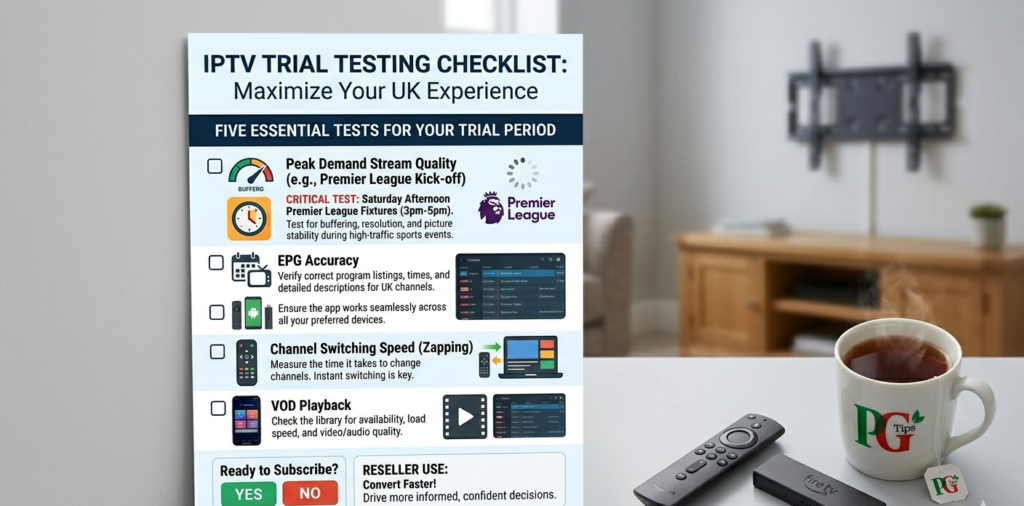
The tests that actually matter for British subscribers:
Peak demand stream quality — testing during a Saturday afternoon sporting window, or at minimum during a busy weekday evening with live fixtures. If the trial period doesn’t naturally include one of these windows, advise the prospective subscriber to test specifically during the next available high-demand period.
Device compatibility — testing on the actual device they’ll use day-to-day, not just on their phone. If they’re planning to watch on a MAG box, test on the MAG box. If they’re using a Samsung smart TV, test through the Smart IPTV app. The device they test on should be the device they’ll subscribe on.
EPG accuracy — checking that the programme guide shows correct information for three or four channels, at the correct UK time. A quick cross-reference against a TV listings website confirms whether EPG data is accurate or running out of sync.
App switching stability — testing that streams load reliably when switching between channels, not just that the first channel selected works. Channel switching performance under load is the most common everyday frustration for IPTV subscribers, and it’s easy to test during a trial period.
VOD playback — attempting to play two or three VOD titles, verifying that the library is functional rather than decorative. Even a basic check that five randomly selected titles play correctly takes three minutes and reveals significant quality differences between panels.
Pro Tip: Send prospective subscribers a brief “trial testing checklist” when you issue their test line credentials. A five-point list — test a live stream during peak hours, check the EPG, try switching channels quickly, test one VOD title, check your chosen device connects properly — takes sixty seconds to read and transforms how thoroughly they evaluate the service. Subscribers who test properly during a trial make faster, more confident conversion decisions. The checklist serves your interests as much as theirs.
The Credit Cost Reality of Running Trials
Trials are not free. Every trial line you issue consumes one credit for the duration it’s active — and depending on your panel’s credit accounting, a 24-hour trial may consume a full month’s credit regardless of actual usage. Understanding this economics is essential for structuring a trial policy that doesn’t quietly drain your margin.
In a typical UK reseller credit structure, a trial line costs £2.00–£2.50 in credit value depending on your volume tier. If your trial converts at 70%, your effective trial acquisition cost per paying subscriber is:
$$ \text{Trial Acquisition Cost Per Subscriber} = \frac{\text{Credit Cost Per Trial}}{\text{Conversion Rate}} $$
$$ = \frac{£2.40}{0.70} = £3.43 \text{ per converted subscriber} $$
At £8 monthly retail with a 65% gross margin, each converted subscriber delivers approximately £5.20 monthly gross profit. The trial acquisition cost of £3.43 is recovered within one month of subscription — a completely viable acquisition economics model.
The problem arises when conversion rate drops. At 40% conversion — which happens when trials are offered without guidance to unqualified prospects — the acquisition cost rises:
$$ = \frac{£2.40}{0.40} = £6.00 \text{ per converted subscriber} $$
At £6.00 acquisition cost and £5.20 monthly gross margin, trials are effectively subsidising subscriber acquisition at a loss in the first month. This is why conversion rate optimisation in your trial process matters economically, not just operationally.
Conversion Rate Optimisation: Turning Trials into Paying Subscribers
The trial-to-subscription conversion process is where most resellers leave money on the table. Issuing a trial and waiting passively for a conversion decision is the lowest-effort and lowest-conversion approach. Here’s what actually works.
The follow-up message at 12 hours — a brief check-in message during the trial period, asking how the service is working and whether the prospective subscriber has any questions. This message serves three purposes: it demonstrates attentiveness, it catches any configuration issues early enough to resolve before the trial ends, and it opens the conversion conversation naturally. Keep it casual: “Just checking in — how’s it looking? Let me know if you need any help with setup.”
The conversion prompt at 20–22 hours — with two to four hours remaining on the trial, a direct but low-pressure conversion message. “Your trial ends in a couple of hours — happy with how it’s working? I can get you set up on a full subscription whenever you’re ready.” This creates a natural deadline without aggressive sales pressure.
The objection response framework — prospective subscribers who haven’t converted often have a specific objection rather than a general disinterest. The most common: “I want to test it more” (offer a short extension in exchange for a partial payment), “I’m not sure about the pricing” (walk through the value comparison), “I had a couple of buffering moments” (diagnose whether it was trial timing, their connection, or a genuine stream issue).
The no-response follow-up at 48 hours — for prospective subscribers who don’t respond to the conversion prompt, a single follow-up 24 hours after trial expiry. “Your trial ended yesterday — any questions before you decide?” After this, the conversion decision rests entirely with them. Don’t chase further.
Red Flags in Trial Requests: Spotting Time-Wasters Early
Not every trial request comes from a genuine prospective subscriber. Some categories of request are worth approaching with caution before issuing credits.
Requests with no device information provided. Genuine prospective subscribers usually know what device they’re using. A request with no device information — just “can I get a trial?” — sometimes signals a reseller competitor testing your panel or someone collecting trial credentials to aggregate and share.
Multiple trial requests from the same contact in a short period. A second trial request within 30 days from the same number or contact is almost always either a conversion that didn’t happen for a specific reason worth understanding, or a trial abuser. Ask directly why they didn’t convert from the first trial before issuing a second.
Requests for specific combinations of credentials — such as asking for both M3U URL and Xtream Codes credentials for the same trial line, or asking for multiple simultaneous connection test lines. Genuine subscriber trials need one connection type and one device. These requests look more like panel evaluation or credential aggregation.
Vague device descriptions. “A box” or “a smart thing” is not a device description. Genuine subscribers typically know whether they have a Fire TV stick, a MAG box, or a Samsung TV. Vague descriptions sometimes indicate a less honest trial intent.
Pro Tip: Implement a simple pre-trial qualification step. Before issuing any trial credentials, ask: “What device are you planning to use?” and “What are you mainly looking to watch?” These two questions cost you nothing, take seconds for a genuine prospective subscriber to answer, and immediately reveal requests that lack the specificity of a genuine subscriber. Someone who can’t answer what device they’ll use hasn’t thought about this seriously enough to convert.
What to Test as a Reseller Evaluating a New Panel
The trial evaluation criteria for panel selection are meaningfully different from subscriber acquisition trials — and this deserves its own specific framework because the stakes are considerably higher. Getting a panel wrong costs you not just a credit but potentially months of subscriber churn and reputation damage.
Request three simultaneous connections — not just one. Single-connection testing tells you almost nothing about how the panel performs under concurrent load. Three simultaneous connections on different device types gives you a meaningful picture of both stream quality and connection management.
Test during peak UK demand windows specifically — the 3pm Saturday window if the trial period allows, or at minimum a busy midweek evening with live fixtures. Weekday afternoon testing on a quiet day is not a valid infrastructure evaluation. The panel has to prove itself when it matters.
Test all three connection methods — Xtream Codes via TiviMate on a Fire TV stick, M3U via GSE Smart IPTV on iOS, and portal via STBEmu on Android. A panel that performs excellently through one connection method and poorly through another tells you which subscriber device types it will disappoint.
Raise a support ticket with a technical question — at an atypical time, ideally a Friday evening or Saturday morning. Clock the response time and evaluate the quality of the answer. This is your actual support SLA, not the one in their marketing materials.
Check EPG accuracy at three different times across the trial period, cross-referencing against an independent TV listings source. Note whether the times are BST-correct — this fails surprisingly often and affects six months of the year.
UK-Specific Trial Testing Requirements
British subscribers have specific viewing priorities that make certain trial tests more important than generic IPTV guidance suggests.
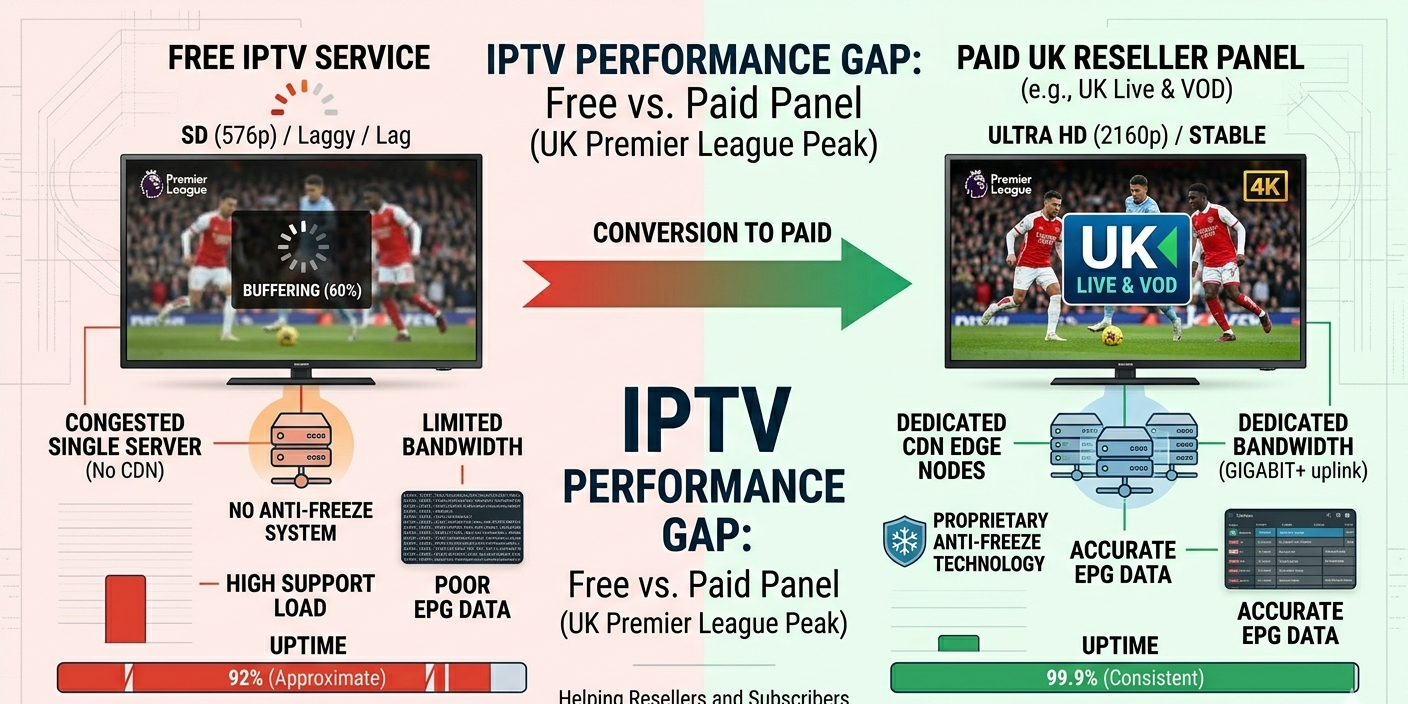
The Saturday afternoon test is non-negotiable for UK panel evaluation. Premier League demand peaks during this window in a way that has no equivalent in most other markets. A panel that holds clean during this window has demonstrated something genuinely meaningful. A panel that buffers or drops during this window has revealed its infrastructure limitations in the most relevant possible way.
EPG BST accuracy should be verified specifically during the months when UK clocks are an hour ahead of UTC — late March through late October. Many panels source EPG data in UTC without applying the BST offset. An EPG that shows times an hour out during summer generates persistent subscriber complaints that are entirely preventable.
MAG box portal stability during peak demand is worth specific testing if your subscriber base includes MAG device users. MAG portal connections and Xtream Codes connections can perform differently under load on the same panel infrastructure — a panel with excellent XC performance and unreliable portal delivery will produce inconsistent experiences across your subscriber base.
Common Trial Mistakes That Cost Resellers Money
Offering trials without specifying what to test. Prospective subscribers who don’t know what to test form impressions based on irrelevant activity. Guide every trial with a specific testing framework.
Issuing trials without follow-up. A trial with no follow-up is a credit donation to someone who may or may not have even used it properly. The follow-up at 12 hours and 20 hours is the operational mechanism that converts trials into subscribers.
Offering trials to anyone who asks without qualification. Pre-qualifying trial requests with two basic questions — device type and primary use case — costs nothing and filters out the least likely converters before you spend credits.
Testing panels only during off-peak hours. A panel that performs flawlessly on a Tuesday afternoon may be a different proposition entirely on a Saturday at 3pm. Peak demand testing is the only evaluation that matters for a British reseller’s purposes.
Not tracking trial conversion rate. If you don’t know your conversion rate, you can’t improve it. Track trials issued and trials converted monthly — it’s the single most informative metric about your acquisition process efficiency.
Honest Recommendation
The IPTV trial — whether you’re using one to evaluate a panel or offering one to acquire subscribers — is one of the highest-leverage activities in your reseller operation when done properly. It either confirms that your service quality justifies your subscriber’s trust, or it reveals problems you need to address before they affect your paying subscriber base.
The panel you offer trials on matters as much as how you structure the trial itself. A trial on a panel with marginal Saturday afternoon performance will produce borderline conversion decisions and hesitant new subscribers. A trial on a panel with genuinely clean peak-demand performance converts confidently — because the service speaks for itself.
For UK resellers who want a panel that performs well enough to convert trials consistently — with UK-optimised CDN infrastructure, reliable anti-freeze during Premier League demand spikes, and EPG accuracy that holds up to a prospective subscriber’s scrutiny — britishseller.co.uk is the platform worth building your trial process around. When your service is good enough that the trial effectively closes itself, the conversion conversation becomes very straightforward indeed.
✅ IPTV Trial: UK Reseller Success Checklist
- Implement a two-question pre-trial qualification before issuing any trial credentials — “What device are you using?” and “What are you mainly looking to watch?” filter out low-conversion requests, reveal the right app recommendation, and position you as a professional operator before the trial has even started.
- Send a trial testing checklist with every set of trial credentials — five specific tests: peak demand stream during sporting hours, EPG accuracy check, device compatibility on their actual device, channel switching stability, and one VOD title. This transforms how thoroughly prospective subscribers evaluate the service and directly improves conversion rate.
- Follow up at 12 hours and 20 hours during every trial period — the 12-hour check-in catches configuration issues early and demonstrates attentiveness. The 20-hour conversion prompt creates a natural deadline that accelerates decision-making. These two messages are the operational mechanism that separates 70%+ conversion rates from 40% ones.
- Track your trial conversion rate monthly as a primary acquisition metric — a healthy rate sits between 65% and 80%. Below 50% indicates a problem with trial timing, service quality, or follow-up process. Above 80% consistently may indicate you’re being too selective in trial issuance. The number tells you where to improve.
- Always evaluate new panels with peak-demand trial testing specifically — three simultaneous connections, tested during a Saturday afternoon Premier League window or a busy midweek evening with live fixtures. A panel that can’t prove itself under the conditions your British subscribers will use it in hasn’t earned your business — regardless of what the sales conversation suggested.