Most people typing “what is IPTV GitHub” into a search bar are expecting a simple one-liner. A link to a playlist. A free app. Maybe a tool that fixes buffering. The reality is messier — and if you’re running a UK IPTV reseller operation or managing a panel, understanding what IPTV GitHub actually represents in 2026 matters more than any single playlist ever could.
Let’s cut through the surface-level noise.
What Is IPTV GitHub at Its Core — and Why It’s Not What Beginners Think
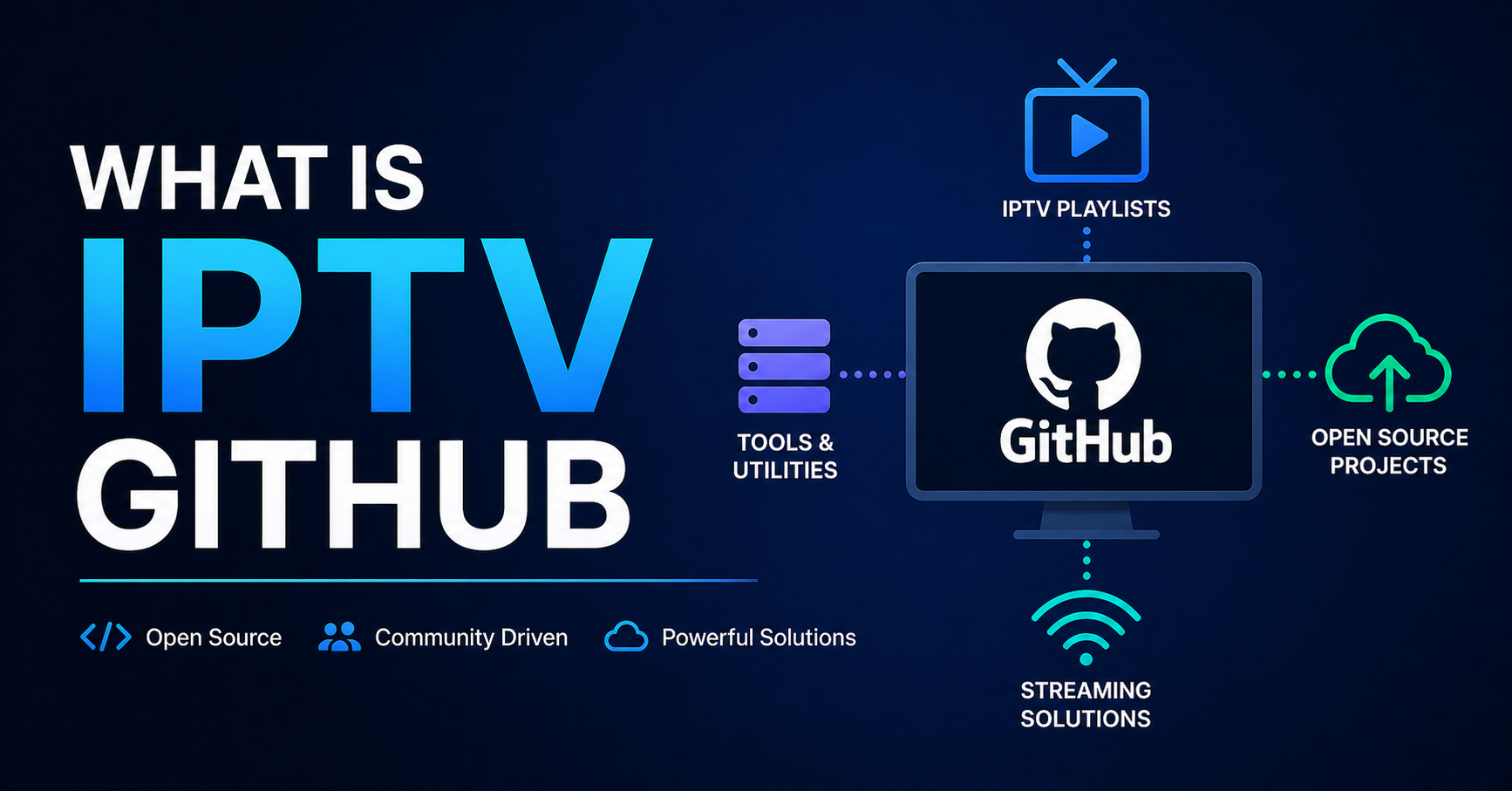
GitHub is a code hosting platform. That’s it. It’s not an IPTV service. It doesn’t stream anything. What is IPTV GitHub, then, in practical terms? It’s a collection point — where developers, hobbyists, and occasionally operators push open-source tools, M3U scripts, EPG parsers, playlist aggregators, and panel automation snippets into public repositories.
For a beginner stumbling across it, it looks like a goldmine. Thousands of repositories. Free M3U links. Channel lists sorted by region.
For someone who’s actually run infrastructure, it looks like a liability warehouse.
Here’s the problem: the moment any M3U list gets pushed to a public GitHub repository, it’s dead within hours. Major broadcasters run automated scrapers that harvest public repos specifically for exposed stream URLs. The links get blacklisted, redirected to honeypots, or quietly throttled at the CDN level before most users ever load them.
Pro Tip: If you found a working M3U from a GitHub repo, it’s either a decoy, it expired 48 hours ago, or it’s a low-priority stream no one is actively protecting. Real infrastructure doesn’t live in public repos.
The Open-Source Tools Layer — Where IPTV GitHub Actually Has Value
Strip away the playlist hype and what is IPTV GitHub becomes a more interesting question. Because there is a legitimate layer here — and operators who ignore it are missing real utility.
Several community-maintained tools live on GitHub that serve genuine infrastructure purposes:
- EPG grabbers — scripts that pull and parse Electronic Programme Guide data from open sources, formatted for Xtream Codes or XtreamUI injection
- Panel monitoring scripts — lightweight uptime checkers that ping your Xtream panel endpoints and alert via Telegram or webhook when response times spike
- M3U validators — tools that batch-check stream URLs for HLS latency, response codes, and segment availability before they ever reach a client device
- Playlist formatters — converters that shift between M3U, XSPF, and JSON formats depending on what the end-device or middleware expects
None of these tools stream anything themselves. They’re infrastructure utilities. That distinction matters enormously — both legally and operationally.
A reseller who knows how to use an EPG synchronisation script correctly is delivering a better product than one who doesn’t. Customer churn is heavily influenced by EPG accuracy. When a user sees the wrong programme title in the guide, they assume the channel is broken. That’s a support ticket, or worse, a chargeback.
Why Resellers Keep Landing on GitHub Despite the Risks
Understanding what is IPTV GitHub also means understanding the pull. It’s not stupidity — it’s economics.
A new reseller with thin margins is looking to cut costs anywhere possible. Panel credits cost money. Backup servers cost money. A private upstream provider costs money. GitHub looks free. And for someone who doesn’t yet understand how enforcement actually works in 2026, “free” is a powerful incentive.
| Factor | GitHub-Sourced Streams | Premium Panel Infrastructure |
|---|---|---|
| Uptime reliability | 20–40% (link rot is constant) | 95–99.9% SLA from established providers |
| ISP blocking exposure | Extremely high (public IPs, known repos) | Mitigated via rotating uplinks and DNS failover |
| EPG accuracy | None to minimal | Full EPG sync with metadata |
| Customer support path | None | Panel dashboard with diagnostics |
| Scalability | Zero (static M3U) | Multi-connection, load-balanced |
| Legal exposure | Highest risk tier | Varies by provider structure |
The math doesn’t work in GitHub’s favour once you’re past the testing phase. The only rational use case for public GitHub IPTV content is benchmarking — understanding what’s out there, what quality looks like at the bottom, and why your paying customers deserve better.
ISP Blocking in 2026 — What Is IPTV GitHub’s Role in the Crackdown?
This is where the conversation shifts from theoretical to operational. What is IPTV GitHub contributing to the current enforcement climate? More than most resellers realise.
AI-assisted ISP blocking systems have matured significantly over the past 18 months. Major network operators in the UK and Europe are no longer manually blacklisting IPs. They’re running pattern recognition models that flag:
- High-frequency HLS segment requests to known CDN ranges
- Traffic signatures matching Xtream Codes API call patterns
- Geolocation mismatches between DNS resolution and physical stream delivery
Public GitHub repositories are actively harvested by these detection systems. Every IP address referenced in a publicly accessible M3U file gets cross-referenced against known IPTV infrastructure. Once flagged, that IP range enters a shared blocklist that propagates across ISP networks through peering agreements.
So what is IPTV GitHub doing to the broader ecosystem? It’s accelerating the identification of unprotected infrastructure. Resellers using GitHub-sourced streams are not just hurting themselves — they’re exposing upstream IPs that other paying customers may also be routed through.
Pro Tip: If your upstream provider’s IPs appear in any public GitHub repository, treat that as a red flag about their operational security. Legitimate infrastructure operators don’t let their delivery IPs get indexed publicly.
Panel Management and the GitHub Toolchain — A Smarter Integration
Back to the legitimate use case. For resellers managing Xtream Codes or XtreamUI panels at scale, what is IPTV GitHub when used correctly? It’s a toolkit for automation that your panel’s native interface doesn’t provide.
Specific workflows where GitHub tools genuinely help:
Bulk credit monitoring: Scripts that pull API data from your panel and output remaining credit balances, active connection counts, and trial expiry windows into a formatted dashboard. Eliminates the need to log into the panel manually multiple times per day.
Automated M3U validation: Before pushing a new stream URL into your panel, running it through a validator script that checks segment delivery time, checks for DNS poisoning indicators, and confirms codec compatibility with common client apps.
Reseller sub-account reporting: Exporters that pull reseller-tier usage data and format it as CSV or JSON for accounting or churn analysis. Understanding which of your resellers is converting trials to paid accounts — and which isn’t — is the difference between scaling intelligently and scaling blindly.
These are not streaming tools. They’re management tools. The distinction keeps you on the right side of platform terms and reduces your operational exposure.
What Is IPTV GitHub Telling You About the Free Tier Mindset?
There’s a psychology worth examining here. The resellers who spend significant time searching what is IPTV GitHub and trying to extract free streams are often the same operators who struggle with customer retention, support ticket volume, and churn rates that make the business unworkable.
It’s not a coincidence.
When your infrastructure is built on unreliable sources, the customer experience reflects that. Buffering isn’t just a technical event — it’s a trust event. A subscriber who experiences three buffering incidents in one evening doesn’t think “the stream had issues.” They think “this service is rubbish.” They cancel. They don’t come back.
The resellers building sustainable operations in 2026 have done the opposite calculation:
- They pay for stable upstream panel access with genuine backup uplink servers
- They understand that load balancing across multiple server nodes is non-negotiable during live sport windows
- They know that HLS latency under 3 seconds during high-demand events is a retention tool, not a luxury
- They treat the panel dashboard as a business intelligence tool, not just a link generator
Pro Tip: The cheapest thing you can do for customer retention is fix your infrastructure. A £10/month saving on panel credits that causes three cancellations at £15/month each is a net loss of £35. The math on quality infrastructure always wins over time.
Backup Uplink Servers — The Gap GitHub Cannot Fill
One of the most consequential decisions any IPTV reseller makes is whether their upstream provider has genuine backup uplink servers or whether they’re running single-point infrastructure dressed up as redundant.
What is IPTV GitHub in this context? It’s a symptom of not having reliable primary infrastructure. Operators who are secure in their upstream don’t need to scavenge GitHub repositories for fallback streams. They have failover built into the panel architecture.
Here’s what genuine backup uplink redundancy looks like in practice:
- Geographic server distribution — primary delivery nodes in separate data centres (not just separate VMs on the same rack)
- Automatic failover switching — when a node drops, stream delivery shifts within seconds, not minutes
- CDN edge caching — for high-demand content, edge nodes pre-cache segment data to reduce origin server load and eliminate the “everyone watching the same match” spike that crashes single-server setups
- DNS-level traffic management — routing requests through health-checked DNS records so that a dead server never receives live traffic
None of this appears in what is IPTV GitHub searches. It’s not there because it’s not free and it’s not simple. But it’s the difference between a reseller business that works and one that generates constant support demands.
Scaling Without Breaking — Lessons from Real Panel Operations
The transition from 50 subscribers to 500 is where most reseller operations hit their first wall. What is IPTV GitHub doing at that scale? Absolutely nothing useful. The toolchain that worked for a hobbyist testing ten streams in a bedroom fails entirely under commercial load.
What actually breaks when you scale without proper infrastructure:
Concurrent connection limits: Most panel packages have hard limits on simultaneous streams. At 50 users, you’re unlikely to hit them at peak. At 500, during a Saturday evening with live football and a popular series premiere, you will.
API response degradation: The Xtream Codes API has known performance bottlenecks under high query volume. If your IPTV UK reseller sub-accounts are all running apps that poll the API every 30 seconds, that load accumulates.
DNS poisoning vulnerability: At larger scale, your streams become worth targeting. DNS poisoning attacks — where bad actors redirect your stream DNS to null routes — become an active threat rather than a theoretical one. Load balancing across multiple DNS-resolved endpoints is the mitigation.
Support ticket explosion: Every technical failure at scale generates multiple simultaneous support contacts. Without a panel dashboard that gives you real-time diagnostics, you’re troubleshooting blind.
The resellers who navigate this transition successfully share one characteristic: they invested in the infrastructure layer before they needed it, not after the crisis hit.
What Is IPTV GitHub in 2026 — The Honest Summary
So let’s land on a clear answer. What is IPTV GitHub in the current landscape?
It is:
- A repository of open-source infrastructure tools with legitimate operational value
- A historical dumping ground for M3U playlists that are now enforcement honeypots
- A diagnostic resource for understanding the bottom of the market
- A community codebase for EPG management, panel automation, and monitoring scripts
It is not:
- A reliable stream source for any commercial operation
- A substitute for real panel infrastructure with backup uplink servers
- Something a serious reseller should be routing customers through
- A safe environment for any IP address you care about protecting
The resellers who understand this distinction move faster, retain customers longer, and survive enforcement waves that wipe out their competitors.
Reseller Execution Checklist
Infrastructure:
- Confirm your upstream provider runs genuine backup uplink servers across separate data centres
- Verify load balancing configuration handles concurrent connection spikes during live events
- Test HLS latency under simulated load before committing to subscriber growth
Panel Management:
- Deploy an API monitoring script (GitHub-sourced is fine here) to track panel response times
- Set up automated alerts for connection count approaching your plan limit
- Run EPG sync validation weekly — wrong EPG data drives unnecessary churn
Risk Mitigation:
- Audit any GitHub repositories your team has referenced for public IP exposure
- Confirm no stream URLs in your panel trace back to publicly indexed infrastructure
- Establish a DNS failover protocol for ISP blocking events in UK/EU markets
Customer Retention:
- Benchmark your buffering rate during peak windows — anything above 2% is a retention problem
- Set trial conversion tracking so you know which reseller sub-accounts are underperforming
- Document your support response time — subscribers cancel faster than they escalate
Understanding what is IPTV GitHub fully means accepting that the term points to two completely different realities depending on who’s asking. For a developer building panel tooling, it’s a useful resource. For someone hoping to build a subscription business on public playlists, it’s a fast route to failed infrastructure and lost customers. The operators who last are the ones who figured out that difference early.