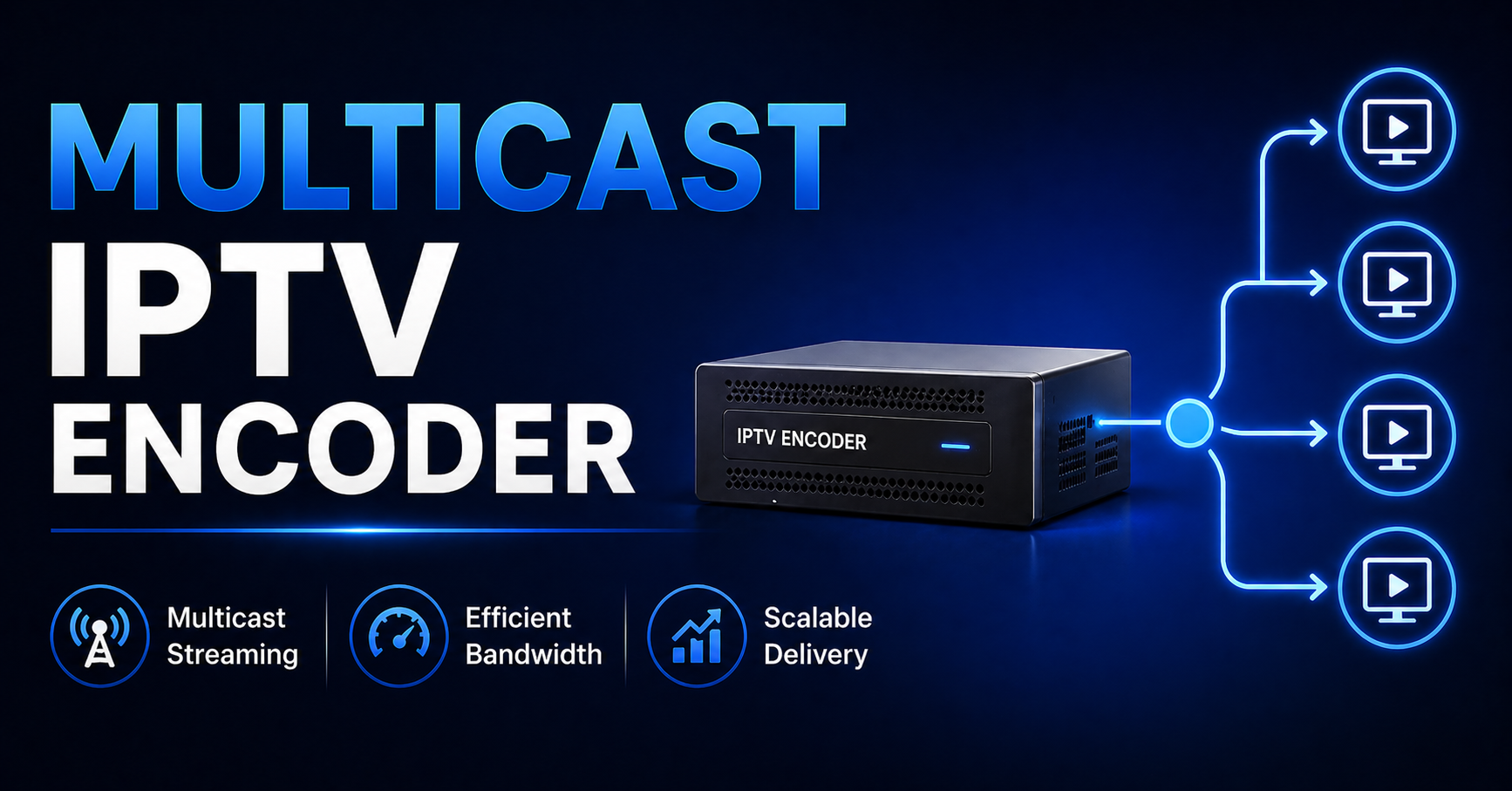
Here’s something most reseller guides will never tell you: the majority of IPTV networks running today are architecturally inefficient by design. They’re built on unicast delivery — meaning every single subscriber pulling a stream creates a separate data thread from the origin server. Scale that to 500 concurrent viewers on one premium sports channel, and you’re not serving one stream. You’re serving 500.
That’s where the multicast IPTV encoder changes everything. Not incrementally. Fundamentally.
Multicast rewires the core delivery logic. Instead of the server replicating your stream per user, it sends one stream to a network group, and the infrastructure handles distribution at the router level. The encoder is what makes that conversion possible — it takes your source feed, transcodes it into multicast-compatible packets, and stamps them with a multicast group address that receivers tune into rather than request individually.
If you’ve been running a UK IPTV reseller panel and wondering why your upstream costs keep climbing even as stream quality stays flat — the architecture is the answer. Unicast scales linearly with users. Multicast doesn’t.
This isn’t theory. Operators who switched to multicast-capable infrastructure in 2024–2025 reported bandwidth cost reductions between 40–65% on high-concurrency channels. That’s money that was previously disappearing into redundant data packets your server was generating thousands of times per hour.
How a Multicast IPTV Encoder Actually Processes a Live Feed
Most people treat the encoder as a black box. That’s a mistake — especially when you’re troubleshooting latency spikes at 11 PM on a match night.
The multicast IPTV encoder receives a source signal — typically SDI, HDMI, or an IP feed — and performs three core operations simultaneously: compression (usually H.264 or H.265), encapsulation into MPEG-TS or HLS containers, and multicast address assignment using the 224.0.0.0/4 IP range reserved for group transmissions.
The encoder doesn’t just compress and forward. It manages the RTP/UDP stream metadata, handles Program Specific Information tables (PAT/PMT), and synchronises the Program Clock Reference so downstream decoders don’t drift out of sync. If your PCR is misconfigured, viewers won’t see buffering — they’ll see a working stream that subtly desyncs audio from video over 20–30 minutes. That’s an encoder configuration failure, not a network one.
What separates a basic encoder from a production-grade multicast IPTV encoder:
- Redundant input failover (automatic source switching under 200ms)
- Hardware-accelerated encoding (prevents CPU bottlenecks at scale)
- IGMP v2/v3 support for router-level group management
- Built-in stream health monitoring with threshold alerting
- Output bitrate shaping to prevent downstream congestion
Pro Tip: Always configure your encoder’s output bitrate at 85% of your committed uplink capacity — never 100%. That 15% buffer is what keeps your streams alive during ISP congestion windows, which in 2026 are increasingly triggered by AI-based traffic shaping algorithms rather than raw saturation events.
The ISP Blocking Problem in 2026 — And Why Multicast Changes the Equation
Unicast IPTV streams have become trivially easy for ISPs to fingerprint. Deep Packet Inspection tools have matured to the point where consistent unicast traffic patterns — same destination IP, regular packet cadence, sustained high bitrate — are flagged algorithmically within minutes on some networks.
The multicast IPTV encoder complicates that fingerprinting process. Because multicast packets are addressed to group IPs rather than individual subscriber endpoints, the traffic signature looks fundamentally different from a standard unicast stream to a subscriber’s home IP. This doesn’t make multicast invisible — nothing does — but it disrupts the pattern-matching that DPI systems rely on.
In 2025–2026, several major ISPs in Europe deployed AI-assisted traffic classification systems that operate at layer 7. These systems don’t just look at packet headers — they analyse payload entropy, timing regularity, and connection persistence to classify streams. Unicast IPTV is a known pattern. Multicast, especially when combined with encrypted tunnelling at the distribution layer, presents a significantly murkier signature.
| Traffic Type | DPI Detection Risk | Bandwidth Efficiency | Scalability |
|---|---|---|---|
| Unicast (standard) | High | Low (1 stream per user) | Poor above 200 users |
| Multicast (unencrypted) | Medium | Very High | Excellent |
| Multicast + Encrypted Tunnel | Low-Medium | High | Excellent |
| CDN-proxied Unicast | Medium-Low | Medium | Good with cost |
This doesn’t mean multicast is a silver bullet against enforcement. DNS poisoning, portal blocking, and MAC address bans operate at completely different layers. But from a pure delivery resilience standpoint, a properly configured multicast IPTV encoder gives you an architecture that’s harder to disrupt than vanilla unicast at scale.
Panel Credits, Concurrent Streams, and What Resellers Get Wrong About Encoder Capacity
Here’s a reseller-specific mistake that costs real money: purchasing panel credits based on subscriber count without accounting for concurrent stream density.
Your multicast IPTV encoder doesn’t care about your total subscriber base. It cares about how many unique channels are being pulled simultaneously. If you have 1,000 subscribers but they’re all watching 30 channels at peak time, your encoder needs to handle 30 active multicast groups — not 1,000 streams. That’s the efficiency gain in practice.
But resellers frequently over-credit their panels based on total users and under-invest in encoder throughput. The result: the encoder becomes the bottleneck, not the network. At high concurrency, an underpowered multicast IPTV encoder will introduce HLS latency spikes, manifest file delays, and segment fetch failures that your subscribers experience as buffering — even though your bandwidth is fine.
Encoder capacity planning formula (basic):
- Identify your peak concurrent channel count (not user count)
- Multiply by average channel bitrate (e.g. 8 Mbps for HD, 25 Mbps for 4K)
- Add 20% overhead for encoding processing and metadata
- That’s your minimum encoder throughput requirement
A 50-channel HD deployment at 8 Mbps per channel requires an encoder capable of handling 400+ Mbps of output with headroom. Most entry-level encoders cap out well below that under real load.
Pro Tip: Run a 72-hour stress test on your encoder before going live with a new subscriber tier. Simulate peak concurrent connections using IPTV stream testing tools. Encoders that fail at hour 48 — not hour 1 — are the silent killers of reseller reputations.
Backup Uplink Architecture — The Part Most Multicast Deployments Skip
The multicast IPTV encoder is only as reliable as the uplink feeding it. This is where I’ve seen resellers invest heavily in encoder hardware and then route everything through a single fibre connection with no failover.
You need uplink redundancy at two levels: source feed redundancy and outbound uplink redundancy.
Source feed redundancy means your encoder has a secondary input — typically a backup IP feed or satellite downlink — that it can switch to automatically if the primary source drops. High-quality multicast IPTV encoders handle this with sub-200ms switchover. Cheaper units can take 2–5 seconds, which viewers perceive as a full buffering event.
Outbound uplink redundancy means your encoder’s multicast output routes through at least two physically separate uplinks to your distribution layer. BGP failover is the standard here for professional deployments. For smaller reseller operations, a bonded connection with automatic failover is the minimum viable setup.
Uplink configuration checklist:
- Primary fibre uplink: dedicated, uncontended if possible
- Secondary uplink: different ISP, different physical path into your facility
- Automatic failover configured at router level (not manual intervention)
- Uplink monitoring with sub-60-second alerting thresholds
- Encoder output bitrate capped below combined failover capacity
The 2025 wave of data centre outages caught a significant number of IPTV operators completely unprepared. Operations with redundant uplinks and properly configured multicast IPTV encoders recovered in under 3 minutes. Operations running single-uplink unicast setups were down for hours.
H.264 vs H.265 Encoding — Which Codec Your Multicast IPTV Encoder Should Be Running in 2026
This debate is settled operationally, even if it still generates forum arguments.
H.265 (HEVC) delivers roughly equivalent visual quality at 40–50% lower bitrate compared to H.264. For multicast deployments — where you’re transmitting one stream to potentially thousands of simultaneous viewers — that bitrate reduction multiplies directly into infrastructure cost savings.
But here’s what gets skipped in generic comparisons: H.265 encoding is computationally heavier. A multicast IPTV encoder running H.265 at the same channel count as an H.264 deployment needs significantly more processing capacity. If you’re running hardware encoders near their rated capacity with H.264, switching to H.265 on the same hardware will degrade performance, not improve it.
The practical 2026 recommendation: use H.265 on any new multicast IPTV encoder deployment where the hardware is rated for it at your target channel count. For existing H.264 infrastructure that’s performing reliably, the migration cost and risk rarely justify the bitrate savings unless you’re at a scale where bandwidth costs are a primary operational expense.
AV1 is emerging as the next-generation codec for streaming deployments. Several encoder manufacturers have announced AV1 hardware acceleration support for 2026 releases. The efficiency gains over H.265 are real — approximately 20–30% additional bitrate reduction — but AV1 decoder support on end-user IPTV boxes remains inconsistent enough that deploying it broadly creates compatibility problems that outweigh the bandwidth savings for most reseller operations today.
Pro Tip: When evaluating a new multicast IPTV encoder, request the manufacturer’s benchmark data for H.265 encoding at your target channel count and bitrate. Rated maximums are tested under ideal conditions. Real-world throughput under concurrent multicast load can be 20–35% lower than spec sheet numbers.
Scaling a Multicast IPTV Encoder Network From 100 to 1,000 Subscribers
The architecture that works at 100 subscribers breaks at 300. The architecture that works at 300 breaks at 800. This is not a flaw — it’s a scaling reality, and understanding where each threshold is protects you from the kind of catastrophic failure that loses you an entire subscriber base overnight.
At 100 subscribers, a single multicast IPTV encoder with adequate throughput and a direct uplink is entirely manageable. Your IGMP group management is simple, your channel count is limited, and your monitoring overhead is low.
At 300–500 subscribers, you start hitting meaningful concurrency on popular channels. This is where load balancing between encoder outputs becomes necessary. You need a distribution layer — typically a multicast-capable layer 3 switch — sitting between your encoder and your outbound network. Without it, popular channels experience group congestion that manifests as periodic freezing rather than constant buffering.
At 500–1,000 subscribers, you’re operating a multi-encoder environment. Each multicast IPTV encoder handles a defined channel group, with redundant peers for failover. Your panel management becomes a serious operational consideration — credit tracking, concurrent stream limits, and churn monitoring all need systematic handling, not manual oversight.
Scaling milestones and infrastructure triggers:
| Subscriber Count | Key Infrastructure Upgrade |
|---|---|
| 0–100 | Single encoder, basic monitoring |
| 100–300 | Load balancer, uplink redundancy |
| 300–600 | Layer 3 multicast switch, secondary encoder |
| 600–1,000+ | Multi-encoder cluster, full BGP failover |
Customer churn at scale is almost never about content — it’s about reliability. Subscribers who experience two buffering events in a week leave. Subscribers who experience zero buffering events for three months become referral sources. The multicast IPTV encoder architecture is what makes that reliability achievable at volume, not manual monitoring or reactive fixes.
Common Multicast IPTV Encoder Failures — And How to Diagnose Them Before Subscribers Notice
Reactive troubleshooting is how resellers lose subscribers. Proactive diagnosis is how they keep them.
The most common failure pattern with multicast IPTV encoder deployments isn’t hardware failure — it’s configuration drift. Over weeks and months of operation, small changes accumulate: a router firmware update that alters IGMP handling, a source feed bitrate change that pushes the encoder past its rated throughput, a misconfigured PCR interval that slowly degrades synchronisation.
These failures are insidious because they don’t trigger obvious alarms. They manifest as degraded quality that subscribers attribute to their own internet connection before raising a support ticket — if they raise one at all. Most just cancel.
Proactive monitoring framework:
- Stream health monitoring with continuous bitrate and packet loss tracking
- PCR accuracy alerts (threshold: more than ±500ms drift triggers investigation)
- IGMP membership report monitoring (unexpected group drops indicate network issues)
- Encoder CPU and thermal monitoring (consistent above 80% CPU is a pre-failure indicator)
- Weekly automated stream quality audits across your full channel list
DNS poisoning — increasingly used as an enforcement tool in 2025–2026 — presents differently from encoder or network failures. If specific channels become unreachable while others remain stable, and your encoder health metrics are normal, DNS interference is the likely cause rather than infrastructure failure. Maintaining secondary DNS resolution paths is standard operational practice for any deployment beyond hobbyist scale.
Pro Tip: Build a private monitoring dashboard that pulls encoder health metrics, uplink status, and stream quality data into a single view. Spending 90 seconds on morning checks catches 80% of developing failures before they reach subscribers. This is the operational discipline that separates resellers who grow from resellers who churn.
Reseller Success Checklist — Multicast IPTV Encoder Operations
This is execution, not theory. Every item here maps to a failure mode that has ended reseller operations.
Infrastructure:
- Multicast IPTV encoder rated at 120%+ of your current peak throughput requirement
- Hardware-accelerated encoding enabled (software encoding is a bottleneck at scale)
- Redundant source feed inputs configured with automatic failover under 200ms
- Dual uplinks from separate ISPs with BGP or bonded failover
Configuration:
- IGMP v3 enabled on all multicast-capable network equipment
- PCR intervals configured per encoder manufacturer specification
- Output bitrate set at 85% of committed uplink capacity
- Multicast group addressing documented and non-overlapping across encoder outputs
Monitoring:
- Real-time stream health alerts with sub-5-minute notification latency
- Thermal and CPU monitoring on encoder hardware
- Weekly full-channel quality audit protocol
- DNS resolution monitoring across primary and backup paths
Scaling readiness:
- Document your current architecture’s concurrency ceiling before you hit it
- Identify your next infrastructure upgrade trigger (subscriber count or encoder load threshold)
- Maintain at least one cold-standby encoder unit if you’re above 300 active subscribers
- Panel credit allocation reviewed monthly against actual concurrent usage patterns
Churn prevention:
- Proactive subscriber communication during any planned maintenance window
- Sub-4-hour resolution target for any stream quality degradation event
- Post-incident review for any outage exceeding 15 minutes — root cause documented
The operators who build durable UK IPTV reseller businesses aren’t the ones with the most channels or the lowest prices. They’re the ones whose multicast IPTV encoder infrastructure holds at 11:45 PM on the biggest match nights of the year. That reliability is built in advance, not improvised under pressure.