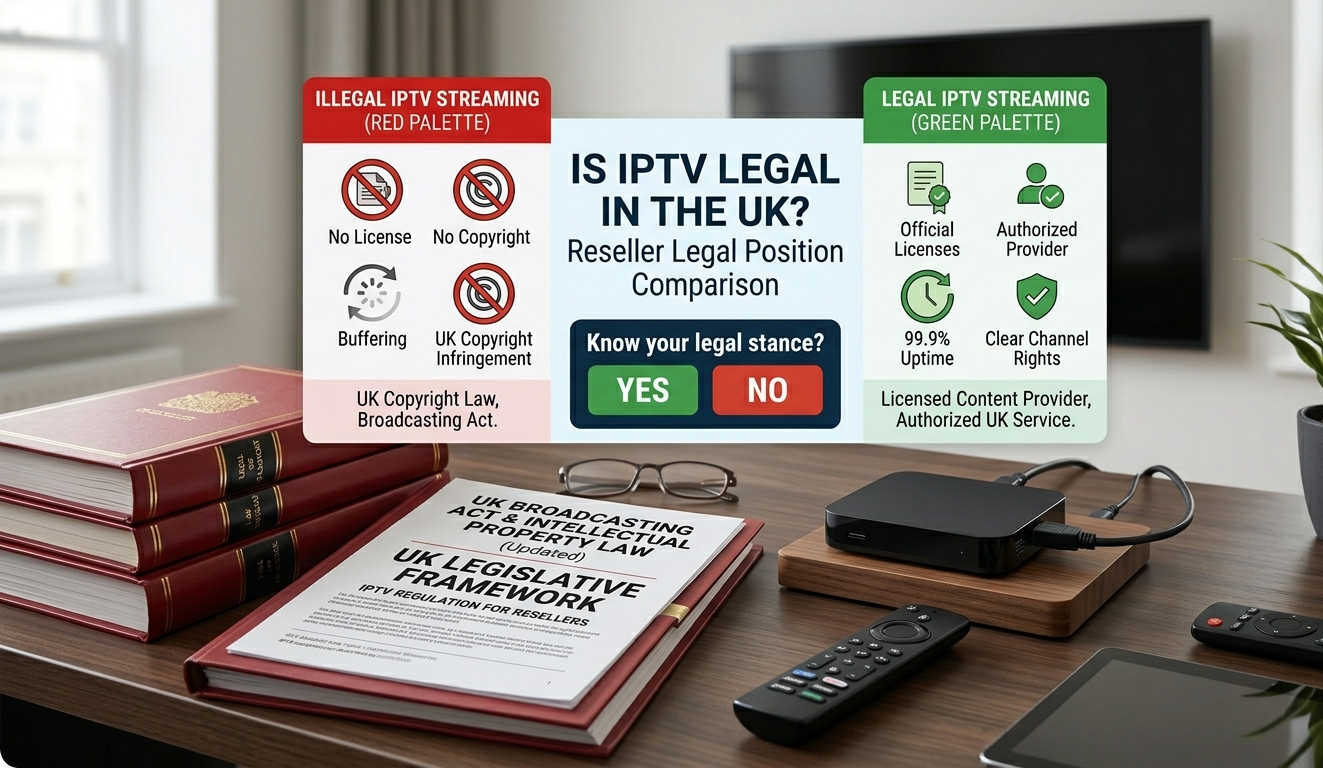
It wasn’t a dramatic raid. No blue lights, no uniformed officers at the door. It was an email from a solicitor representing a rights enforcement body, addressed to a reseller I knew personally, referencing specific IP addresses tied to his panel’s delivery infrastructure, specific dates and times of alleged infringement, and a financial claim figure that made his panel revenue for the entire previous year look trivial by comparison. This guide clears up whether IPTV is legal in the UK, and what that means specifically for resellers.
He had been operating for eighteen months. He had never asked the question: is IPTV legal in UK in the context of how I am specifically running my business? He had assumed, as many UK IPTV resellers do, that because the panel software itself was legal, the activity was legal. That assumption cost him significantly more than the legal fees. It cost him the business entirely. The question of whether IPTV is legal in the UK is not a binary one with a clean yes or no answer. It is a layered legal framework that resellers who intend to operate sustainably in 2026 must understand with precision, not approximation.
Understanding the Technology vs. the Content Distinction
The starting point for any honest answer to whether IPTV is legal in the UK is separating the technology from the content it delivers. IPTV as a technology, the delivery of video content over internet protocol networks, is entirely legal. It is the mechanism used by licensed services across the UK and globally. The legality question does not attach to the delivery method. It attaches exclusively to whether the content being delivered is licensed for distribution by the entity distributing it.
This distinction matters enormously for resellers because it means the panel software you operate is legal. The act of selling subscription lines is legal. The business model of reselling access to a streaming panel is legal. What determines the legal status of your specific operation is the licensing status of the content streams your panel delivers to end customers, and whether you, as the reseller, have taken reasonable steps to verify and ensure that licensing compliance exists within your supply chain.
In 2026, with enforcement bodies deploying significantly more sophisticated investigation tools including AI-driven traffic analysis and panel infiltration techniques, the position that “I’m just selling the panel access, not the content” provides substantially less legal protection than it did three years ago.
The Three Legal Categories Every UK IPTV Reseller Must Distinguish
Pro Tip: The legal risk gradient for UK IPTV resellers in 2026 runs from zero to severe depending on a single variable: whether the content streams your panel delivers include live premium sports and first-run entertainment from major UK broadcasters without a licence. Resellers operating panels that deliver only legitimate free-to-air repackaged content occupy a fundamentally different risk position from those delivering full premium sports packages. Know exactly which category your operation sits in.
The UK legal framework around streaming content creates three distinct operator categories, each with a materially different risk profile:
- Category A, licensed IPTV resellers: operating under formal content licensing agreements, reselling access to platforms that hold direct agreements with content rights holders. Fully legal.
- Examples include resellers of legitimate OTT platform subscriptions. Zero enforcement risk from rights holders.
- Category B, grey-area panel resellers: operating panels where the upstream content licensing status is unclear, unverified, or plausibly deniable. Legal risk is moderate to high depending on content mix, scale of operation, and enforcement attention in the reseller’s specific market segment. The majority of UK panel resellers in 2026 operate in this category.
- Category C, knowingly unlicensed premium content resellers: operating panels delivering live premium sports and major broadcaster content without any licensing mechanism. Highest enforcement risk. Subject to civil claims from rights holders, potential criminal referral under the Copyright, Designs and Patents Act 1988, and since 2017, potential prosecution under the Computer Misuse Act in specific circumstances.
Understanding which category your operation occupies is not optional risk management. It is the foundational legal self-assessment that determines every subsequent operational decision.
How UK Enforcement Has Evolved in 2026: What Resellers Are Actually Facing
The enforcement landscape for IPTV operations in the UK has shifted from reactive, large-scale takedowns targeting obvious bad actors toward proactive, data-driven identification of mid-tier resellers who previously operated below the enforcement radar. In 2026, rights enforcement bodies are deploying AI-driven traffic analysis tools that can identify panel infrastructure, map reseller networks, and build evidentiary cases from open-source data without requiring physical access to any server or device.
The practical consequence for resellers is that scale is no longer the primary enforcement trigger. Operations with as few as 50-100 active lines have received formal legal correspondence over the past two years when their panels were delivering specific categories of high-value licensed content. The targeting criteria appear to prioritise content category, specifically live premium sports and first-run entertainment, over operation size. A reseller with 500 lines delivering only free-to-air content occupies a fundamentally different enforcement risk position than a reseller with 80 lines delivering a full premium sports package.
This content-category-driven enforcement model is the single most important development in IPTV legal risk in the past two years, and it is the variable that most resellers, who focus on scale as their primary risk indicator, are systematically miscalculating.
Read More: IPTV Reseller Panel
Reseller Panel Business Liability: Where the Risk Actually Sits
| Operator level | Legal exposure type | Primary risk vector | Enforcement frequency 2026 |
|---|---|---|---|
| End customer | Civil, personal use defence available | Cease and desist letters | Low |
| Retail reseller (1-100 lines) | Civil, financial damages claim | Rights holder investigation | Moderate, increasing |
| Mid-tier reseller (100-500 lines) | Civil + potential criminal referral | Enforcement body targeting | High for premium content |
| Panel operator / upstream provider | Criminal, Copyright Act 1988 | Police/FACT investigation | Very high |
| Infrastructure provider | Civil, secondary liability | Rights holder legal action | Moderate |
The liability chain table illustrates why the question “is IPTV legal in UK” cannot be answered at the technology level, it must be answered at the specific operator level within the distribution chain. Retail resellers occupy a middle-risk position that has historically been under-enforced relative to panel operators and upstream providers. In 2026, that historical under-enforcement is correcting as rights holders develop more cost-efficient methods of pursuing mid-tier operators using the evidentiary groundwork built during larger investigations.
Operational Risk Mitigation: What Legally Aware UK IPTV Resellers Do Differently
The legal risk exposure for a reseller can be thought of as a simple relationship: Legal Risk Exposure equals Content Risk Score multiplied by Active Lines multiplied by Enforcement Attention, minus a Mitigation Factor. Content Risk Score runs from 1 for free-to-air only up to 10 for full premium sports and entertainment. Active Lines is your total subscriber count. Enforcement Attention is a sector intensity score from 1 to 5, currently sitting at 4 in the UK. Mitigation Factor, scored 1 to 3, reflects operational separation, legal documentation, and due diligence measures.
Pro Tip: The Mitigation Factor in that relationship is the only variable you fully control. Resellers who treat legal risk as purely a function of what their upstream provider is doing are ignoring the operational decisions that materially reduce their own exposure, separation of business entities, documented supplier due diligence, clear terms of service, and proactive legal consultation before scale, not after a letter arrives.
Legally aware resellers in 2026 take four operational steps that their less informed counterparts consistently skip. They maintain documented supplier due diligence records, evidence that they have asked questions about content licensing within their supply chain and recorded the responses. They operate with formal terms of service that clearly delineate responsibility for content compliance between the platform and the end user. They consult a solicitor with intellectual property experience before crossing meaningful scale thresholds, not after receiving legal correspondence. And they monitor enforcement news within the IPTV sector actively, adjusting their content mix and operational posture when enforcement attention shifts toward their market segment.
Panels Prime operates as a panel management software provider with documented operational boundaries, providing resellers with a platform that maintains clear separation between panel infrastructure and content delivery responsibility.
The Questions Every Reseller Must Answer Before Scaling
The reseller community in 2026 has a persistent tendency to conflate “I haven’t been contacted yet” with “what I am doing is legal.” These are not the same position. Enforcement timelines in the UK rights protection sector routinely run twelve to thirty-six months from initial intelligence gathering to formal contact, meaning the absence of a legal letter today is not evidence of legal compliance. It is evidence that investigation, if underway, has not yet reached the correspondence stage.
The honest self-assessment every reseller must complete before scaling past 50 lines involves three questions. First: does my panel deliver content that is licensed for the distribution I am providing? Second: can I document reasonable due diligence that I have taken steps to verify this? Third: do my customer-facing terms of service accurately represent the nature and limitations of the service I am providing? If the answer to any of these questions is “no” or “I don’t know,” scaling is amplifying legal exposure, not building a business. The technology is not the issue. The content, the scale, and the documentation of due diligence are the variables that determine whether a UK IPTV reseller operation is legally defensible in 2026.
Is IPTV Legal in UK: Reseller Risk Management Checklist
- Categorise your content mix honestly, map every content category your panel delivers against the three legal operator categories and identify where your specific operation sits on the enforcement risk gradient
- Document your supplier due diligence, maintain written records of questions asked and responses received regarding content licensing within your supply chain; documentation of reasonable enquiry is a material factor in civil enforcement proceedings
- Consult an IP solicitor before crossing 100 active lines, not after receiving legal correspondence; the cost of a 90-minute consultation is a fraction of the cost of responding to a formal rights holder claim under time pressure
- Draft formal terms of service that delineate content responsibility, your customer-facing documentation must clearly establish the nature of the platform service you are providing and the user’s responsibility for their own usage compliance
- Monitor sector enforcement news actively, rights enforcement bodies publish enforcement actions and sector priorities; resellers who track this information can adjust their operational posture before enforcement attention reaches their specific market segment rather than responding after the fact
Panels Prime provides panel management software only and does not host, store, or distribute media content.