I’ve read the Reddit threads. You probably have too. Someone posts asking how to become an IPTV reseller, and within an hour there are fifteen replies ranging from “it’s illegal don’t do it” to “DM me bro I’ll set you up” — neither of which is remotely useful if you’re trying to make a serious, informed decision.
Here’s the thing: becoming an IPTV reseller is a legitimate business model when operated correctly. It’s also a minefield if you walk into it without understanding the infrastructure, the economics, or the very specific ways this industry punishes naivety. I’ve watched people lose hundreds of pounds in their first month because they followed forum advice from someone who’d been running their own operation for three weeks.
This guide is what I wish I’d had when I started. No hype, no vague advice, no “DM me” nonsense.
Table of Contents
- What Reddit Actually Says (And Why Most of It Misses the Point)
- What an IPTV Reseller Actually Does
- The Technical Setup: What You Need Before You Sell a Single Line
- Choosing Your Panel: The Decision That Shapes Everything
- Pricing Your Subscriptions for Profit
- Building Your First 50 Subscribers
- The Mistakes That Kill New Resellers
- Realistic Income Expectations
- Where to Start Without Getting Burned
What Reddit Actually Says (And Why Most of It Misses the Point)
The Reddit discourse around IPTV reselling tends to cluster around two unhelpful extremes. On one side, you get the reflexive “that’s piracy” crowd who treat every IPTV discussion as a moral emergency. On the other, you get the aggressively enthusiastic promoters who make it sound like passive income appears the moment you buy a credit package.
Both camps are missing the actual conversation, which is this: reselling IPTV subscription management software — access to a panel platform that subscribers use to manage their own streams — is a business that requires real operational knowledge, real customer service skills, and a realistic understanding of margins and risk.
Reddit also massively underestimates the infrastructure complexity. You’ll find threads where people recommend panels based on a single week of personal use, with no mention of how that panel performs during simultaneous high-demand windows, what the credit expiry terms are, or whether the provider has a history of disappearing with people’s money.
In my experience, the best information about how to become an IPTV reseller doesn’t come from Reddit. It comes from people who’ve actually run subscriber bases, dealt with refund requests, and rebuilt their business after a provider went dark.
Pro Tip: When researching panels or providers on forums, filter for posts from accounts with history — not new accounts with suspiciously enthusiastic recommendations. The IPTV space attracts a lot of affiliate promotion disguised as genuine advice. If someone is pushing a specific panel hard with no criticism whatsoever, treat it with scepticism.
What an IPTV Reseller Actually Does
Let’s be clear about the business model before we go further.
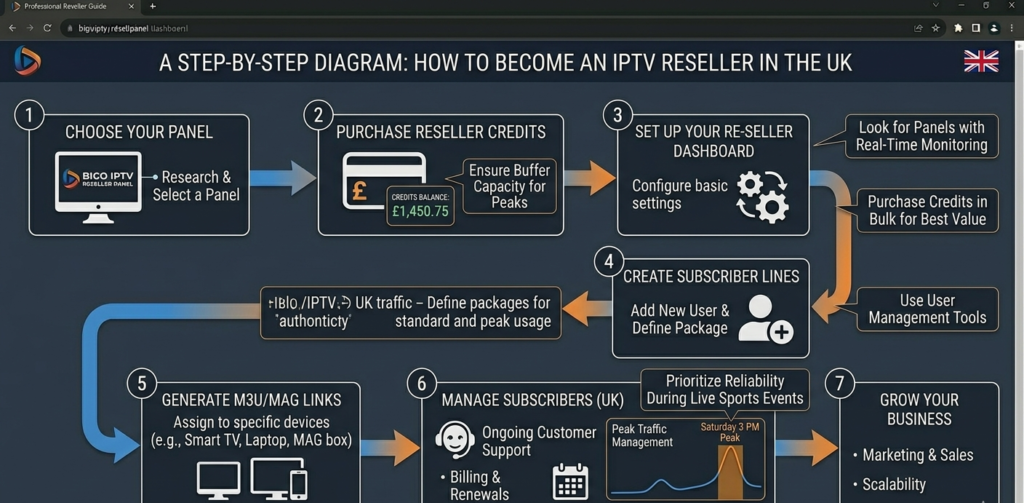
As an IPTV reseller, you operate as a distributor between a panel provider and end subscribers. You purchase credits in bulk from your panel supplier. Each credit represents the cost of one active subscription line for one month. You then sell access to those lines to subscribers at a retail price above your credit cost — that margin is your profit.
You do not host servers. You do not manage upstream content. You do not deal with infrastructure. Your operational responsibilities are: subscriber management, billing, first-line technical support, and marketing.
That’s genuinely it. The technical complexity sits upstream with your panel provider. Your job is client acquisition and retention.
This is why panel choice is so critical — because everything you can’t control directly (stream quality, uptime, anti-freeze performance) is determined by the infrastructure your provider runs.
The Technical Setup: What You Need Before You Sell a Single Line
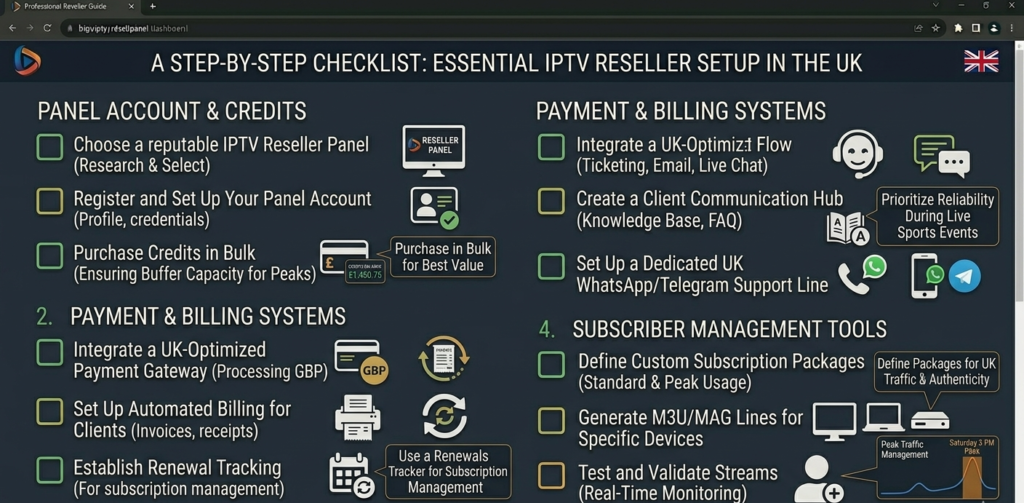
When I first started, I underestimated how much even a simple reseller setup requires in terms of preparation. Here’s the minimum viable setup before you take a single payment:
A verified reseller panel account with test lines confirmed working across at least three device types — Xtream Codes app, MAG box or STBEmu portal, and M3U player. If you haven’t tested all three, you haven’t tested properly.
A payment system — PayPal, Stripe, or bank transfer with clear invoicing. Subscribers paying cash-in-hand arrangements don’t scale, and they create disputes you can’t document.
A communication channel — WhatsApp Business or Telegram. Subscribers will contact you at inconvenient times. Having a dedicated channel separate from your personal phone keeps things manageable.
A simple renewals tracker — even a spreadsheet works at the start. You need to know when each subscriber’s line expires so you can chase renewals proactively rather than reactively.
A written subscriber policy — covering refunds, downtime credits, and acceptable use. Basic, but it protects you when the inevitable difficult conversation happens.
Pro Tip: Set up your WhatsApp Business profile with a proper business name, description, and automated away message before you acquire a single subscriber. It takes 20 minutes and immediately makes you look more professional than 80% of the competition in this space.
Choosing Your Panel: The Decision That Shapes Everything
I cannot overstate how much this single decision affects every other aspect of your business. A good panel makes client management straightforward and keeps refund rates low. A bad panel will occupy most of your waking hours with buffering complaints and eventually cost you everything you’ve built.
The non-negotiables when evaluating any panel for UK resellers:
UK-optimised streaming infrastructure. Your subscribers are predominantly on British broadband connections. The panel’s upstream servers need to have proper UK or EU edge nodes — not just a single overseas data centre routing everything through a congested international connection.
Genuine anti-freeze capability. Premier League fixtures create simultaneous load spikes that expose weak infrastructure fast. Ask specifically how the panel handles concurrent stream demand during peak events. Vague answers are a red flag.
Xtream Codes API, MAG portal support, and M3U output. All three, without exception. These cover the device spread of a typical UK subscriber base.
Transparent credit pricing with volume tiers. You should know exactly what your cost per line is at 50, 100, and 200 subscribers before you commit to anything.
A provider with a verifiable track record. Longevity matters in this industry. A panel that’s been operating consistently for 18+ months is meaningfully lower risk than something that appeared three months ago with a polished website and aggressive pricing.
Pricing Your Subscriptions for Profit
The pricing mistake I see most often from new resellers is racing to the bottom competitively — undercutting the market to acquire subscribers faster, without running the margin maths properly.
Here’s the framework that actually works:
Minimum Viable Retail Price=Credit Cost÷(1−Target Margin)\text{Minimum Viable Retail Price} = \text{Credit Cost} \div (1 – \text{Target Margin})
If your credit cost is £2.50 per line and you want a 65% gross margin:
Retail Price=£2.50÷(1−0.65)=£2.50÷0.35=£7.14\text{Retail Price} = £2.50 \div (1 – 0.65) = £2.50 \div 0.35 = £7.14
Round up to £7.50 or £8.00. That’s your floor. Go below it and your margin disappears the moment you have a single difficult month with above-average refunds or support overhead.
| Subscriber Count | Credit Cost/Line | Retail Price | Monthly Gross Profit |
|---|---|---|---|
| 30 | £2.50 | £8.00 | £165 |
| 75 | £2.40 | £8.00 | £420 |
| 150 | £2.20 | £8.00 | £870 |
| 300 | £2.00 | £8.00 | £1,800 |
The credit cost reduction at volume is the scaling mechanic that makes this business genuinely interesting above 100 subscribers. Below that, it’s a solid side income. Above it, it starts to look like a real operation.
Pro Tip: Don’t price by looking at what competitors charge. Price by understanding your own cost structure and target margin. Competitors who are undercharging are either subsidising their acquisition costs or heading for churn-driven losses — you don’t want to follow either path.
Building Your First 50 Subscribers
Reddit will tell you to “just post in Facebook groups” or “run ads.” Both approaches have a place, but neither is where most successful small resellers actually build their initial subscriber base.
In my experience, the first 50 subscribers almost always come from personal network and word of mouth. Someone you know mentions they’re paying too much for a streaming service. You offer a trial. It works. They tell two people. Those two people tell two more.
That organic chain is slower than paid acquisition but produces subscribers with dramatically lower churn. People who joined because a friend recommended you are far more likely to stay through a bad week than cold-acquisition customers who found you through an ad.
Beyond personal network, the channels that consistently work for UK resellers are Telegram communities relevant to your niche, localised Facebook groups where tech and streaming topics come up naturally, and simple SEO-optimised landing pages that capture search traffic from people actively looking for IPTV subscriptions in their area.
What doesn’t work: aggressive cold outreach, spam-posting in forums, and competing purely on price with no differentiation. You’ll acquire subscribers, burn through them with high churn, and end up back where you started.
The Mistakes That Kill New Resellers
I’ve seen these patterns repeat enough times that they’re essentially predictable:
Committing too many credits before testing properly. Buying a large credit block to get the volume discount, before verifying that the panel actually performs under real conditions. Test first. Always.
No refund policy. Taking a payment with no documented policy means every refund request is a negotiation. You’ll lose most of them and resent all of them.
Using a personal phone number for subscriber support. This is a boundaries issue that becomes a mental health issue at scale. Separate business communication from day one.
Ignoring churn data. If subscribers are leaving and you don’t know why, you can’t fix it. Track every cancellation, ask for a reason, and look for patterns.
Single panel dependency. If your only panel provider goes down, your entire business goes down with it. Always maintain a tested backup with a small credit balance.
Realistic Income Expectations
Let me be direct here, because Reddit tends toward both doom and hype on this topic.
At 50 active subscribers with healthy margins, you’re looking at £200–£280 net monthly profit. That’s a good side income, not a salary replacement.
At 150 subscribers with optimised credit pricing and under 8% monthly churn, you’re in the £700–£900 range. Meaningful money, still manageable as a one-person operation.
At 300+ subscribers, you’re running a real business that requires structured support, reliable automation, and serious panel infrastructure. The income is significant, but so is the operational load.
The trajectory is realistic and achievable. Just don’t start by telling yourself you’ll have 200 subscribers in three months. Start by telling yourself you’ll have 30 satisfied subscribers in three months. That foundation is what everything else gets built on.
Where to Start Without Getting Burned
If you’ve read this far and you’re serious about starting properly, the single most important first step is choosing the right panel. Everything else — pricing, marketing, support systems — can be built and iterated. Bad infrastructure can’t be easily fixed once you have paying subscribers depending on it.
For UK resellers who want a verified starting point with transparent credit pricing and infrastructure that’s been tested by working operators, britishseller.co.uk is worth a serious look. It’s not the flashiest recommendation you’ll find, but it’s the kind of stable foundation that lets you focus on building a business rather than managing a technical crisis.
✅ How to Become an IPTV Reseller: Success Checklist
- Choose your panel before anything else — test it properly across multiple devices and during a real peak demand window before committing credit spend or acquiring a single subscriber.
- Know your unit economics cold — credit cost, break-even subscriber count, target gross margin, and minimum retail price should all be calculated before you set your pricing.
- Build your operational infrastructure first — payment system, communication channel, renewals tracker, and subscriber policy should all be in place before you take your first payment.
- Start with personal network, not paid ads — your first 30–50 subscribers will come from word of mouth, and they’ll churn far less than cold-acquired customers. Prioritise quality over speed.
- Track everything from month one — subscriber count, churn rate, refund rate, and monthly net profit. The data you collect in your first three months will tell you exactly where to focus your energy in months four through twelve.