
Canadian IPTV Reseller Guide: The Complete 2026 Market Briefing
A reseller I spoke with last year had built a decent little operation, 70-odd subscribers across Ontario and British Columbia, steady renewals, minimal complaints. Then his provider pulled the plug. No warning, no migration path, no refund on the 40 credits he’d pre-purchased. Just gone. His Telegram messages went unanswered, the panel URL returned a 404, and 70 subscribers were suddenly his problem to explain.
He’d chosen his panel based on a recommendation in a Discord server from someone he’d never met, running an operation he’d never verified. It’s a story I’ve heard more times than I’d like, and it happens in the Canadian market more than most, precisely because it’s a market that’s grown fast without the same established reseller community infrastructure you see in the UK.
If you’re considering becoming a Canadian IPTV Panel reseller, this guide is the briefing I’d give you before you spent a single dollar.
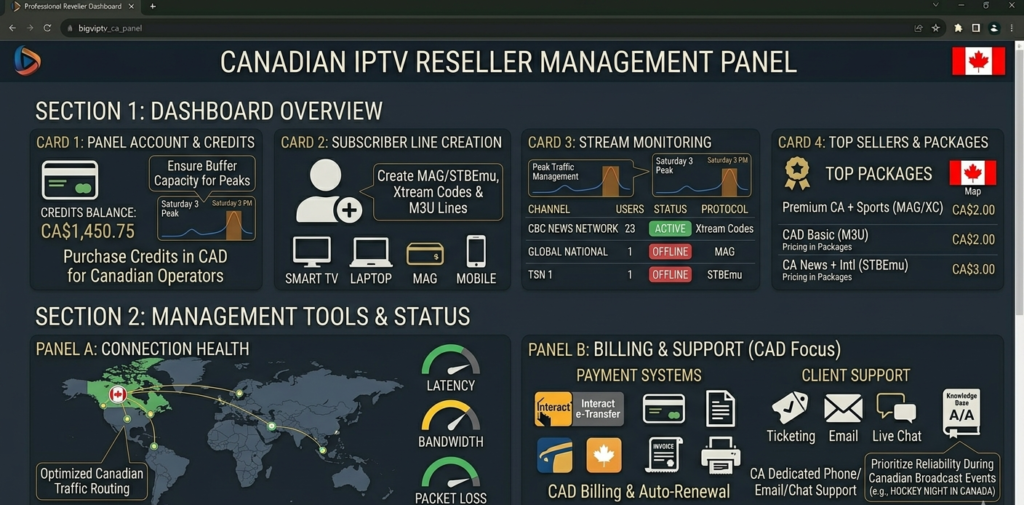
The Canadian IPTV Market in 2026: What Makes It Different
Canada is a genuinely interesting market for IPTV resellers, and not just because of its size. There are some structural features of Canadian media consumption that create real commercial opportunity, and some that create specific operational challenges.
The sheer geography is the obvious starting point. Canada spans six time zones. A subscriber in Vancouver and a subscriber in Halifax are watching the same NHL game at completely different local times, which means your panel infrastructure needs to handle consistent performance across a genuinely distributed user base, not just a concentrated urban cluster.
Then there’s the pricing sensitivity. Canadian cable and satellite packages have historically been expensive relative to the content value they deliver. Rogers, Bell, and similar providers charge premium rates for bundled packages that a significant portion of the population finds poor value. That gap is where IPTV resellers operate, and it’s been widening steadily.
The regulatory environment is worth acknowledging honestly. Canadian broadcasting law has been evolving, and ISP-level enforcement has increased in recent years. This isn’t a reason to avoid the market, but it is a reason to operate thoughtfully, with a clear understanding of what you’re actually selling (panel management software and subscription access, not hosted content) and to ensure your panel provider’s terms are transparent about the same.
Sport is the real demand driver. NHL hockey, CFL football, and increasingly Premier League coverage among the substantial UK-origin diaspora create predictable high-demand windows that your infrastructure needs to handle cleanly.
Pro Tip: If you’re targeting Canadian subscribers, ask your panel provider specifically about North American CDN coverage. A panel with strong UK and EU infrastructure but no North American edge nodes will deliver noticeably worse performance to Canadian subscribers, higher latency, more buffering during peak demand, than one with proper transatlantic distribution.
How the Reseller Model Works (And Where Canada Gets Complicated)
The core model is identical to any other market. You purchase credits from a panel provider, convert those credits into subscriber lines, sell access to those lines at a retail margin, and manage the client relationship ongoing.
What’s different in Canada is the cross-border operational complexity many resellers encounter. A significant portion of established IPTV panels with strong infrastructure are UK or EU-based operations. That’s fine, geography of the panel provider is less important than the geography of their CDN infrastructure, but it does introduce a few wrinkles.
Currency conversion adds a layer to your margin calculations. If you’re buying credits in GBP or EUR and selling subscriptions in CAD, exchange rate movement can quietly erode your margins over time if you’re not pricing with a buffer. I’ve seen resellers set their CAD retail prices based on a spot rate calculation, then watch a 5% currency movement eat their entire profit on a month’s renewals.
Payment processing is another consideration. Not every UK or EU-based panel provider accepts CAD payments or has streamlined processes for non-UK resellers. Confirm this before purchasing credits, since the last thing you want is a payment processing issue when you’re trying to renew a credit balance at 9pm before a big match night.
Support time zones matter too. If your panel’s support team operates on GMT and your subscribers are in Pacific time, a Saturday evening outage in Vancouver hits your panel support team’s Sunday morning. Know your provider’s actual support hours and build your expectations, and your subscriber communications, around reality, not the best case.
Choosing the Right Panel as a Canadian Reseller
The panel selection criteria for Canadian resellers overlaps significantly with the UK checklist, but with some specific additions.
North American CDN presence is the first filter. Ask directly: “Do you have CDN nodes in North America, specifically Canada or the US?” A provider who can’t answer this specifically either doesn’t have them or doesn’t understand their own infrastructure well enough. Neither is reassuring.
Multi-timezone line management, the ability to set trial periods, renewal reminders, and expiry notifications that work sensibly across time zones, matters more in Canada than in a single-timezone market.
CAD-friendly pricing or at least stable credit costs, so your margin calculations don’t require constant recalibration based on exchange rates.
Xtream Codes API, MAG portal support, STBEmu compatibility, and M3U output are all still non-negotiable. Canadian subscribers use the same ecosystem of player apps as UK users, TiviMate, IPTV Smarters, GSE Smart IPTV, so the device compatibility requirements are identical.
Provider longevity and verifiable track record, this matters even more in the Canadian market because the IPTV Panel reseller community is less established, which means fewer public sources of verified provider feedback. You’re doing more due diligence with less community data to draw on.
Pro Tip: Before committing any significant credit spend with a panel provider, request a video call or at minimum a real-time chat session with their support team. The response quality, technical knowledge, and communication speed you experience during that pre-sales interaction is a reliable proxy for what you’ll get when something goes wrong at 11pm on a hockey night.
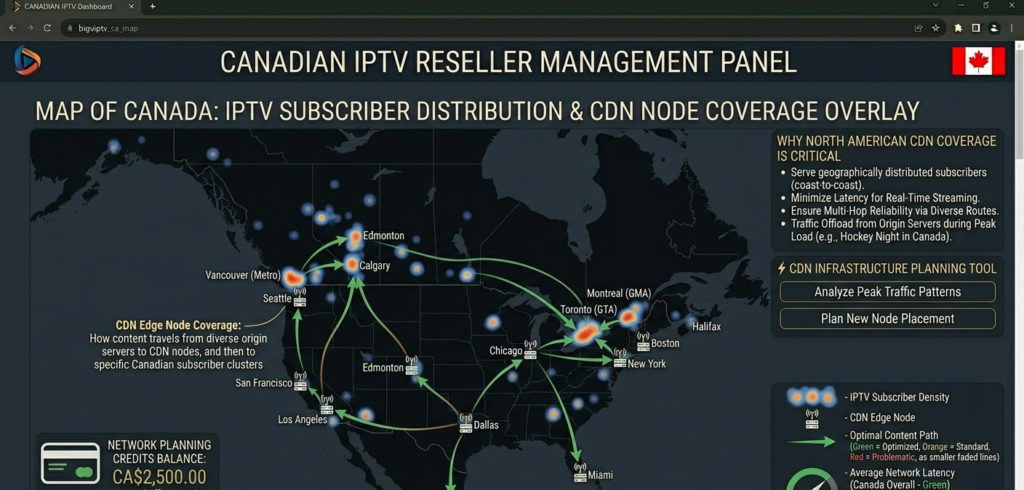
Map of Canada showing IPTV subscriber distribution across provinces with CDN node coverage overlay for reseller infrastructure planning
Technical Requirements You Cannot Compromise On
Running a Canadian IPTV reseller operation means your technical baseline needs to cover a broader device landscape than a purely UK-focused operation.
Canadian subscribers skew toward smart TV apps and streaming sticks alongside the traditional MAG box setup more common in the UK. Roku and Fire TV penetration is significant in Canada, so your panel’s app compatibility list needs to extend beyond the European standard setup.
Anti-freeze technology is equally critical in Canada, arguably more so, because the content most in demand (live hockey, live football) has the same real-time nature as Premier League fixtures in the UK. There’s no tolerance for buffering during a playoff game. The demand spike during a Stanley Cup game would challenge any underpowered infrastructure.
Uptime reliability needs to sit at 99.5% or above on a monthly basis for a sustainable Canadian operation. Anything below that will generate refund requests at a rate that eliminates your margin. In my experience, the panels that genuinely hit and consistently maintain 99.5%+ uptime all have one thing in common: redundant upstream sourcing with automatic failover, not a single upstream dependency.
Pricing Strategy for the Canadian Market
Canadian consumers are accustomed to paying more for media services than their UK counterparts, legacy cable and satellite pricing has created an anchored expectation of relatively high monthly costs for live programming access. This works in your favour as a reseller.
A retail price of CAD $15-$20 per month per line is broadly accepted in the Canadian market and positions your service as excellent value relative to traditional alternatives. At the current GBP/CAD exchange rate, this translates to a very healthy margin if your credits are priced competitively in GBP.
Monthly Margin (CAD) = (Subscribers × CAD Retail Price) − (Credit Cost in GBP × Exchange Rate × Subscribers)
Working example at 80 subscribers, CAD $18 retail, £2.50 credit cost, 1.72 GBP/CAD rate:
(80 × $18) − (£2.50 × 1.72 × 80) = $1,440 − $344 = $1,096 CAD gross monthly profit
That’s approximately £637 at current rates, a genuinely strong margin for an 80-subscriber operation. The Canadian pricing environment is one of the market’s most attractive features for resellers who know how to exploit it.
| Subscribers | CAD Retail | Credit Cost (GBP) | Monthly Gross (CAD) |
|---|---|---|---|
| 30 | $18 | £2.50 | $411 |
| 80 | $18 | £2.50 | $1,096 |
| 150 | $18 | £2.20 | $2,247 |
| 300 | $18 | £2.00 | $3,996 |
Pro Tip: Price in CAD and be explicit with your subscribers that your pricing is in Canadian dollars. Currency clarity reduces billing disputes significantly, especially if you’re taking payments through PayPal or similar platforms that sometimes display converted amounts confusingly.
Building Your Subscriber Base in Canada
The Canadian reseller market is less saturated than the UK equivalent, which means the organic growth ceiling is higher, but the established community channels are thinner too.
Facebook groups are more central to the Canadian IPTV conversation than Telegram, which dominates in the UK. Province-specific groups focused on sports, tech, and cord-cutting are where your target audience naturally congregates. Participation, genuinely helpful participation, not spam, builds the kind of trust that converts to subscribers.
Reddit plays a larger role in Canadian tech communities than in UK equivalents. Subreddits focused on cord-cutting, Canadian sports streaming, and provincial tech communities are all worth engaging with over time. The key word is engaging, answering questions, sharing genuine knowledge, not promoting.
The diaspora angle is underexplored. Canada has substantial communities with strong ties to UK, South Asian, Caribbean, and Middle Eastern football and cricket cultures. These communities have very specific content interests and strong word-of-mouth networks. A reseller who serves one community well will find referrals flow naturally.
The Mistakes That End Canadian Reseller Businesses Early
Buying credits before testing Canadian performance specifically. A panel that performs excellently for UK subscribers may deliver mediocre results to subscribers in Toronto due to routing inefficiencies. Test before you commit.
Ignoring currency risk in your pricing. Set your CAD prices with a buffer against exchange rate movement. A 5% swing in GBP/CAD that isn’t priced in becomes a 5% margin reduction across your entire subscriber base.
No written subscriber agreement. Canadian consumers are accustomed to documented service terms. Operating without them creates exposure in dispute situations.
Single panel dependency. This applies in every market but bites particularly hard in Canada where re-acquiring subscribers after a provider failure is harder due to the thinner community network.
Underestimating support demand during hockey season. NHL and playoff scheduling creates support demand patterns that are as intense as Premier League season in the UK. Staff your support availability accordingly.
Honest Recommendation for Getting Started Properly
The Canadian IPTV reseller opportunity is real, the margins are attractive, and the market is genuinely underserved relative to its size. But the foundation has to be right, and the foundation is your panel choice.
For UK-based resellers looking to serve Canadian subscribers, or Canadian operators building their first reseller setup, the infrastructure requirements are demanding enough that panel selection deserves serious research time before any credit spend.
britishseller.co.uk is a panel operation I’d point resellers toward for evaluation, it’s built with the operational reliability and transparent credit pricing that makes the Canadian market economics actually work. If you’re building a cross-market operation serving both UK and Canadian subscribers, having a stable, established panel base makes that expansion significantly more manageable.
Canadian IPTV Reseller Success Checklist
Verify North American CDN coverage before anything else, testing your panel’s stream performance from a Canadian IP address specifically, not just from a UK connection. Latency and stability can differ dramatically, and your subscribers will notice immediately.
Build currency risk into your pricing from day one, pricing your CAD subscriptions with at least a 10% buffer above your GBP-converted credit cost to absorb exchange rate movement without eating into your margin.
Test during peak Canadian sport windows, running your trial lines during NHL game nights and major sporting events, not just quiet weekday afternoons. Real infrastructure performance only reveals itself under simultaneous high-demand conditions.
Establish written subscriber terms before taking payment, since refund policy, downtime credit process, and acceptable use terms should be documented and shared with every subscriber before their first payment. It protects you and signals professionalism.
Build province-specific community presence before scaling, since the Canadian reseller market rewards localised trust more than broad promotion. One well-connected subscriber in a tight-knit community is worth ten cold-acquired customers who found you through a generic ad.