Best IPTV Reseller Panel: What Actually Separates the Good Ones From the Rest
A reseller I mentored a couple of years back rang me on a Sunday morning sounding genuinely defeated. He’d been running his IPTV business for four months, had built up 65 subscribers, and had just watched his provider vanish overnight, panel gone, Telegram group deleted, credits worth nothing. No warning, no refund, no recourse. Four months of client acquisition, word-of-mouth referrals, and late-night support sessions. Gone.
Choosing the best IPTV reseller panel isn’t just a technical decision. It’s a business-critical one. The wrong choice doesn’t just cost you money, it costs you reputation, and in this industry, reputation travels fast.
So let me walk you through exactly what separates a genuinely good reseller panel from the ones that will quietly destroy your business.
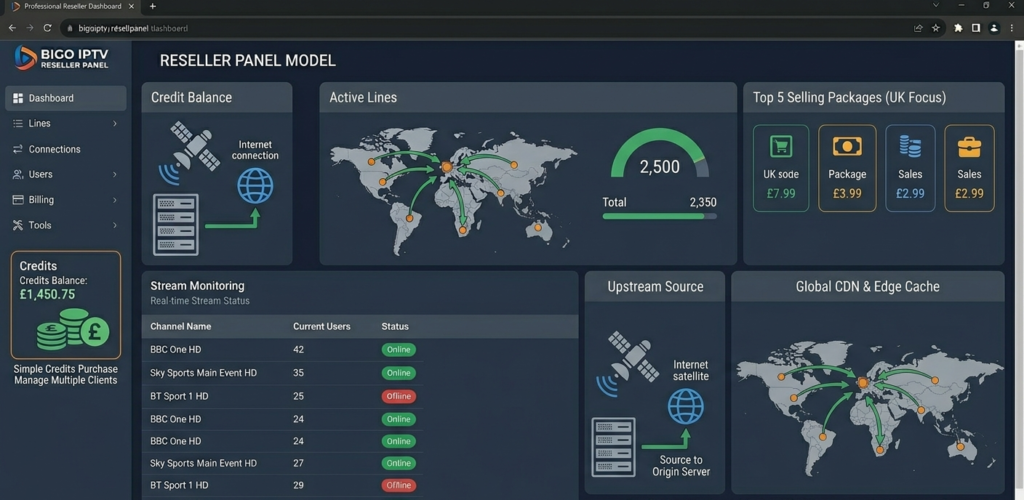
Best IPTV reseller panel dashboard showing active lines, credit balance, and stream monitoring for UK operators
What Makes an IPTV Reseller Panel Actually “The Best”?
This question gets thrown around a lot in reseller forums, and the answers are usually either vague (“it just works”) or suspiciously promotional. Let me give you a more structured answer.
The best IPTV reseller panel for a UK operator is the one that consistently does three things: delivers reliable streams during peak demand, gives you operational control without technical complexity, and comes backed by a provider you can actually trust.
That last point is where most people fail. They chase features, EPG guides, VOD libraries, multi-connection support, without first verifying whether the business behind the panel is stable, transparent, and invested in uptime. Features are meaningless if the panel disappears in month five.
In my experience, the panels that consistently outperform aren’t necessarily the ones with the longest feature list. They’re the ones built by operators who’ve actually run reseller networks themselves and understand what breaks under real-world conditions.
Pro Tip: Ask any potential panel provider this question directly: “What happens to my credits and active lines if your upstream supplier has an outage?” Their answer, and how quickly they give it, will tell you almost everything you need to know about how seriously they take operational reliability.
The Non-Negotiable Technical Features
Before anything else, a reseller panel needs to clear a baseline technical checklist. These aren’t premium features, they’re table stakes in 2026.
Xtream Codes API compatibility is essential. The vast majority of popular IPTV player apps, TiviMate, IPTV Smarters Pro, GSE Smart IPTV, use Xtream Codes as their connection standard. If a panel doesn’t support it natively, your subscribers will face constant app compatibility issues.
MAG box and STBEmu support matters more than many new IPTV resellers expect. A significant portion of UK IPTV subscribers use set-top boxes rather than app-based players. If your panel can’t generate portal URLs for MAG devices or support STBEmu portal configuration, you’re locked out of a sizeable customer segment.
M3U playlist output should be standard. Not all subscribers are technically confident, some will specifically ask for an M3U link because it’s what they know. A panel that can’t generate clean M3U output is already behind.
Anti-freeze technology is where panels genuinely differentiate. This isn’t just marketing language, real anti-freeze implementation means the panel actively manages stream buffering, switches between server nodes during congestion, and maintains playback continuity when upstream bandwidth fluctuates. Panels without it will buffer. Visibly, noticeably, on a Saturday at 3pm.
Multi-connection management, the ability to limit or allow simultaneous streams per subscription, is critical for protecting your credit margins and preventing account sharing abuse.
UK-Specific Performance Requirements
Here’s something that generic “best IPTV panel” listicles almost never address: the UK market has specific infrastructure demands that not every panel is built to handle.
Premier League match days create simultaneous demand spikes unlike almost anything else in streaming. Thousands of subscribers across the country hitting the same content window at the same time. A panel with adequate everyday performance can fall apart completely under that load if its CDN architecture isn’t built for it.
UK subscribers expect low latency. They’re typically on fibre broadband, FTTP or FTTC, and the moment buffering appears on a device that’s connected at 80Mbps, they blame the service, not their connection. Rightly so. That means your panel’s upstream servers need proper UK or EU edge nodes, not just a single data centre routing everything through an overseas connection.
The 3pm Saturday blackout is another UK-specific consideration. During this window, certain live football coverage is restricted domestically, which means demand for IPTV alternatives spikes sharply. Your panel needs to handle that surge without degradation.
Pro Tip: When trialling a panel, specifically test stream performance between 2:45pm and 5:30pm on a Saturday. That window is as close to a real stress test as you’ll get without actually running paying subscribers. If it holds clean, the infrastructure is credible. If it wobbles, walk away.
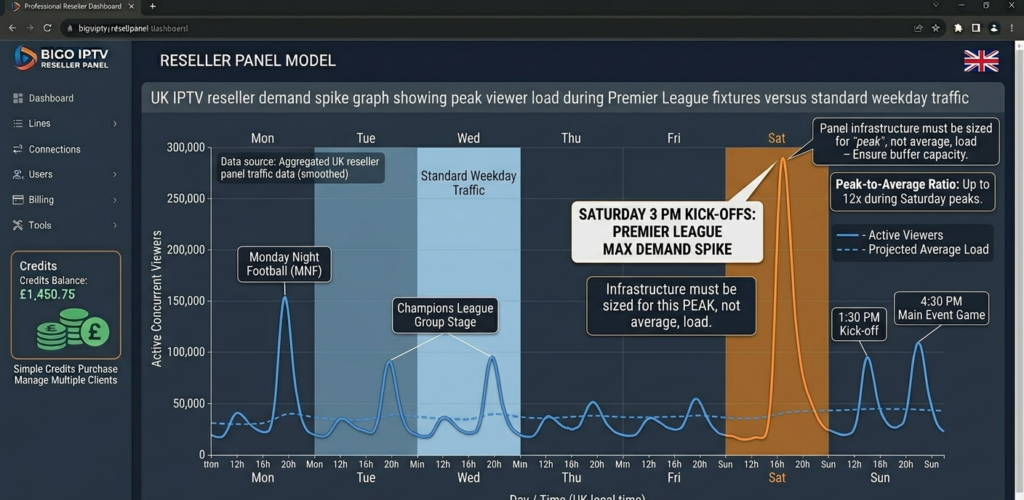
UK IPTV reseller demand spike graph showing peak viewer load during Premier League fixtures versus standard weekday traffic
Pricing Structure and Credit Economics
The best reseller panel isn’t just about stream quality, it’s about whether the credit economics actually support a profitable business.
| Factor | What to Look For |
|---|---|
| Minimum credit purchase | Low enough to test without heavy commitment |
| Cost per credit at scale | Clear tiered discounts for volume buyers |
| Credit expiry policy | No expiry, or at least 12+ months |
| Top-up flexibility | Instant, 24/7, no manual approval delays |
| Refund/dispute policy | Documented and fair, not vague |
Any panel that can’t clearly answer all five of these upfront is hiding something in the pricing model.
The Profit Maths Every Reseller Should Know
Let me run the numbers at two common subscriber levels so you can see how panel credit pricing directly impacts your margins.
Monthly Profit = (Subscribers × Retail Price) − (Credit Cost × Subscribers) − Overheads
At 50 subscribers:
(50 × £8) − (50 × £2.50) − £25 = £400 − £125 − £25 = £250
At 150 subscribers:
(150 × £8) − (150 × £2.20) − £40 = £1200 − £330 − £40 = £830
Notice the credit cost drops slightly at volume, that’s the tier pricing effect. At 150 subscribers, your monthly net is approaching £830 with minimal operational overhead. That’s a meaningful side income, and it scales cleanly if your churn rate stays below 8%.
Churn is the variable that destroys these numbers. A panel with consistent buffering issues will push churn to 20-30%, at which point you’re spending more on acquiring new subscribers than you’re retaining from existing ones.
Pro Tip: Track your monthly churn rate from day one, even if it’s just a simple spreadsheet. If churn exceeds 10% in any given month, investigate stream quality first before assuming it’s a pricing or marketing problem. In my experience, 80% of IPTV churn traces back to a technical issue, not a commercial one.
Red Flags That Should Immediately Disqualify a Panel
I’ve seen resellers lose thousands, not because they were careless, but because they ignored warning signs that were obvious in retrospect.
No verifiable business presence. If the panel provider has no website, no documentation, and exists only as a Telegram username, you have no recourse if things go wrong. That’s not a business relationship, it’s a gamble.
Prices suspiciously below market rate. Credits at £1/line when the market sits at £2-£3 means either the upstream content is unstable, the servers are oversold, or both. Cheap credits will cost you clients.
Support that disappears at weekends. IPTV issues don’t respect office hours. If a provider’s support goes quiet on Saturday afternoons, precisely when your subscribers are most active, that tells you everything about their operational priorities.
No trial period or test lines. Any credible panel offers test access. A provider that refuses to let you verify performance before purchasing credits is either hiding something or has nothing worth verifying.
Vague answers about server locations. “We have international servers” is not an infrastructure specification. Press for UK or EU server locations, CDN details, and uptime guarantees. Evasion here is a red flag.
How to Test Any Panel Before Committing
Testing properly takes about 48 hours and costs nothing beyond a small trial credit purchase. Here’s the process I follow:
Set up three simultaneous test lines on different devices, one MAG or STBEmu connection, one Xtream Codes app, one M3U player. Run them at the same time during a peak evening window, ideally a Tuesday or Wednesday night when live fixtures are scheduled. Watch for buffering frequency, stream recovery time after a drop, and EPG accuracy.
Then test during off-peak hours on a weekday afternoon. Compare the experience. A good panel should feel essentially identical at 3am and 3pm on match day. If there’s a noticeable quality gap, the infrastructure isn’t sized for peak load.
Finally, raise a support ticket with a non-urgent question and clock the response time. Under four hours is acceptable. Under one hour is impressive. Over 24 hours is unacceptable for a live service business.
Our Honest Recommendation
There’s no single panel that’s objectively perfect for every reseller, business size, subscriber profile, and technical requirements vary too much for a one-size-fits-all answer. What I can tell you is what to prioritise: UK-optimised infrastructure, transparent credit pricing, genuine anti-freeze capability, and a provider with a verifiable track record.
If you want a starting point that consistently comes up in conversations with UK IPTV resellers who’ve done their homework, britishseller.co.uk is worth evaluating seriously. It’s not a flashy recommendation, it’s a practical one, based on the kind of operational stability that actually matters when you’ve got paying subscribers counting on you every weekend.
IPTV Reseller Success Checklist
- Verify infrastructure before purchase: test simultaneously across multiple devices and connection types during a real peak window, not just a quick solo stream on a quiet afternoon.
- Understand your credit economics completely: know your cost per line, your break-even subscriber count, and your target margin before you price your subscriptions.
- Document everything with your provider: credit expiry terms, support SLAs, refund policies. If it’s not written down, it doesn’t exist when things go wrong.
- Track churn monthly from day one: it’s the single most important metric in a subscription business and the earliest warning signal that something is wrong with stream quality.
- Never run a single panel without a tested backup: hold a small credit balance with a secondary provider. The day your primary goes down on a Saturday, you’ll consider it the best investment you ever made.