Do You Need a Dedicated Server for IPTV Reseller? The Honest Answer
It was about 11pm on a Wednesday when a reseller I know, running roughly 80 active subscribers at the time, messaged me in a panic. His panel had gone dark. No streams, no dashboard access, no response from his provider. He’d taken the DIY route six months earlier: rented a dedicated server, installed panel software himself, and figured he’d cut out the middleman. What he hadn’t figured out was that managing upstream content licensing, server hardening, anti-DDoS protection, and CDN failover is basically a full-time job. By the time his server came back online, he’d lost 23 subscribers in 48 hours.
That story Dedicated Server for IPTV Reseller is why I keep getting asked the same question: do you actually need a dedicated server for IPTV reseller operations? The short answer is almost certainly not. But let me give you the long answer, because the reasoning matters more than the conclusion.
What “Dedicated Server” Actually Means in IPTV Context
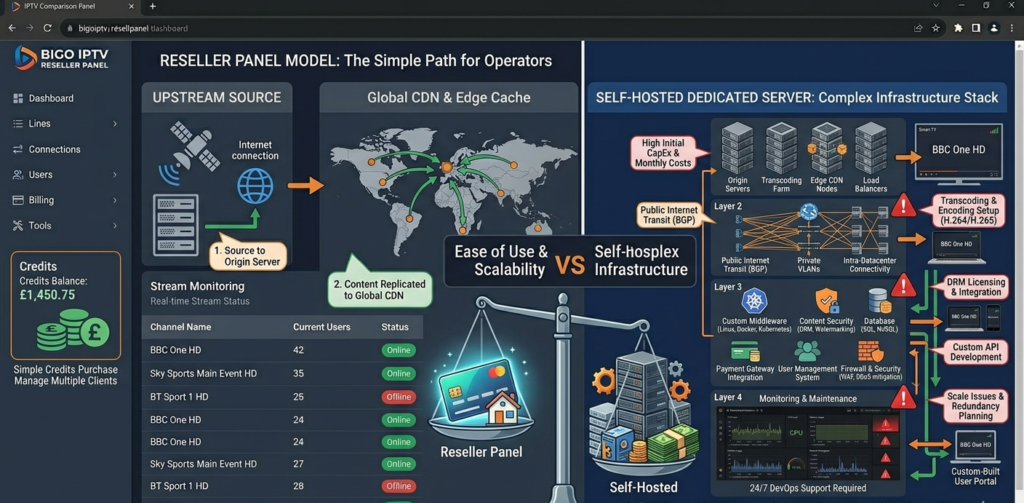
When people say “dedicated server for IPTV reseller,” they usually mean one of two very different things, and mixing them up is where the confusion starts.
Option A: A dedicated server that you rent to host your own IPTV panel software and content streams. This means you’re essentially becoming a provider, not just a reseller. You’re responsible for sourcing content, maintaining uptime, managing bandwidth, and handling everything from billing integration to anti-freeze configuration.
Option B: A dedicated server purely for running your reseller panel management interface, the dashboard you use to create and manage subscriber lines, while the actual stream infrastructure sits upstream with your provider.
Option A is an entirely different business. Option B is largely unnecessary for anyone below a few hundred subscribers, because modern cloud-based reseller panels handle this for you already.
Most people asking this question are thinking about Option A without fully realising what they’re signing up for.
The Reseller Model vs. the Operator Model: Know the Difference
This distinction is the single most important thing to understand before spending a penny on server infrastructure.
As a reseller, your job is to sell subscription access, manage client relationships, handle billing, and provide first-line support. The technical infrastructure, servers, CDN nodes, stream encoding, anti-freeze, failover routing, is your upstream provider’s problem. You buy credits, sell lines, and pocket the margin.
As an operator, you own or lease the infrastructure. You’re responsible for everything. Source reliability, server security, DDoS mitigation, content routing, uptime SLAs, all of it lands on your desk.
The operator model can be more profitable at scale. But “at scale” means thousands of subscribers, not dozens. I’ve seen people jump into the operator model with 50 clients and spend more on server costs and technical firefighting than they ever earned back.
Pro Tip: If you’re under 200 active subscribers, the reseller panel model will almost always outperform self-hosting on both profit margin and sanity. The infrastructure overhead of a dedicated server setup simply doesn’t justify itself at that volume.
Real Costs of Running Your Own Server
Let me put some honest numbers on this, because the “I’ll save money by hosting myself” logic tends to fall apart quickly under scrutiny.
| Cost Component | Monthly Estimate (UK) |
|---|---|
| Dedicated server rental (mid-tier) | £80-£180 |
| Bandwidth (unmetered, UK DC) | £40-£100 |
| Panel software licence | £20-£60 |
| Anti-DDoS protection | £30-£80 |
| Upstream content access | Variable / often opaque |
| Your time (support, maintenance) | Unquantified but significant |
| Minimum monthly overhead | £170-£420+ |
Now compare that to a reseller panel with 60 subscribers paying £8/month each:
Gross Revenue = 60 × £8 = £480
Net Profit (Panel Model) = £480 − (60 × £2.50) = £480 − £150 = £330
Net Profit (Self-Hosted) = £480 − £150 − £300 (server costs) = £30
The maths is fairly brutal. At 60 subscribers, self-hosting cuts your profit from £330 to roughly £30, and that’s assuming zero downtime, zero support issues, and zero time cost on your end.
Why Most UK Resellers Don’t Need One
The UK IPTV reseller market in 2026 is mature enough that quality panel providers have done the hard infrastructure work for you. Good panels already offer:
UK-optimised CDN routing: edge nodes positioned for British broadband infrastructure
Anti-freeze technology: adaptive bitrate and stream redundancy built in
MAG box and STBEmu compatibility: device support handled at the platform level
Xtream Codes API: standard integration that works with every major player app
Automated line management: create, extend, suspend, and delete lines without touching a server
Premier League weekends are the stress test that separates decent panels from disastrous ones. A well-run panel provider with proper UK server capacity will absorb those demand spikes without you even noticing. A cheap self-hosted setup with inadequate bandwidth? You’ll notice. Your subscribers will notice. Your refund queue will certainly notice.
Pro Tip: The 3pm Saturday blackout window is actually your best performance test as a reseller. If your streams hold solid during peak simultaneous viewership, no buffering, no freezing, your provider’s infrastructure is genuinely capable. If it wobbles, have that conversation before you onboard another 20 clients.
When a Dedicated Server Might Make Sense
I won’t pretend there’s never a case for it. There is, just not where most people assume.
Consider dedicated server infrastructure when:
You’re consistently above 500 active subscribers and your panel provider’s credit margins are eating significantly into revenue
You want to offer a genuinely differentiated product, custom apps, branded interfaces, niche content packages, that no reseller panel can provide
You have technical staff or partners who can maintain server infrastructure without it becoming your daily job
You’re building toward a full IPTV business, not a side income stream
Even then, most serious operators use a hybrid model, a managed dedicated server for panel hosting, but upstream content from established providers rather than attempting to source and host streams independently.
What You Actually Need to Run a Profitable Reseller Business
Forget the server for now. Here’s what genuinely moves the needle for IPTV resellers in the UK:
- A reliable reseller panel with verified UK infrastructure. This is your foundation. Everything else depends on it.
- A pricing strategy with healthy margin. Work backwards from your credit cost. If credits cost you £2.50/line, retail at £7-£9. Never go below a 65% gross margin.
- A proper client communication system. WhatsApp Business, Telegram channel, or even a simple email sequence. Clients who feel looked after churn far less.
- A refund policy that protects you. Credit extensions rather than cash refunds where possible. Documented clearly before a client signs up.
- A growth system. Referral incentives, a simple landing page, and consistent follow-up will grow a reseller business faster than any technical upgrade.
If you want a panel that handles the infrastructure side properly, with UK-focused performance and a transparent credit system that makes the above economics actually work, britishseller.co.uk is worth a serious look. It’s where I’d point a reseller who wants a stable operational base without the server headaches.
Pro Tip: Never build your reseller business on a single panel provider without keeping a tested backup. It doesn’t cost much to hold a small credit balance with a secondary panel, and when your primary goes down on a Saturday evening, you’ll be very glad you did.
IPTV Reseller Success Checklist
- Choose a panel, not a server: unless you’re above 500 subscribers with technical support in place, a managed UK IPTV reseller panel is more profitable and far less stressful than self-hosting.
- Know your break-even number: calculate exactly how many active subscribers cover your credit costs, and treat that number as your first milestone, not your goal.
- Test infrastructure during peak demand: run your trial lines on a busy Saturday evening, not a quiet Tuesday morning. Real performance only shows under load.
- Price with margin discipline: never let competitive pressure push you below a 60% gross margin. Thin margins and refunds will eliminate your profit entirely.
- Build retention before acquisition: one satisfied subscriber who stays 12 months is worth more than three who churn in 60 days. Prioritise support quality and stream reliability above everything else.