The Saturday Afternoon Question That Ends the Conversation
I’ve had this conversation more times than I can count. A prospective subscriber messages me, slightly apologetically, to say they’ve been using a free IPTV service they found online and it’s been “mostly fine.” They’re considering paying for something better but want to know if it’s actually worth it. What’s the difference?
I always ask the same question: “How was it on Saturday afternoon during the football?”
There’s usually a pause. Then: “Actually, it was terrible. Buffering constantly. Had to keep restarting it.”
“And on a quiet Tuesday evening?”
“Fine, actually. Works perfectly.”
That gap, the difference between a free IPTV service on a quiet weekday and the same service during Premier League peak demand, is the entire conversation. Because quiet Tuesday evenings don’t stress infrastructure. Saturday 3pm fixtures do. And when infrastructure is being offered for free, there’s usually a very specific reason it can’t handle the load that actually matters to British subscribers.
Understanding what free IPTV actually is, why it exists, what it costs you in ways that don’t show up on a price tag, and how it fits into the reseller business picture, that’s what this guide covers. Whether you’re a reseller thinking about how to position your paid service against free alternatives, or a subscriber wondering whether there’s any genuine reason to pay, read this before making any decisions.
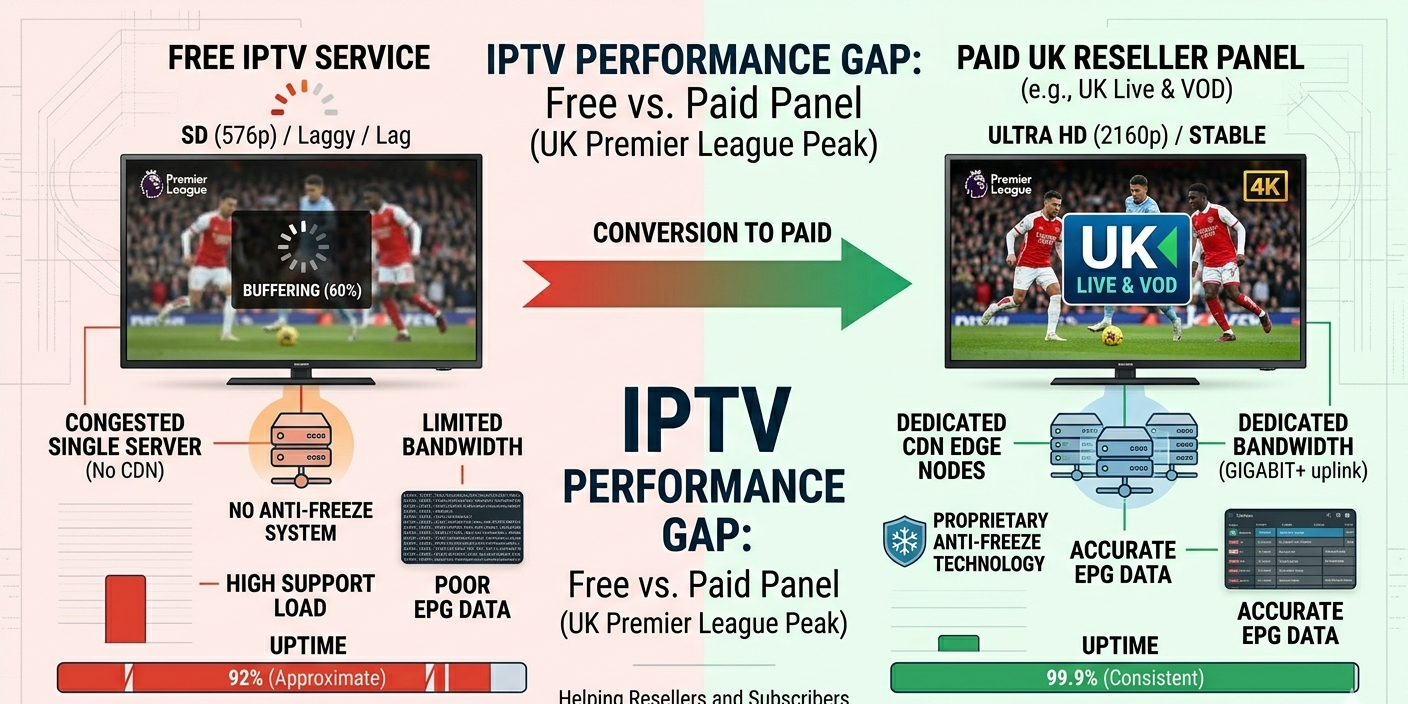
Comparison diagram showing free IPTV service infrastructure limitations versus paid IPTV reseller panel performance during UK Premier League peak demand, stream quality, uptime, and EPG accuracy contrast
What Free IPTV Actually Is: The Real Picture
Free IPTV is not a single thing. It’s a category that encompasses several completely different products with very different characteristics, risk profiles, and motivations behind them.
Legitimately free IPTV does exist in a narrow sense, some countries provide publicly funded broadcast content through internet-accessible streams. In the UK, the BBC iPlayer, ITVX, Channel 4 streaming, and similar services are genuinely free, legitimate, and well-funded. These are not what most people mean when they search for “free IPTV.”
Advertising-supported free IPTV services exist in the legitimate streaming market, Pluto TV is the most prominent example, where content is free at the point of access but funded by advertising revenue. These services offer limited, curated content libraries rather than comprehensive live television.
Free IPTV services with comprehensive live TV, the kind offering hundreds of channels including live sport, with no advertising and no legitimate licensing, are not free in any economically meaningful sense. They’re free to access for the end user because the costs are being covered by someone else, through some mechanism that isn’t being disclosed. Understanding what that mechanism is tells you most of what you need to know about why these services exist and what they cost users in non-monetary ways.
In my experience, the vast majority of “free IPTV” services that UK subscribers encounter fall into three categories: trial bait from providers who want to acquire paying subscribers, data harvesting operations where the user’s data is the product, or unstable services running on inadequate infrastructure that will fail unpredictably.
b When a prospective subscriber mentions they’ve been using a free IPTV service, treat it as a sales opportunity rather than a competitive threat. The gap between free IPTV performance during peak demand and your paid service’s performance during the same window is your most powerful conversion argument, and it’s an argument the subscriber can verify themselves during a trial period. Ask them directly: “How was it during last Saturday’s football?” The answer almost always opens the door.
Why Free IPTV Exists: The Business Models Behind It
Nothing in streaming is genuinely free, the infrastructure costs are real regardless of what the end user pays. So when IPTV services are offered at no charge, understanding what’s funding the operation reveals the hidden costs.
Lead generation and conversion funnels are one model. Some free IPTV services are deliberately constructed as acquisition tools, offering free access to demonstrate a service with the intent of converting users to paid subscriptions. This is a legitimate business model when operated transparently. The risk is that the free tier is genuinely representative of the paid service’s quality, which means if the free tier is poor, you can reasonably infer the paid tier isn’t much better.
Data harvesting is another. Free services that require account creation, device registration, or app installation have access to usage data, device information, and potentially personal information. For some operators, this data has commercial value, either directly through sale or indirectly through targeted advertising. Users of these services are paying with data rather than money, which is a real cost that simply doesn’t appear on a price tag.
Unstable or pirated infrastructure is a third. Some free IPTV services are running on infrastructure they haven’t legitimately paid for, scraped stream URLs, borrowed CDN capacity, or systems that will simply stop working when the operators behind them decide to move on or face enforcement action. These services are free because their operators have no sustainable cost base, which also means they have no reason to maintain them and every reason to abandon them when it becomes inconvenient.
Community or personal projects make up a small fourth category. A small category of free IPTV services are genuine hobby or community projects, maintained by individuals for personal or small-group use. These are typically small in scale, unstable in reliability, and not designed for a subscriber base of any meaningful size.
Understanding which category a specific free service falls into changes the risk calculus significantly, but from a practical standpoint, all of them share the characteristic that the infrastructure investment, operational stability, and accountability that a paid reseller operation provides simply doesn’t exist.
The Hidden Costs of Free IPTV for Subscribers
The price tag is £0. The costs are real, they’re just denominated in different currencies than money.
There’s a real time cost of unreliability. A free IPTV service that works 70% of the time isn’t saving you money compared to a paid service that works 97% of the time. The 30% failure rate costs you in wasted time, frustration, and missed viewing, particularly during the high-value moments like live sport that motivated the search for IPTV in the first place. Quantify this honestly: if you watch ten hours of IPTV per week and the service fails 30% of the time, that’s three hours per week of failed viewing experience. Over a year, that’s over 150 hours. What’s your time worth?
There are data and privacy costs too. Free services that require registration or app installation have your usage data, potentially your IP address, device identifiers, and viewing history. The value of this data varies, but the cost is a reduction in privacy that a paid subscription, where the commercial relationship is transparent and the operator has accountability, doesn’t impose in the same way.
Security exposure is another real risk. Some free IPTV applications distributed outside official app stores carry security risks that legitimate paid services don’t. APK files from unknown sources are a known vector for malware and spyware on Android devices. The cost of a compromised device is potentially far higher than the cost of any IPTV subscription.
And there’s an opportunity cost for resellers. This is the most important hidden cost from a business perspective: every subscriber using a free IPTV service is a potential paying subscriber who hasn’t been converted yet. Free services don’t compete with paid services on quality, they compete on price. The reseller’s job is to demonstrate that the quality gap between free and paid is worth the price difference, which is straightforward when the comparison happens during a Premier League Saturday afternoon rather than a quiet Tuesday.
Consider a subscriber spending three hours weekly managing free IPTV failures, valuing their time at £12/hour. That works out to 3 × £12 × 52, or £1,872 in annual time cost. Against a paid IPTV subscription at £8/month, that’s £8 × 12, or £96 in annual subscription cost.
The economics of paying for reliability are overwhelming when time cost is honestly accounted for. This calculation, made explicitly in a conversion conversation, is remarkably persuasive.
Free IPTV and the UK Reseller Business Model
From a reseller’s perspective, free IPTV services occupy a specific competitive position, and understanding that position helps you respond to it effectively rather than being threatened by it.
Free IPTV doesn’t compete with paid UK IPTV reseller services on quality. It competes on price, specifically on the barrier to initial commitment that £0 represents versus £8/month. The subscriber who’s using a free service and experiencing consistent Saturday afternoon buffering is already a warm prospect for your paid service. They’ve demonstrated that they want IPTV. They’ve demonstrated that they care about live sport. They’ve demonstrated that their current service isn’t meeting their needs. What they haven’t done yet is made the case to themselves that the quality difference is worth the price.
Your job as a reseller isn’t to compete with free on price, you can’t and shouldn’t try. Your job is to make the quality gap visible and credible. The trial is your primary tool for doing this: a well-structured 24-hour trial that specifically includes a Saturday afternoon sporting window will demonstrate the quality difference more convincingly than any sales conversation.
The subscriber demographic that uses free IPTV is also, importantly, your most accessible acquisition pool. They’re already IPTV-educated, they understand what the product is, they have compatible devices, and they’ve already decided they want streaming television rather than traditional pay-TV. The only remaining conversion question is whether your paid service is worth the price versus their free alternative. On quality grounds, during peak demand, the answer is almost always yes.
Pro Tip: When marketing your paid IPTV service, don’t mention free IPTV as something to switch away from, this positions free as the default and paid as the upgrade, which isn’t the framing you want. Instead, position your service around the specific use case where free services consistently fail: “reliable live sport on match day, every week, without buffering.” This framing speaks directly to what British IPTV subscribers actually want and positions the quality of your service as the primary value, not the price comparison.
Free IPTV vs paid IPTV performance chart showing stream reliability percentages, Saturday afternoon uptime comparison, EPG accuracy rates, and support availability contrast for UK subscribers making a service choice
How Free IPTV Services Perform Under British Peak Demand
This is the conversation that converts more prospective subscribers than any other, and it’s grounded in a structural reality about free IPTV infrastructure that’s worth understanding properly.
Free IPTV services have two categories of infrastructure problem that make them specifically poor performers during British peak demand.
Capacity constraints are the first. Free services don’t generate revenue proportional to their user base growth. As more users access the service, the infrastructure costs increase while revenue doesn’t. The result is a structural tendency toward undersized infrastructure relative to actual demand. During a quiet Tuesday evening with low concurrent load, this undersizing doesn’t matter. During a Premier League Saturday with thousands of simultaneous UK viewers, it does, catastrophically.
No UK-specific infrastructure investment is the second. Quality paid panels invest in UK-specific CDN edge nodes and infrastructure sized specifically for British demand patterns. Free services, without the revenue to justify this investment, typically route UK streams through generic international infrastructure with higher latency and no UK-specific capacity allocation. The 3pm Saturday spike, which any properly run UK IPTV panel plans for specifically, blindsides free services that have no UK demand modelling at all.
The practical result is the experience the prospective subscriber described at the start of this guide: fine on Tuesday, terrible on Saturday. And Saturday is the only day that actually matters to most British IPTV subscribers.
The Data and Privacy Reality of Free IPTV
This section exists because most guides on free IPTV simply ignore it, and ignoring it does a disservice to subscribers who deserve to make informed choices.
When you use a free IPTV service, the operator has access to your IP address, which reveals your approximate geographical location. If account registration is required, they have your email address and potentially other personal details. If you’ve installed a free IPTV app from a source outside official app stores, the operator has whatever permissions the app requested, which in some cases includes device storage, contact lists, and microphone access that goes well beyond anything an IPTV service requires.
Your viewing history, which channels you watch, how long you watch, when you watch, has commercial value as audience data. The viewing patterns of thousands of UK users watching live sport on Saturday afternoons is genuinely valuable market research data that advertising platforms and media companies pay for.
This doesn’t mean every free IPTV service is a malicious data harvesting operation. But it does mean that “free” IPTV involves a value exchange that isn’t explicitly disclosed, and informed consent requires understanding that exchange.
For subscribers who are privacy-conscious, the argument for a paid service with a real commercial relationship and documented terms isn’t just about stream quality. It’s about operating in a transparent, accountable commercial context rather than an opaque one.
Here’s an honest side-by-side comparison of free and paid IPTV:
| Dimension | Free IPTV | Quality paid reseller |
|---|---|---|
| Cost to subscriber | £0 | £6–£12/month |
| Peak demand performance | Typically poor | Reliable with right panel |
| Everyday performance | Often acceptable | Consistent |
| EPG accuracy | Variable to poor | Good with quality panel |
| VOD library | Limited or unreliable | Comprehensive |
| Support availability | None | Reseller first-line |
| Account security | Unclear | Documented terms |
| Data handling | Opaque | GDPR-accountable |
| Service continuity | Unpredictable | Stable |
| Device compatibility | Limited | Full ecosystem |
| Catch-up TV | Rarely available | Panel-dependent |
| Accountability if it fails | None | Reseller relationship |
The comparison isn’t designed to disparage free IPTV categorically, some free services are more capable than others in specific dimensions. But the accountability and support row is where paid reseller services have an insurmountable structural advantage. When a free service fails, there’s no one to contact. When a paid service has an issue, the subscriber has a reseller relationship, a real person who’s commercially motivated to resolve the problem.
This accountability differential is one of the most underused selling points in the British IPTV reseller market. It’s not about features or price, it’s about having someone responsible for your service experience, which is fundamentally different from using an anonymous free service and hoping it works.
How UK Resellers Should Position Against Free Alternatives
The tactical response to free IPTV competition in your subscriber acquisition conversations should be built around three positioning principles.
Don’t compete on price. The moment you start justifying your subscription cost against free alternatives, you’ve accepted that free is the benchmark. It isn’t. Your benchmark is the cost of traditional pay-TV, against which your £8/month IPTV subscription is outstanding value regardless of free alternatives existing.
Compete on the specific failure points of free services. Saturday afternoon performance, EPG accuracy, VOD reliability, and support availability are all areas where quality paid services structurally outperform free alternatives. Position around these specifics rather than making general quality claims.
Use the trial as your proof mechanism. Every prospective subscriber who mentions using a free service should be offered a trial specifically positioned as a comparison opportunity: “Try mine this Saturday afternoon during the football and compare it to what you’ve been using. Let the quality speak for itself.” This is the most efficient conversion conversation available because you’re not asking them to take your word for it, you’re inviting them to verify it themselves.
Pro Tip: Build a simple comparison one-liner for the conversion conversation: “Free IPTV works on quiet evenings. Paid IPTV works on match day.” Seven words that capture the entire competitive positioning. British subscribers know exactly what “match day” means and why it matters. This sentence, said once, confidently, often closes the conversion conversation without any further elaboration needed.
The Subscribers Who Switch From Free to Paid, And Why
Understanding the trigger events that convert free IPTV users into paying subscribers helps you identify and approach the right prospects at the right moment.
Match day failure is the most common trigger. A subscriber who’s tolerated mediocre free IPTV performance finally experiences a complete outage or continuous buffering during a genuinely important fixture, a cup final, a title-deciding match, a derby, and decides enough is enough. These subscribers are highly motivated to switch because they’ve reached their personal tolerance threshold.
Device upgrade is another. A subscriber who gets a new television, a new Fire TV stick, or a new MAG box often uses the setup moment as an opportunity to reassess their IPTV service. The willingness to set up a new service is at its highest during device transitions.
Word of mouth plays a role too. A friend or family member mentions they’re paying for an IPTV service and it “just works.” The comparison between their experience and the free service’s performance suddenly becomes concrete.
And data/security concerns can be the trigger. An article about free streaming app security risks, or a friend’s experience with a compromised device from a free IPTV APK, prompts a reconsideration of the risk calculus.
Each of these trigger events is an acquisition opportunity, and knowing them helps you identify prospective subscribers at the right moment. Someone who’s just had a terrible match day experience with their free service is maximally motivated to switch and will respond to a well-timed, quality-focused message far more positively than a cold approach.
Building a Paid Service That Free IPTV Can’t Compete With
The free IPTV competitive threat is neutralised not by price competition but by delivering a service quality and subscriber experience that free alternatives structurally cannot match. Here’s what that requires.
Peak demand reliability is the non-negotiable foundation. Your panel must hold clean streams during Premier League Saturdays. This is the single quality dimension where free services most consistently fail and where paying subscribers most clearly experience their subscription’s value.
Responsive personal support is the accountability differential. Every subscriber should know that when something goes wrong, they have a real person to contact who will respond promptly and work to resolve the issue. This is impossible with free services and is your most sustainable competitive advantage.
Accurate EPG is the daily quality signal. A programme guide that’s consistently accurate, BST-correct, and navigable for live sport planning is the everyday quality indicator that reminds subscribers of the value difference between their paid service and the free alternative they came from.
Proactive communication is the relationship investment. Match day preparation messages, transparent outage communication, and renewal acknowledgements create a subscriber relationship that free services cannot replicate. Subscribers who feel looked after by a real operator don’t go looking for free alternatives.
For UK resellers who want the panel infrastructure that makes this quality level achievable, with UK-optimised CDN performance, genuine anti-freeze capability during Premier League demand peaks, accurate EPG with BST handling, and the operational stability that lets you make reliability promises you can keep, britishseller.co.uk is the recommendation I make to resellers who’ve decided to compete on quality rather than price, and want the infrastructure to back that position up.
Free IPTV: UK Reseller Success Checklist
Position your paid service against traditional pay-TV, not against free IPTV, the comparison that makes your £8/month subscription look exceptional is against £40 to £80/month cable or satellite packages. The comparison against free alternatives accepts a framing that undersells your value proposition and invites a price competition you can’t win.
Use the Saturday afternoon test as your primary conversion mechanism with free IPTV users, offer a trial specifically positioned to include a peak demand football window. The quality difference that demonstrates during that window is your most persuasive sales argument and one the prospective subscriber can verify independently rather than taking your word for.
Address the accountability differential explicitly in your positioning, “you have someone to contact when it doesn’t work” is a structural advantage over free IPTV that’s genuinely valued by British subscribers who’ve experienced the frustration of a free service failing during a match with no recourse. Make this advantage visible in your subscriber communications.
Build a match day reliability narrative, your brand as a UK IPTV reseller should be associated specifically with reliable Saturday afternoon performance. Every communication, every trial recommendation, and every subscriber testimonial should reinforce this specific quality positioning. It’s the one thing free IPTV cannot credibly claim and the one thing British subscribers care about most.
Identify and approach free IPTV users at trigger moments, match day failures, device upgrades, and word-of-mouth moments are when free IPTV users are most motivated to switch. Being visible and approachable in the communities where these conversations happen, local Facebook groups, sports supporter communities, tech discussion forums, means you’re present when prospective subscribers are actively reconsidering their current service.