Three months into running my first proper smart IPTV setup, I had 60 clients, a panel I barely understood, and a provider I’d found through a Telegram group somebody had shared in a Facebook comment. Peak confidence. Zero infrastructure knowledge.
Then a Champions League night happened.
Within 40 minutes of kick-off, 22 clients were offline. The streams hadn’t just buffered — they’d died entirely. My provider’s support channel went silent. No response for four hours. I spent that evening manually issuing credits, writing apology messages, and quietly vowing never to cut corners on infrastructure again.
That night is the reason I now talk about smart IPTV the way I do — not as a buzzword, but as a genuine operational standard. Because there’s nothing smart about a setup that collapses the moment it’s actually needed.
Table of Contents
- What “Smart IPTV” Actually Means in 2026
- The Device Landscape: MAG, STBEmu, Smart TVs and Where Things Go Wrong
- Panel Intelligence — What a Proper Smart IPTV Setup Looks Like
- Anti-Freeze, CDN, and Why UK Servers Are Non-Negotiable
- The Economics of Running a Smart IPTV Reseller Business
- Scams, Fake Panels, and the Red Flags I Wish I’d Spotted Earlier
- Scaling Without Breaking Everything
- Where Serious UK Resellers Are Heading in 2026
What “Smart IPTV” Actually Means in 2026
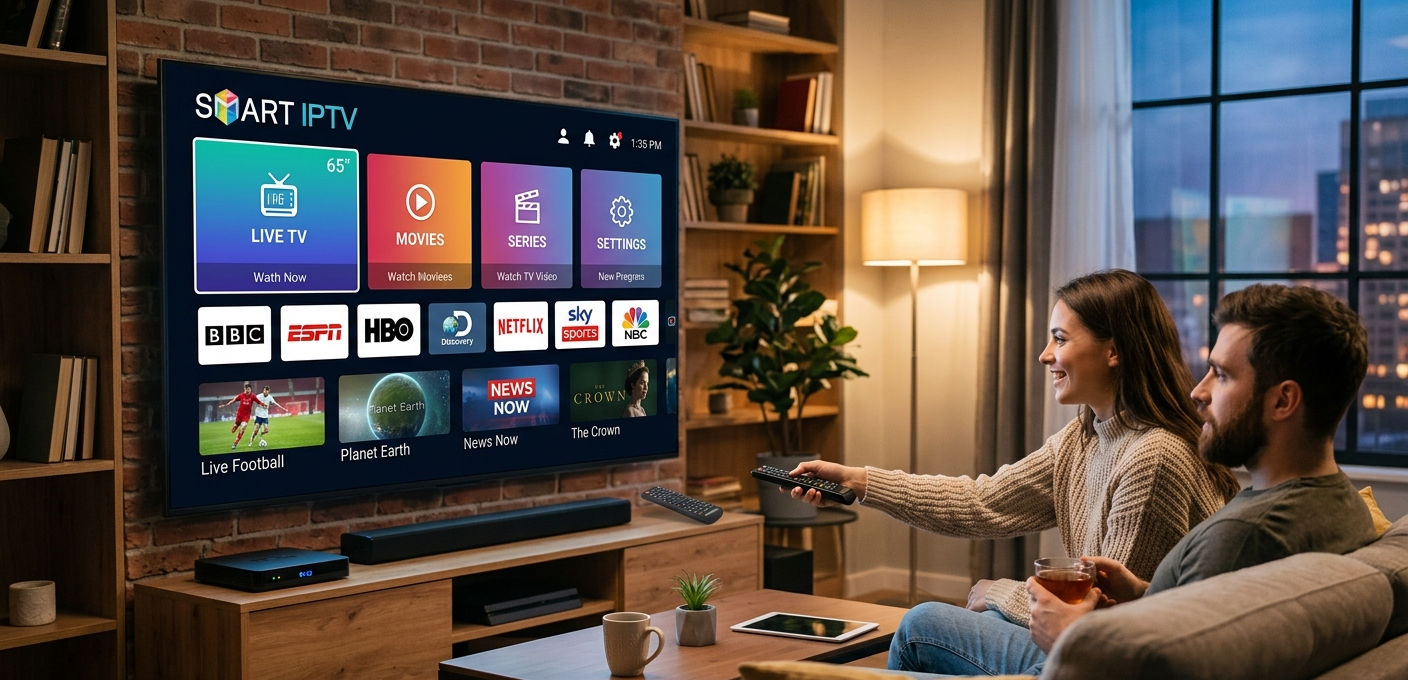
The term gets thrown around loosely. Some people use it to mean IPTV delivered to a smart TV. Others use it to describe a specific app — Smart IPTV (SIPTV) — which has been a popular portal for Samsung and LG televisions for years. In practice, the phrase now broadly refers to any IP-based television delivery that’s been properly configured for modern devices with EPG support, on-demand libraries, and stable stream management.
For resellers, smart IPTV is less about the end device and more about the infrastructure behind it. A genuinely smart setup means your panel has real-time monitoring, your streams have redundancy built in, and your clients can switch between devices without the whole thing falling apart.
What it doesn’t mean — and this bears repeating — is slapping an M3U link on a WhatsApp message and calling yourself a provider. I’ve seen that model. It doesn’t end well, especially not on a Saturday afternoon in October.
Pro Tip: If a potential supplier can’t tell you whether their smart IPTV infrastructure uses adaptive bitrate streaming or fixed bitrate, that’s a serious warning sign. Adaptive bitrate is the baseline for any setup serving HD content at scale in 2026.
The Device Landscape: MAG, STBEmu, Smart TVs and Where Things Go Wrong
Smart IPTV delivery needs to work cleanly across multiple device types simultaneously — and each one behaves differently under load.
MAG boxes remain popular with older UK clients who want a set-top box experience. They’re reliable when paired with stable Stalker middleware, but notoriously unforgiving when server response times are poor. A MAG box buffering issue almost always traces back to portal latency rather than the device itself.
STBEmu has become the go-to for Android users emulating MAG behaviour. It’s flexible, but I’ve seen resellers hand over STBEmu portals without testing them properly on different Android firmware versions. The result? Clients who can’t get past the login screen ringing you on a Sunday morning.
Smart TVs with native apps — particularly Samsung and LG running the SIPTV application — have their own quirks. The app’s playlist format requirements are strict. Send a malformed M3U and it won’t load. I’ve had clients convinced their television was broken when the issue was a single rogue character in a URL string.
The point is this: a smart IPTV business isn’t just about having streams. It’s about knowing how each device type interacts with your infrastructure and being able to troubleshoot each one without Googling it in front of the client.
Pro Tip: Maintain a simple device compatibility document — MAG setup steps, STBEmu configuration guide, smart TV app instructions. Send it with every new subscription. It cuts your support workload dramatically and makes you look like you’ve been doing this for years. Even if you haven’t.
Panel Intelligence — What a Proper Smart IPTV Setup Looks Like
Your panel is the engine of your smart IPTV business. Everything else is cosmetic.
A properly configured panel gives you: live stream health monitoring, per-line connection limits, sub-reseller access with isolated credit pools, EPG mapping accuracy, and VOD library management. If your current panel doesn’t offer all of that, you’re operating blind.
The difference between a smart IPTV operation and a chaotic one often comes down to connection limits. I’ve had clients share their credentials with three family members without telling me. Suddenly one “line” is running four simultaneous streams and hammering the server. A panel with enforced connection limits prevents that — protecting both your infrastructure and your margins.
EPG accuracy is another one resellers underestimate. Clients in the UK expect their programme guide to be correct. A smart IPTV setup where the EPG is perpetually misaligned, showing last week’s listings or the wrong programme names, generates complaints even when the streams themselves are perfectly fine. It looks unprofessional. And in a market built on trust, looking unprofessional is expensive.
Anti-Freeze, CDN, and Why UK Servers Are Non-Negotiable
Smart IPTV in the UK has a specific challenge that resellers in other markets don’t face to the same degree: concentrated, predictable demand spikes. The Premier League schedule is essentially a stress test calendar for your infrastructure.
Anti-freeze technology works by maintaining a rolling buffer that compensates for brief packet loss events. Without it, a 2–3% packet loss during a high-traffic period produces visible freezing. With properly implemented anti-freeze, the same packet loss is invisible to the viewer.
Here’s the bandwidth reality when you’re running a mid-sized smart IPTV reseller operation:
Required Bandwidth (Mbps)=N×B×P\text{Required Bandwidth (Mbps)} = N \times B \times P
Where:
- NN = Number of simultaneous active streams
- BB = Average bitrate per stream (typically 6–10 Mbps for HD)
- PP = Peak demand multiplier (0.8–1.0 during live sport)
For 150 active smart IPTV clients at 8 Mbps per stream during a peak Premier League window:
150×8×0.9=1,080 Mbps150 \times 8 \times 0.9 = 1{,}080 \text{ Mbps}
Over a gigabit of sustained throughput. Any provider whose UK infrastructure isn’t built to handle that without degradation is simply not suitable for a serious smart IPTV reseller at scale.
The Economics of Running a Smart IPTV Reseller Business
Let’s talk numbers, because this industry is full of optimistic projections that quietly ignore operational costs.
Net Monthly Profit=(Active Subs×Resale Price)−Credit Costs−Panel Fee−Refund Losses\text{Net Monthly Profit} = (\text{Active Subs} \times \text{Resale Price}) – \text{Credit Costs} – \text{Panel Fee} – \text{Refund Losses}
Realistic mid-level example:
- 120 active smart IPTV subscriptions at £9/month = £1,080
- Credit cost at £3.50/line = £420
- Panel and hosting = £35
- Refunds at 5% = £54
Net: approximately £571/month
That’s genuine, repeatable income — provided your churn stays manageable. And churn, in a smart IPTV business, is almost entirely a function of stream quality. Fix the infrastructure and the retention figures follow. I’ve seen resellers with identical pricing but completely different renewal rates, purely because one was running a stable UK-based smart IPTV setup and the other was routing streams through an offshore server with 200ms latency.
Pro Tip: Calculate your churn cost in cash terms each month. If 10 clients don’t renew at £9 each, that’s £90 gone — plus the acquisition effort to replace them. A slightly more expensive but more reliable smart IPTV supplier often pays for itself within two months purely through improved retention.
Scams, Fake Panels, and the Red Flags I Wish I’d Spotted Earlier
This industry has a scam problem. Not a minor one. A significant, ongoing, costly-for-the-unprepared one.
The most common pattern I’ve encountered: a “wholesaler” approaches you on Telegram with ridiculously cheap reseller credits for their smart IPTV panel. You test it for 48 hours — it’s flawless. You move 80 clients across. Three weeks later, the panel vanishes. No warning. No refund. Just gone, along with your money and your clients’ trust.
Red flags I now watch for obsessively:
No verifiable UK presence — A legitimate smart IPTV infrastructure provider for the UK market will have at minimum a domain with some history, a traceable support system, and ideally some form of reseller community around them.
Pricing that makes no economic sense — If credits are priced so low that the margins seem impossible to sustain, they probably are. Someone is either planning to disappear or the streams are scraped from unstable sources.
No panel demo before purchase — Any serious provider will let you run a trial. Resistance to this is a significant red flag.
WhatsApp-only support — It’s 2026. A provider running a legitimate smart IPTV operation has a ticketing system or at minimum a monitored support channel. WhatsApp-only means one person with one phone who may or may not respond at 11pm on a Saturday.
Scaling Without Breaking Everything
Growth in smart IPTV is deceptively straightforward until it isn’t. The jump from 50 to 200 clients exposes every weakness in your setup simultaneously.
The resellers I’ve seen scale successfully share a few habits. They test new infrastructure under realistic load before committing clients. They maintain a relationship with their provider rather than treating it as anonymous. They keep a reserve fund specifically for refund periods during provider transitions. And they never move their entire client base to a new smart IPTV setup at once — always a phased migration, never a cliff edge.
Pro Tip: When scaling your smart IPTV operation, treat your first 20 clients on any new panel like a pilot programme. Monitor them obsessively for two weeks before onboarding the rest. If problems emerge, they’re contained. If everything holds, you scale with confidence.
Where Serious UK Resellers Are Heading in 2026
The smart IPTV market in the UK is maturing. The easy money from poorly-informed clients willing to accept mediocre streams has largely evaporated. What’s left — and what’s genuinely profitable — is the premium tier: reliable delivery, proper device support, real customer service, and an infrastructure setup that survives Premier League weekends without drama.
That’s the standard I hold my own operation to. And it’s the standard I’d encourage any reseller entering or growing in this space to aim for.
If you’re looking for a smart IPTV wholesale setup that’s been built with UK demand in mind — proper UK server infrastructure, reseller panel controls, and the kind of uptime that doesn’t collapse when everyone in England is watching the same match — BritishSeller.co.uk is where I’d point you. Not because of a commission. Because after enough bad experiences, finding something that actually works is worth mentioning.
✅ IPTV Reseller Success Checklist
- Verify UK server infrastructure before committing — Test latency from a UK IP, confirm genuine local hosting, and stress-test during a live sport event before moving any clients across.
- Enforce connection limits on every line — Unmanaged credential sharing kills server performance and eats into your margins silently. Set limits from day one.
- Build a device-specific onboarding guide — MAG, STBEmu, and smart TV apps all need different setup instructions. Document them once, use them forever.
- Track refund rate monthly as a KPI — Anything above 6–7% is a signal your smart IPTV infrastructure is underperforming, not that your clients are difficult.
- Phase every provider migration — Never move your full client base to a new smart IPTV setup in one go. Pilot with 15–20 clients first, monitor for two weeks, then scale.