IPTV vs Cable TV: What I Learned Running Both Worlds
A customer called me at 11 PM during a Champions League semi-final, furious that his stream had frozen on the 78th minute. Two streets over, his neighbour with a cable box was watching the same match without a hiccup. That single phone call tells you more about the IPTV vs cable TV debate than any spec sheet ever will — and it’s also where most comparisons get the story completely wrong.
Because here’s the thing nobody selling you a subscription will admit: the better technology doesn’t always win the living room. Reliability, cost, control, and tolerance for fiddling all pull in different directions. After a decade of provisioning streams, watching uplinks buckle, and reading thousands of angry support tickets, I’ve stopped thinking of IPTV vs cable TV as a winner-takes-all fight. It’s a trade-off, and the right answer depends entirely on who’s holding the remote.
Let me walk you through what I’ve actually seen.
The Delivery Method Is the Whole Story
Cable television rides a closed, dedicated coaxial or fibre line that the provider owns end to end. Your signal never touches the open internet. That physical isolation is boring — and boring is exactly why it almost never fails.
IPTV does the opposite. It chops video into data packets and ships them across the same public internet carrying your emails, your kid’s gaming, and your neighbour’s torrents. When the IPTV vs cable TV conversation turns technical, this is the fork in the road everything else branches from.
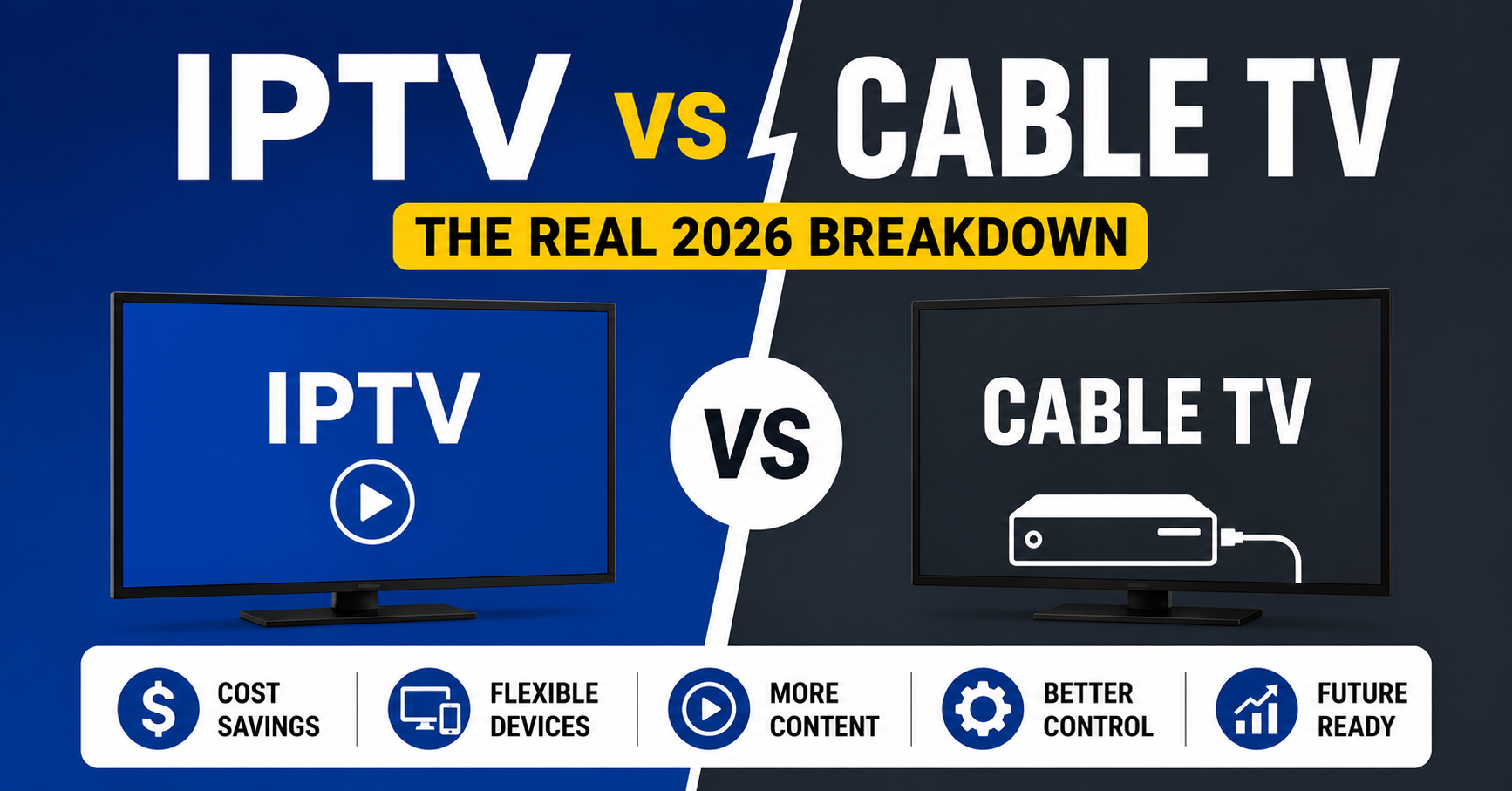
| Factor | Cable TV | IPTV |
|---|---|---|
| Transport | Dedicated coax/fibre | Public internet |
| Channel limit | Bandwidth-capped | Effectively unlimited |
| Setup | Technician visit | App + login |
| Failure point | Rare, provider-side | Network, ISP, or panel |
| Content reach | Regional/national | Global |
A mistake we repeatedly see: people assume IPTV “uses the internet” the way Netflix does. It doesn’t, quite. Netflix has billions in CDN infrastructure smoothing every wrinkle. Most IPTV operations run a fraction of that, which is why the experience swings so wildly between providers.
Why Your Internet Connection Decides Everything
I’ve watched two customers on the same service have opposite experiences purely because of what happened upstream of them. With cable, the provider controls the road from studio to your wall socket. With IPTV, you and your ISP own the last and most chaotic mile.
This is the single most under-explained point in the entire IPTV vs cable TV question. A 4K IPTV stream wants roughly 25 Mbps of stable throughput — not peak, stable. Cable doesn’t care about your Wi-Fi, your router’s age, or whether your ISP is quietly throttling video traffic at 9 PM.
Pro Tip: Before blaming any IPTV provider, run a speed test during the failure, not after. Nine times out of ten the numbers crater at peak hours — that’s ISP congestion or deep packet inspection throttling, and no provider can fix your ISP for you.
The Cost Comparison That Actually Holds Up
Everyone leads with price, so let’s be honest about it. Cable looks cheap until the bill arrives stuffed with box rental, broadcast fees, regional sports surcharges, and the “promotional rate expired” gut-punch in month thirteen.
Here’s the real-world monthly picture across US/UK/Canada markets:
- Cable TV: advertised £30–£50, real-world £70–£120 after equipment, fees, and bundling pressure
- IPTV: £8–£20 for comparable or larger channel counts, no hardware rental
- Hidden cable cost: early-termination fees that can hit £200+
- Hidden IPTV cost: you supply the device and the bandwidth
The IPTV vs cable TV gap on raw cost isn’t close. But — and I say this as someone whose business is IPTV — cheap means nothing if it’s down during the one match you cared about. Price is where IPTV wins on paper. Reliability is where cable defends its premium.
What Breaks, and When It Breaks
This is the section I wish more people read before switching. During a major sports event, I’ve watched uplinks that hummed along fine all month suddenly saturate the instant kickoff hit. Cable doesn’t have this problem — its capacity is provisioned per household and doesn’t care how many people tune in at once.
IPTV concurrency is brutal. One UK IPTV reseller lost nearly a third of his customer base in a single weekend because his upstream provider oversold capacity before a title fight and the whole panel buckled under load. Nobody saw it coming because the service was flawless on a quiet Tuesday.
Common failure points I’ve personally dealt with:
- Uplink saturation during concurrent peak viewing
- DNS poisoning redirecting users to dead endpoints
- EPG (guide data) collapsing while streams stay live
- ISP-level blocking waves that kill access overnight
- Panel database overload when too many resellers provision at once
Cable’s failure list, by comparison, is short: storm damage, the occasional regional outage, a dead set-top box. The IPTV vs cable TV reliability gap is real, and anyone telling you otherwise hasn’t sat through a 2 AM emergency migration.
The Control Trade-Off Nobody Mentions
Cable gives you a sealed box and a remote. That’s the deal. You can’t add channels it doesn’t carry, you can’t watch on a phone in another country, and you certainly can’t resell it.
IPTV flips that entirely. You pick the device — Firestick, Android TV, a smart TV app, a MAG box — you pick the player, and you can carry your subscription anywhere with a connection. For the people I work with most, this is the whole appeal of IPTV vs cable TV: flexibility cable structurally cannot offer.
Pro Tip: The flexibility cuts both ways. Every device you support is another thing that can break. After reviewing hundreds of support requests, I can tell you the overwhelming majority of “the service is broken” tickets are actually a customer’s app cache, a wrong DNS setting, or a player that needs reinstalling — not the stream at all.
Picture Quality: A Closer Race Than Marketing Suggests
On a good day, a well-provisioned IPTV 4K stream genuinely matches or beats compressed cable HD. Cable providers compress aggressively to fit hundreds of channels down one pipe, and you can see it on fast-motion sports — that smeary, blocky look during a quick camera pan.
But “on a good day” is doing heavy lifting. Cable’s quality is consistent. IPTV quality is a function of source feed, server load, your bandwidth, and the moon’s alignment. I’ve seen the same channel look pristine at noon and fall apart at 8 PM.
The HEVC factor
Modern IPTV increasingly uses H.265/HEVC encoding, which delivers that 4K picture at roughly half the bandwidth of older H.264. When a provider has migrated to HEVC and your device supports it, the IPTV vs cable TV quality argument genuinely tilts toward IPTV. When they haven’t, you’re back to buffering during the busy hours.
Who Should Actually Choose What
After all of this, let me be direct, because pretending there’s one answer helps nobody.
Choose cable if: you have an unstable or capped internet connection, you value set-and-forget reliability over everything, you watch mostly local channels, and you genuinely don’t mind the bill.
Choose IPTV if: you have solid stable broadband, you want global content and multi-device freedom, you’re cost-conscious, and you can tolerate the occasional hiccup or are willing to learn basic troubleshooting.
The IPTV vs cable TV decision really does come down to temperament as much as technology. I’ve talked relatives out of switching because I knew their rural connection couldn’t carry it. A good operator tells you when their own product is the wrong fit — and if you’re hunting for a provider that’s honest about that, a reliable UK IPTV reseller and subscription service matters far more than the headline price.
A Quick Reality Check on the Legal Picture
I won’t dance around it. The IPTV vs cable TV conversation also has a legitimacy dimension. Cable is unambiguously licensed. The IPTV space ranges from fully licensed services to operations in murky territory. Enforcement waves are real, providers vanish overnight, and customers get caught in the fallout. This is exactly why provider stability and reputation should weigh heavier in your decision than channel count — a cheap service that disappears in a month cost you more than it saved.
Frequently Asked Questions
Is IPTV better than cable TV overall?
Neither wins outright. IPTV vs cable TV comes down to your priorities: IPTV delivers more channels, lower cost, and multi-device freedom, while cable delivers rock-solid reliability that doesn’t depend on your internet. If you have stable fast broadband and want value, IPTV usually wins. If you want zero-effort consistency, cable holds the edge.
Why does my IPTV buffer when cable never did?
Cable runs on a dedicated line the provider controls completely. IPTV travels across your public internet, so buffering almost always traces back to ISP congestion at peak hours, weak Wi-Fi, or an overloaded provider server. Run a speed test during the buffering to find the real culprit — it’s rarely the channel itself.
Is IPTV cheaper than cable TV in the long run?
Almost always, yes. Cable’s advertised price balloons with box rental, broadcast fees, and surcharges, typically landing at £70–£120 monthly. IPTV runs £8–£20 with no hardware rental. The IPTV vs cable TV cost gap is substantial, though you supply your own device and pay for the broadband it rides on.
Can I run an IPTV reseller business the way cable franchises work?
Not the same way. Cable distribution is tightly licensed and capital-heavy. IPTV reselling uses credit-based panels that let you provision subscriptions for customers without owning infrastructure. The barrier to entry is far lower, but so is the stability — your reputation lives or dies on your upstream provider’s reliability.
Does IPTV picture quality beat cable?
It can. Cable compresses heavily to fit hundreds of channels, while a well-provisioned IPTV 4K stream using HEVC can look sharper. But IPTV quality fluctuates with server load and your bandwidth, whereas cable stays consistent. Best case, IPTV wins; average case, cable’s steadiness is hard to beat.
Will my IPTV service suddenly stop working?
It’s a real risk that cable doesn’t share. IPTV providers can face enforcement action, capacity failures, or simply vanish. This is why choosing an established, reputable provider matters far more than the lowest price — stability is the thing cheap services quietly sacrifice.
Do I need special equipment for IPTV compared to cable?
No technician visit and no proprietary box. IPTV runs on devices you likely already own — a Firestick, smart TV, Android box, or phone. Cable requires the provider’s set-top box, usually rented monthly. This hardware freedom is a core part of why the IPTV vs cable TV equation favours IPTV on flexibility.
Is IPTV legal in the US, UK, and Canada?
Licensed IPTV services are fully legal across all three. The legality question hinges entirely on whether a provider holds proper content rights. Stick with reputable, transparent services and avoid anything advertising every premium channel for a few pounds — that pricing is the warning sign.
Execution Checklist
For subscribers:
- Run a speed test at peak hours before judging any IPTV service
- Confirm your device supports HEVC/H.265 for 4K streams
- Use a wired connection where possible to remove Wi-Fi as a variable
- Choose a provider on reputation and stability, not lowest price
- Keep a backup player app installed in case one fails
For resellers:
- Verify your upstream provider’s concurrency capacity before a major sports weekend
- Monitor uplink load during peak events, not just on quiet days
- Set DNS failover so a poisoned endpoint doesn’t kill your whole base
- Track support tickets by root cause to spot infrastructure problems early
- Vet provider stability before committing your customer base to them
For sub-resellers:
- Test the panel under load before promising customers reliability
- Keep credit reserves so you can provision instantly during demand spikes
- Document the most common subscriber fixes to cut your support time
- Build relationships with more than one upstream source as insurance
- Communicate honestly about peak-hour performance instead of overpromising
That’s the field view of IPTV vs cable TV — not the marketing version. The technology question was settled years ago in IPTV’s favour; the reliability and trust question is the one still being fought in living rooms every night. Pick based on your connection, your patience, and your provider’s track record, and you’ll rarely regret the choice.