A friend of mine got into the IPTV reseller business on a whim. He’d been paying for a subscription himself, figured there was money in selling them, found a provider on Telegram, bought 50 credits, and started taking orders from people at work.
Three weeks later he messaged me in a mild panic. His provider had gone dark. No streams. No response. No refund. Fifty credits he’d never get to use, and four clients expecting their money back.
He hadn’t really done anything wrong. He just hadn’t understood how the business actually works before he jumped in. There’s a real difference between being a subscriber and being the person who supplies them, and the gap between those two is where most beginners get caught out.
This guide IPTV Resellers UK covers everything: how IPTV UK resellers operate, how the money flows, what it actually takes to become one, and how to build something that doesn’t collapse the moment a provider gets flaky.
How Does the IPTV Reseller Business Actually Work?
The structure is straightforward once you see it clearly. There are three tiers.
At the top sits the provider. They run the actual server infrastructure, the CDN, the content delivery systems, and the anti-freeze technology that keeps streams smooth during high-traffic periods. They don’t sell directly to end users at scale. Instead, they sell wholesale access to resellers.
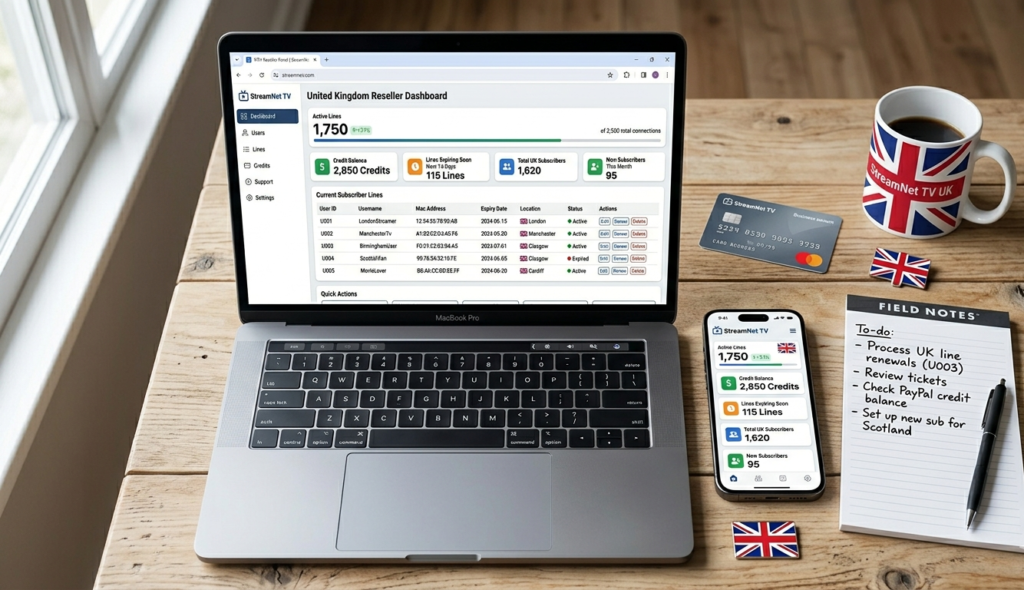
In the middle is the reseller, which is you if you’re reading this with any intent. You buy credits from the provider at a wholesale rate, use them to create and manage subscription lines through a panel, and sell those subscriptions on to end users at a retail price. You set your own pricing, manage your own clients, and keep the margin.
At the bottom are the subscribers — people who pay a monthly fee to access live streams on their TV, Firestick, MAG box, or phone.
Your entire business sits in that middle tier. You control the client relationship, the pricing, and the support. The provider controls the infrastructure. When that’s solid, life is good. When it isn’t, that’s when your phone starts filling up with angry messages.
Pro Tip: Always think of yourself as a service business, not a reselling operation. The subscribers don’t see the provider. They see you. Whatever happens on the infrastructure side, the accountability lands on your desk. Choose your provider like your reputation depends on it, because it does.
What IPTV Resellers Actually Do Day to Day
People romanticise this business as passive income. It isn’t, at least not early on. Here’s what the day-to-day actually looks like for a working UK reseller:
Managing new orders. When someone buys a subscription, you create a new line in your panel, set the expiry date, choose the connection limit, and send the login credentials. Depending on your setup this takes two to five minutes per subscriber.
Handling support queries. Buffering complaints, device setup questions, forgotten passwords, app configuration issues, subscribers will message you about all of it. A small, well-managed client base of 80–100 subscribers typically generates five to fifteen support interactions per week.
Monitoring expiring lines. Your panel will show you which subscriptions are due to expire. Sending renewal reminders four to five days before expiry is one of the highest-return habits in this business. Subscribers who lapse often don’t come back, not because they were unhappy, but because they simply forgot.
Dealing with provider issues. Stream outages happen. A responsible IPTV reseller communicates proactively when there’s an infrastructure issue, rather than going silent and hoping subscribers don’t notice.
Managing credits. Tracking your credit balance, timing top-ups, and calculating your monthly cost structure keeps your margins where they need to be.
None of this is complicated. But it does require consistency. The resellers who build something sustainable are the ones who treat it like a real small business from day one.
How to Become an IPTV Reseller in the UK
The process of becoming an IPTV reseller has a few distinct stages. Rushing through them is how people end up like my friend, out of pocket and scrambling for refunds.
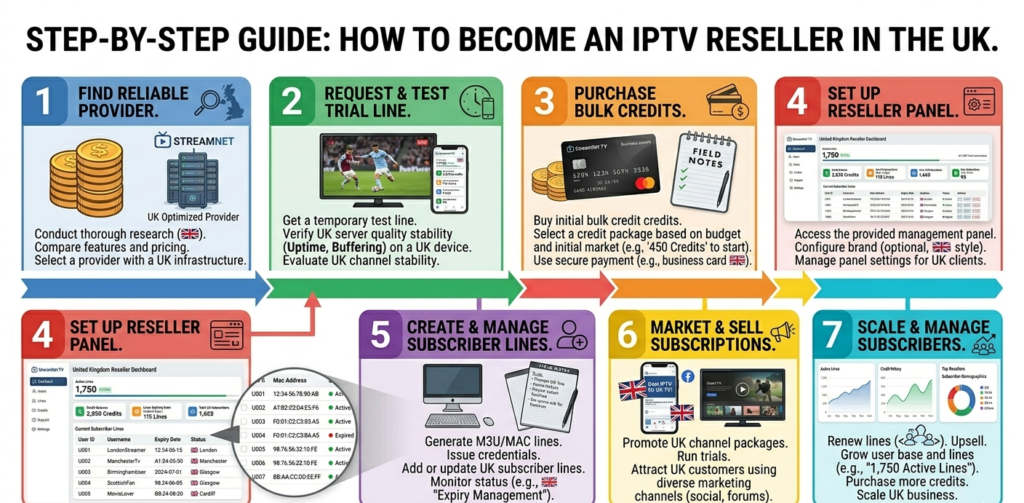
Stage 1: Find a provider and test thoroughly. Before you spend a penny on credits, get a trial line from any provider you’re considering. Test it across every device type your future subscribers might use, so Firestick, Android box, MAG device, smart TV, STBEmu, and mobile. Test at different times of day, and critically, test during a live football match if you can. If it buffers when load is high, your subscribers will find out before you do.
Stage 2: Understand the panel. Every IPTV reseller panel has a learning curve. Spend time inside it before you start selling. Create test lines. Practice generating M3U URLs and Xtream Codes credentials. Figure out the DNS settings and white-label options. Know what you’re working with before a real client is waiting on the other end.
Stage 3: Set your pricing. Price your subscriptions based on your cost structure and the market, not on what you think will attract the most clients. Underselling wrecks your margin and pulls in the subscribers who drain your support time. In the UK, £7 to £10 a month for a reliable single-connection line is both competitive and sustainable.
Stage 4: Build your sales and support flow. Even if you’re starting with five subscribers, have a process for onboarding, a method for collecting payment, and a channel for handling support queries. WhatsApp works fine at small scale. As you grow, you’ll want something more structured.
Stage 5: Start small, validate, then scale. Don’t buy 500 credits to launch. Buy enough to cover 30–50 subscribers and prove the model works with your specific provider before committing to larger volumes.
The Wholesale Layer: How IPTV Credits and Pricing Work
The wholesale side of the IPTV reseller business is built on credits. One credit equals one month of one active subscription line. You buy credits in bulk at a wholesale rate and spend them as you create subscriber lines.
Wholesale pricing varies considerably depending on the provider’s quality tier, server infrastructure, and the volume you’re purchasing. In the UK market, realistic wholesale credit pricing looks something like this:
Entry-level providers: £0.80–£1.20 per credit. Low cost, but typically lower uptime and minimal anti-freeze capability. Fine for testing, not for building a client base.
Mid-tier providers: £1.50–£2.00 per credit. Better server infrastructure, more reliable anti-freeze, and typically better support. This is where most serious UK IPTV resellers operate.
Premium providers: £2.20–£3.00 per credit. Dedicated UK servers, high concurrency capacity, multi-CDN routing. Appropriate once you’re operating at 200+ active lines and the cost of a bad stream is measured in subscriber churn rather than occasional complaints.
Understanding which tier fits your current stage is part of running the business intelligently.
Pro Tip: Never max out your credits at a single tier. Buy enough to serve your current subscriber base with a 20% buffer. Topping up regularly keeps your cash flow flexible and means you’re not locked into a single large purchase if a provider relationship sours.
What Does It Cost to Start?
This is the question most new IPTV resellers search for but rarely get an honest answer to. Here’s a realistic breakdown for a UK-based launch:
Initial credit purchase (50 credits at mid-tier): £75–£100 Panel access fee (some providers charge monthly, others include it): £0–£30/month Domain for white-label DNS setup: £10–£15/year Payment processing (crypto is common; some use bank transfer initially): variable Basic support tooling (WhatsApp Business is free; nothing else is strictly necessary to start): £0
Realistic total to start properly: £100–£150.
That’s genuinely accessible. The risk isn’t in the startup cost. It’s in choosing the wrong provider and losing that investment to an unreliable panel.
Calculating Real Profit as a UK IPTV Reseller
Working out your real profit is simple. Take what your active subscribers pay you each month, subtract what those credits cost you at wholesale, then subtract your monthly overheads. What’s left is your actual net.
Plugging in realistic figures for a reseller six months into the business:
Active subscribers: 90 Retail price: £9/month Wholesale credit rate: £1.80 Monthly overheads: £35
Gross revenue: £810 Credit cost: £162 Overheads: £35 Net monthly profit: £613
That’s achievable. Not overnight, but achievable within six to nine months of consistent operation. In the first two to three months, with subscriber numbers still building and retention not yet stabilised, expect net returns closer to £150–£300. The business scales with time and operational discipline, not with shortcuts.
The Risks IPTV Resellers Face (And How to Manage Them)
I’ve seen resellers lose thousands because they didn’t take these risks seriously. Here’s what to watch for:
Provider disappearing. It happens. Telegram channels go quiet, panels go offline, credits evaporate. Mitigate this by never holding more than 60 days’ worth of credits with a single provider, and always keeping notes on your active subscriber base so you can migrate to a new panel if needed.
Oversold servers. A provider who sells more concurrent connections than their infrastructure can handle will deliver fine streams during quiet periods and fail catastrophically during Premier League matchdays. There is no way to detect this from the outside without testing during peak load.
Chargeback risk. Subscribers who experience buffering sometimes go straight to a card dispute rather than contacting you. A clear refund policy communicated at the point of sale reduces this significantly. Keep your chargeback rate below 1% or payment processors will take notice.
Fake panels and scam providers. If someone is offering credits at significantly below market rate with no trial option and pressure to buy quickly, it’s a scam. It doesn’t matter how professional the website looks.
Pro Tip: Keep a simple spreadsheet of every subscriber — name, contact method, line details, expiry date, payment method. If your panel goes down, this list is your business continuity plan. Without it, you have nothing.
Choosing an IPTV Reseller Service That Won’t Let You Down
What separates a provider worth working with from one that will cost you clients?
Transparent infrastructure. They can tell you where their servers are, what their concurrent capacity is, and how their anti-freeze system works. Vague answers to direct questions are a red flag.
Trial access without pressure. Any legitimate IPTV reseller service will let you test lines before committing to a credit purchase. Providers who refuse trials or make them difficult to obtain don’t trust their own product.
Responsive support. If it takes 18 hours to respond to a pre-sales question, that’s your preview of what support looks like when something goes wrong at 9pm on a Saturday.
Panel stability and features. Sub-reseller support, DNS white-labelling, Xtream Codes API compatibility, and clean expiry management are baseline requirements for any panel you’d build a business on.
britishseller.co.uk has been a reference point among UK IPTV resellers looking for a panel setup that covers these fundamentals without unnecessary complexity. If you’re in the early stages of building your reseller operation, it’s worth a look as a starting point — not because it’s the only option, but because starting with a clean, stable panel foundation saves a lot of headaches later.
IPTV Resellers UK Success Checklist
1. Test during peak load, not idle. Any server works at 2am on a Wednesday. Test your streams during a live football broadcast before you commit to any provider.
2. Start with 50 credits, not 500. Validate your provider and your sales process on a small scale before you scale capital investment.
3. Price for margin, not volume. Undercutting the market attracts demanding, disloyal clients. Price your service at what it’s genuinely worth — £7–£10/month is the UK sweet spot for a reliable line.
4. Keep a subscriber database outside your panel. If the panel goes down, your subscriber list is the only thing that lets you recover. A simple spreadsheet is enough.
5. Treat support response time as a competitive advantage. Most IPTV resellers have slow or absent support. Being the one who replies within two hours, even just to say you’re on it, builds the kind of loyalty that lowers churn and brings in the referrals that grow the business.
Becoming one of the successful UK’s IPTV resellers isn’t complicated. It does mean doing things in the right order, choosing your provider with real scrutiny, and running the business with the same care you’d give any client-facing service.
The ones who build something lasting are the ones who treat it seriously from the start. Everything else is just process.