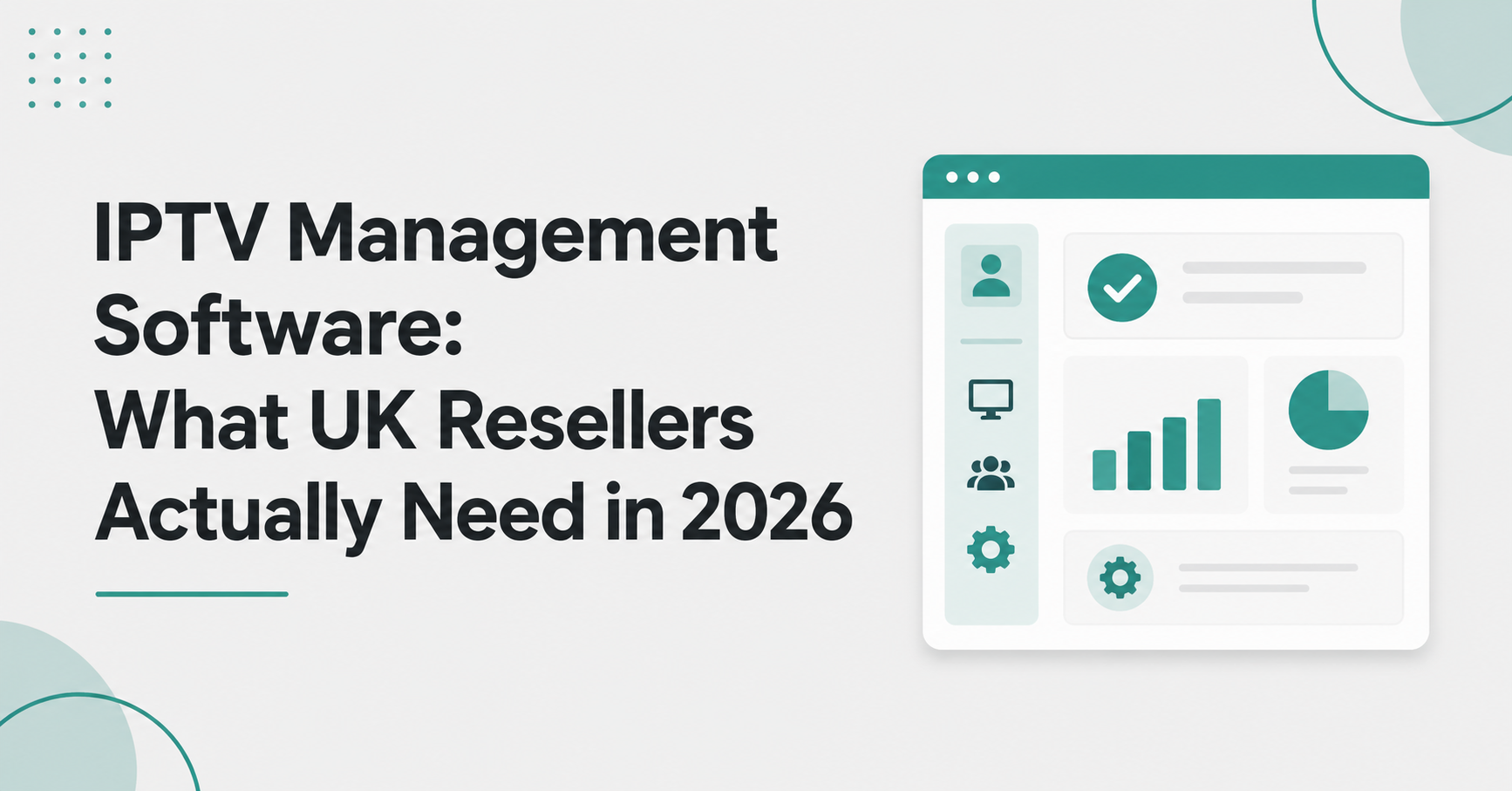
Why This Reseller Rebuilt His IPTV Management Software Setup
The message came in at 7:43am on a Monday. A reseller I’d spoken to a few months prior, running about 65 subscribers across Manchester and the surrounding area, had spent the entire previous evening manually cross-referencing a spreadsheet against his panel dashboard because his IPTV management software had no automated renewal tracking. Three subscribers had been on expired lines for four days without him realising. Two had already messaged a competitor.
“I’m running this like it’s 2019,” he said. “There has to be a better way.”
There is. IPTV management software, in its fullest sense, is any system that helps you create, organise, monitor, and maintain IPTV subscription lines and the subscriber relationships attached to them. That covers panel-level line creation and credit control, subscriber lifecycle tracking, billing and payment automation, stream quality monitoring, and business reporting. Most resellers only ever get the first piece from their provider and end up patching the rest together with spreadsheets, which is exactly the gap that catches people out.
The problem is that “IPTV management software” gets conflated with too many different things in this industry, panel dashboards, billing systems, CRM tools, subscriber portals, and most IPTV Panel resellers end up with a patchwork of half-solutions rather than a coherent operational stack.
This guide cuts through that confusion. Here’s what IPTV management software actually covers, what you need at different stages of growth, and how to evaluate what’s genuinely fit for purpose in the UK market.
What IPTV Management Software Actually Covers
Before evaluating any specific solution, it’s worth being precise about what falls under the “IPTV management software” umbrella, because the term is used to describe everything from a basic panel dashboard to a fully integrated business operations platform.
In practice, this breaks down into several distinct functional areas that may be handled by a single integrated platform or by separate tools working together.
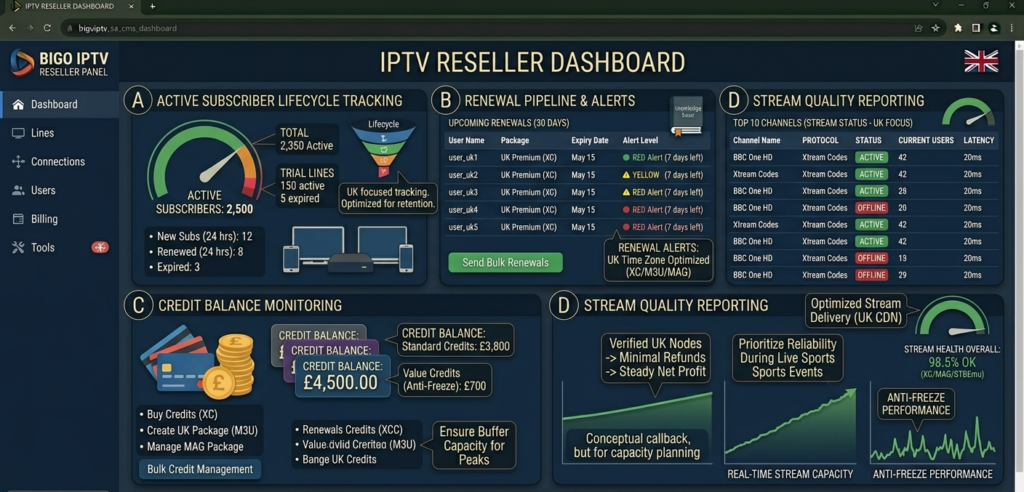
Panel-level management covers line creation, credit allocation, connection limit configuration, and direct subscriber account control. This is what most resellers mean when they say “my panel,” the dashboard provided by their panel provider.
Subscriber relationship management covers the business layer above the panel: tracking who your subscribers are, when their lines expire, what their payment history looks like, and how to communicate with them at scale.
Billing and payment processing covers invoicing, payment collection, renewal automation, and financial reporting.
Stream monitoring and quality management covers real-time visibility into stream performance, uptime tracking, and issue detection.
Reporting and analytics covers business intelligence: subscriber growth, churn rates, revenue trends, and margin analysis.
Most resellers start with panel-level management only, because that’s what their provider gives them, and then gradually build out the other layers as their operation grows. The problem is that “gradually” often means “reactively, after something breaks.” Getting the full stack in place earlier produces dramatically better business outcomes.
Pro Tip: Map out your current management stack on paper, what tool handles each function listed above. If any function has “nothing” or “manual spreadsheet” next to it, that’s where your operational risk lives. Prioritise closing those gaps in order of business impact: renewal tracking first, then billing automation, then reporting. Each one you close reduces your monthly firefighting load measurably.
The Core Functions That Matter Most to Resellers
Not all management software features are equally important at every stage of a reseller business. Here’s how to prioritise.
For resellers under 50 subscribers, the critical functions are: reliable line creation and management, a clear credit balance display, and some form of renewal tracking, even a basic one. At this scale, manual processes can still work, but only if they’re disciplined. A spreadsheet that’s updated religiously is better than management software that’s ignored.
For resellers between 50 and 150 subscribers, automated renewal alerts become essential. Manual tracking of 100+ subscriber expiry dates is a reliability risk that will eventually cause missed renewals, frustrated clients, and preventable churn. Billing integration that automates payment collection removes the human bottleneck from the renewal process.
For resellers above 150 subscribers, full business intelligence reporting, automated subscriber communication, and stream quality monitoring become important enough to actively invest in. At this scale, decisions about pricing, credit purchasing, and infrastructure need data behind them, not intuition.
Subscriber Lifecycle Management: The Operational Core
If there’s a single function that IPTV management software needs to get right above everything else, it’s subscriber lifecycle management, the end-to-end tracking of a subscriber from initial setup through active subscription to renewal or cancellation.
A well-implemented subscriber lifecycle system tells you, at any given moment: which subscribers are active, which are approaching renewal, which are on trial lines, which have lapsed, and which have been suspended. It alerts you to upcoming renewals with enough lead time to chase payment before the line expires. It records the history of each subscriber’s account, when they joined, how they’ve paid, whether they’ve had any issues.
Without this, you’re flying blind. And flying blind at 80 subscribers means regularly discovering that clients you thought were active have been on expired lines for a week, which is exactly what happened to the reseller I mentioned at the start.
The practical minimum for subscriber lifecycle management in 2026:
- Renewal alerts at 7 days and 3 days before expiry, giving you enough time to chase payment before the line goes dark, not after.
- Subscriber status dashboard, a single view showing active, expiring soon, expired, and suspended lines without needing to check each account individually.
- Communication logging, a record of when you last contacted each subscriber and what was discussed. At scale, this is the difference between professional client management and embarrassing repeat conversations.
- Trial line tracking, separate visibility for trial subscribers with conversion status. Trials that aren’t converted are revenue that’s been left on the table.
Pro Tip: Set your renewal chase sequence to begin 7 days before expiry, not 1 or 2 days. Subscribers who haven’t renewed by 3 days before expiry need a personal follow-up, not just an automated reminder. The ones who respond to a direct message and renew on day 4 would have churned silently if you’d waited until day 1 to contact them. That sequence, done consistently, is worth several percentage points of retention rate annually.
Billing and Payment Integration
Billing is the function that separates resellers who run a business from resellers who run a hobby. Manual payment collection, taking bank transfers, chasing invoices individually, reconciling payments by hand, does not scale. It also creates cash flow visibility problems that affect your ability to manage credit purchasing strategically.
Good billing integration in IPTV management software should handle:
Automated invoice generation, invoices sent automatically on a defined schedule ahead of renewal, with subscriber details and payment instructions pre-populated.
Payment method flexibility, UK subscribers use a range of payment methods. Bank transfer, PayPal, and card payments through Stripe or similar processors should all be supported or at least compatible with your management stack.
Payment status tracking, real-time visibility into which renewals have been paid, which are outstanding, and which have failed. Chasing unpaid invoices manually from a list of 100+ subscribers is a time sink that billing automation eliminates.
Revenue reporting, monthly revenue totals, outstanding balances, and payment trend data should be accessible without manual calculation.
Monthly Revenue Visibility = (Confirmed Payments ÷ Total Expected Renewals) × 100
A healthy operation should be running at 90%+ confirmed payment rate by day 5 of each billing cycle. If you’re below 80%, either your renewal chase sequence isn’t working, your payment process has friction, or your churn rate is higher than you’re acknowledging.
IPTV reseller billing dashboard showing automated invoice tracking, payment status monitoring, and monthly revenue reporting for UK subscriber management
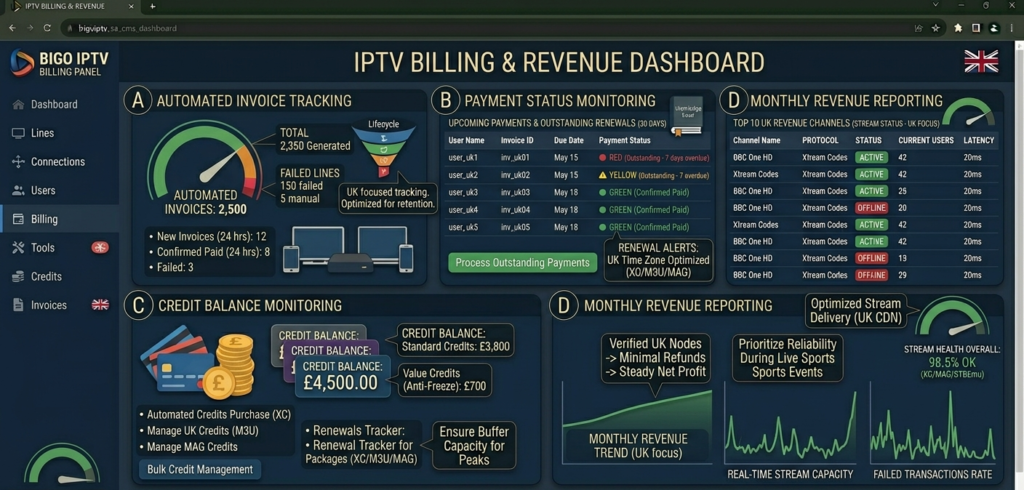
IPTV reseller billing dashboard showing automated invoice tracking, payment status monitoring, and monthly revenue reporting for UK subscriber management
Stream Monitoring and Quality Management
This is the management software function that most panel-level dashboards handle inadequately, and the gap between what panels provide and what resellers actually need is significant.
Basic panel dashboards show you whether a line is active and how many connections it’s currently using. That’s the floor. What resellers actually need to manage stream quality proactively is considerably more:
Real-time stream status monitoring, visibility into whether streams are delivering correctly, not just whether lines are active. A line can be technically active on the panel while delivering a buffering or broken stream to the subscriber, and without stream-level monitoring, you won’t know until the subscriber messages you.
Historical uptime data, the ability to see uptime percentages over rolling time periods. This data is what you need when evaluating your provider’s performance, negotiating credit terms, or deciding whether to migrate to a different panel.
Concurrent connection monitoring, visibility into how many simultaneous connections are active across your subscriber base at any given time. During peak fixtures, this data tells you whether your credit capacity is being approached and whether account sharing abuse is occurring.
Alert configuration, automated notifications when stream quality degrades below a defined threshold, so you’re aware of issues before your subscribers start messaging.
Most panel providers offer minimal stream monitoring capability. Resellers who want comprehensive quality visibility often need to supplement their panel dashboard with third-party monitoring tools, which is worth the additional overhead once you’re above 100 subscribers.
Pro Tip: At minimum, check your panel’s stream status manually during the first 15 minutes of every major live sporting event. This sounds simple, but the number of resellers who find out about a Saturday afternoon outage from subscriber complaints rather than their own monitoring is remarkably high. Proactive checking means you can communicate outage status to subscribers before they message you, which changes the entire dynamic of that conversation.
Reporting and Business Intelligence
At under 50 subscribers, you can run a IPTV Panel reseller business on instinct and rough mental arithmetic. Above that threshold, decisions made without data start costing you money in ways that are difficult to trace.
The reporting functions that matter most for IPTV management software:
Monthly churn rate, the percentage of subscribers who don’t renew in a given month. This is your single most important business health metric. Target under 8% monthly churn. Above 12% signals a systematic problem that needs identifying before you scale.
Subscriber acquisition vs. retention tracking, understanding whether your subscriber count growth comes from new acquisitions or improved retention. Retention-driven growth is structurally healthier and cheaper to sustain.
Credit utilisation reporting, tracking how efficiently your purchased credits are being converted into active subscriber revenue. Unused credit balances sitting idle represent capital that’s not earning return.
Revenue per subscriber trend, monitoring whether your average revenue per subscriber is holding stable, growing (through upsells or price adjustments), or declining (through discount creep or competitive pressure).
Annual Subscriber Value = Monthly Retail Price × (1 − Monthly Churn Rate)^12 × 12
At £8/month retail with 5% monthly churn:
£8 × (0.95)^12 × 12 = £8 × 0.540 × 12 = £51.84
At £8/month retail with 15% monthly churn:
£8 × (0.85)^12 × 12 = £8 × 0.142 × 12 = £13.63
The difference in annual value per subscriber between 5% and 15% monthly churn is £38.21, nearly five months of subscription revenue. At 100 subscribers, that gap represents £3,821 in annual revenue difference purely from churn rate improvement.
UK-Specific Requirements
IPTV management software used in the UK market needs to address some specific operational requirements that generic international platforms often miss.
BST-aware scheduling, renewal alerts, automated communications, and reporting time stamps need to correctly reflect UK time zones including the BST offset from late March through late October. Systems that run on UTC without offset correction will schedule communications an hour out from subscriber expectations during half the year.
British English throughout, subscriber-facing communications, invoice templates, and notification copy should use British English conventions. Americanised spelling in client communications signals a generic, off-the-shelf solution, which undermines the professional image you’re trying to build.
GDPR-compliant data handling, UK subscriber data falls under UK GDPR post-Brexit. Any management software that stores subscriber personal data needs to handle it in accordance with UK data protection law. This is particularly relevant for cloud-based management tools that may store data on non-UK servers.
Payment method alignment, UK subscribers predominantly use bank transfer, PayPal, and card payments. Management software billing integration needs to support the payment methods your subscribers actually use, not just those common in other markets.
Pro Tip: Review every automated communication template in your management software from the perspective of a UK subscriber receiving it. Check for Americanised spelling, incorrect date formats (MM/DD rather than DD/MM), dollar signs instead of pound signs, and time references that don’t account for BST. These small localisation errors compound into a perception of unprofessionalism that affects subscriber trust more than most resellers realise.
The Cost of Poor Management Software
Let me translate the operational weaknesses of inadequate IPTV management software into actual financial terms, because this is where the abstract becomes concrete.
Missed renewals from poor lifecycle tracking, at 100 subscribers with a 7-day average gap between expiry and detection, you’re losing an average of 1.6% of monthly revenue to lines that have lapsed without triggering a renewal chase. At £800 monthly gross revenue, that’s £12.80 per month or £153.60 annually, from tracking failure alone.
Churn from poor communication, subscribers who don’t receive timely renewal reminders churn at meaningfully higher rates than those who do. A 3% churn rate improvement from better communication automation is worth approximately £288 annually at 100 subscribers and £8 retail price.
Time cost of manual processes, at 100 subscribers, manual renewal tracking, invoice chasing, and payment reconciliation consume an estimated 10–15 hours monthly. Valued conservatively at £12/hour, that’s £120–£180 monthly in time cost that automation eliminates.
Combined, poor management software costs a 100-subscriber operation an estimated £500–£600 annually in avoidable losses, before accounting for the harder-to-quantify reputational cost of the operational errors that manual processes inevitably produce.
Scaling from 50 to 500 Subscribers: What Changes
The management software requirements at 50 subscribers and at 500 subscribers are categorically different, and resellers who don’t upgrade their management stack as they scale will hit a ceiling that’s defined by operational capacity rather than market opportunity.
At 50 subscribers, a good panel dashboard plus a disciplined spreadsheet is survivable. Uncomfortable, but survivable.
At 150 subscribers, manual processes become a reliability liability. Automated renewal tracking and billing integration are no longer optional luxuries, they’re the foundation that allows further growth without proportional increase in support overhead.
At 300+ subscribers, full business intelligence reporting, automated subscriber communication sequences, and stream quality monitoring become the difference between a business that’s growing intentionally and one that’s growing chaotically. At this scale, decisions made without data produce expensive mistakes.
The resellers I’ve seen scale successfully past 200 subscribers almost universally have one thing in common: they invested in proper management infrastructure before they needed it, not after they were drowning without it.
Honest Recommendation
The right IPTV management software stack is the one that matches your current scale, has room to grow with you, and integrates cleanly with a panel that actually performs. Getting the panel right is still the foundation, management software sitting on top of unreliable infrastructure is like a sophisticated alarm system in a structurally unsound building.
For UK resellers who want a panel with built-in management capabilities that go meaningfully beyond basic line creation, with subscriber tracking, credit management, and reporting functionality designed for the UK market, britishseller.co.uk is consistently worth evaluating. It’s the recommendation I make to resellers who’ve outgrown their current setup and are ready to operate like a proper business rather than a side hustle held together with spreadsheets and optimism.
✅ IPTV Management Software: Reseller Success Checklist
- Audit your current management stack against the five functional areas, panel management, subscriber lifecycle, billing, stream monitoring, and reporting. Any gap currently filled by a manual process or spreadsheet is an operational risk that will become a crisis at scale.
- Implement automated renewal alerts at 7 days and 3 days before expiry, this single change typically reduces churn by 3–5 percentage points for resellers who’ve been relying on manual tracking. The revenue impact at any significant subscriber count is substantial enough to justify it immediately.
- Calculate your true time cost of manual processes monthly, count the hours you spend on renewal tracking, payment chasing, and reconciliation, then multiply by a realistic hourly value.
- That number is the ROI case for billing automation, and it’s almost always larger than resellers expect.
- Set up stream quality spot checks during every major live sporting event, proactive monitoring during peak demand windows catches issues before subscribers do, which changes the entire dynamic of outage communication from reactive to managed.
- Review your management software scalability before you need it, assess whether your current stack can handle 3x your current subscriber count without breaking. If it can’t, plan the upgrade now rather than during a growth phase when operational capacity is already under pressure.