IPTV Management System for UK Resellers in 2026: What You Actually Need
The first time I realised my IPTV management system was the actual problem, not my provider, not my pricing, not my marketing, was a Wednesday afternoon when I sat down to do a routine credit check and discovered I had no idea how many active subscribers I actually had.
Not approximately. Actually no idea.
Lines had been created, extended manually, some suspended, others quietly expired. A few subscribers had paid for renewals I hadn’t yet processed. Two were on trials I’d forgotten to convert. The panel dashboard showed one number. My mental count suggested another. My bank account implied a third.
It took three hours to reconcile. Three hours that generated zero revenue, zero subscriber value, and a fairly uncomfortable realisation that I was running a growing business on the operational infrastructure of a car boot sale.
That experience prompted a complete overhaul of how I approached IPTV management, and it’s a conversation I’ve had with dozens of resellers since, almost always triggered by a similar moment of reckoning. If you’re currently managing your subscriber base through a combination of panel dashboards, WhatsApp message history, and optimistic memory, this guide is specifically for you.
IPTV management system overview diagram showing the five operational pillars (line management, subscriber tracking, billing automation, stream monitoring, and business reporting) for UK reseller operations
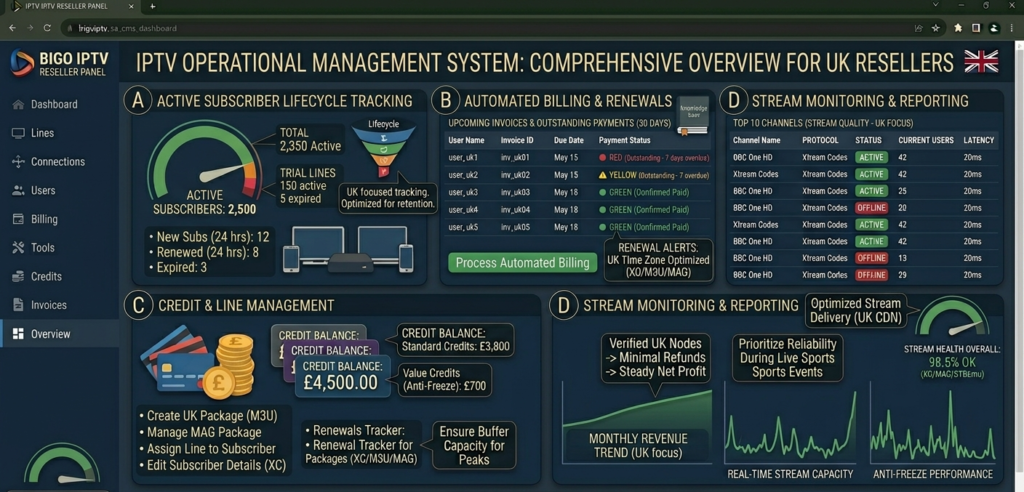
IPTV management system overview diagram showing the five operational pillars line management, subscriber tracking, billing automation, stream monitoring, and business reporting for UK reseller operations
What an IPTV Management System Actually Covers
The term gets used loosely. Sometimes to mean a panel dashboard, sometimes a billing tool, sometimes the whole operational picture. Let me be precise, because the definition determines how you evaluate whether your current setup is adequate.
An IPTV management system, in the context of a reseller business, is the complete operational infrastructure that governs how you create and manage subscription lines, track subscriber relationships, collect payments, monitor service quality, and make data-driven business decisions. It’s not one tool. It’s the integrated stack of systems (panel dashboard, subscriber database, billing platform, monitoring capability, and reporting layer) that collectively determine whether your business runs smoothly or runs you ragged.
Most resellers start with just the panel dashboard their provider gives them and gradually bolt on other elements as problems emerge. The result is typically a fragmented stack with gaps, duplicated data, and no single source of truth for any important operational question. How many active subscribers do I have? What’s my monthly revenue? Which lines expire this week? Who hasn’t paid? Which streams are underperforming?
If any of those questions requires you to check multiple places or do manual arithmetic to answer, your management system has gaps that will cost you money and time as you scale.
The resellers who build genuinely sustainable operations, consistently above 150 subscribers with healthy margins and manageable support overhead, almost universally have one thing in common: they treated their management system as a business infrastructure investment, not an afterthought.
Pro Tip: Do a five-minute operational audit right now. Open your current management setup and try to answer these four questions without leaving the interface: How many subscribers renew this week? What is my current credit balance expressed in months of capacity? What was my churn rate last month? Which subscriber has been active longest? If you can’t answer all four quickly and accurately, you have management system gaps that need addressing before you scale further.
Why Most Resellers Outgrow Their Initial Setup Faster Than They Expect
When you start with 15 or 20 subscribers, the panel dashboard is sufficient. You know every subscriber by name. You remember roughly when each line was created. You can hold the entire operational picture in your head without any supplementary system.
This works until it doesn’t, and the transition from “working” to “not working” happens faster than almost every IPTV Panel reseller anticipates. In my experience, the tipping point is somewhere between 40 and 60 subscribers. Below that threshold, manual management is uncomfortable but survivable. Above it, the gaps in your management system start producing real business consequences: missed renewals, undetected line expirations, payment reconciliation errors, and churn you can’t explain because you have no data to investigate.
The compounding problem is that growth makes the gap worse. Every new subscriber added to a fragmented management system increases the operational complexity non-linearly. Going from 50 to 100 subscribers doesn’t double your management workload, it more than doubles it, because the interactions between subscriber records, credit balances, payment statuses, and renewal schedules multiply as the subscriber base grows.
Resellers who wait until they’re drowning to address their management system face a much harder transition than those who build proper infrastructure at 40 to 50 subscribers, before the complexity becomes unmanageable. The work is the same either way, but one version happens on your terms, and the other happens in crisis mode while subscribers are waiting for responses.
The Five Operational Pillars of a Proper Management System
Rather than thinking about management system tools, it’s more useful to think about the five operational functions that any adequate IPTV management system needs to perform. You can then evaluate your current setup against each pillar independently.
Pillar 1: Line and Credit Management. Creating, modifying, suspending, and terminating subscription lines with full visibility into credit consumption and remaining balance.
Pillar 2: Subscriber Relationship Tracking. Maintaining accurate records of who your subscribers are, their contact details, account history, and current subscription status.
Pillar 3: Billing and Payment Automation. Generating invoices, collecting payments, tracking outstanding balances, and reconciling revenue automatically rather than manually.
Pillar 4: Stream Quality Monitoring. Maintaining visibility into whether streams are performing correctly for subscribers, with proactive alerting when quality degrades.
Pillar 5: Business Reporting and Analytics. Producing the data you need to make informed decisions about pricing, credit purchasing, provider selection, and growth strategy.
A management system that performs all five functions adequately, whether through a single integrated platform or a well-integrated stack of separate tools, is the operational foundation of a scalable reseller business. Missing any one pillar creates a vulnerability that will eventually surface as a business problem.
Line and Credit Management: Getting the Foundation Right
This is the pillar that panel dashboards handle most directly, and it’s where most resellers feel reasonably comfortable. But “comfortable” and “adequate” aren’t the same thing.
Good line and credit management in an IPTV management system means more than being able to create and delete lines. It means having real-time visibility into your credit balance expressed in meaningful terms, not just a number, but what that number represents in operational capacity. How many months of 100 active subscribers does your current credit balance support? That’s the question you should be able to answer instantly.
It also means having clear visibility into line status across your entire subscriber base simultaneously. Active lines, trial lines, expiring lines, suspended lines, and expired lines should all be visible in a single organised view, not buried in individual account records that require manual checking.
Connection limit management matters more than most new resellers expect. The ability to set and enforce concurrent connection limits per line is how you protect your credit margins from account sharing abuse. A subscriber paying for one line and sharing it across four devices is consuming four streams’ worth of infrastructure for one credit’s price. Without connection limit enforcement, this erodes your effective margin invisibly.
Pro Tip: Audit your active lines monthly for unusual concurrent connection patterns. A line consistently showing three or four simultaneous connections when your policy allows two is a signal worth investigating. Some account sharing is inevitable in any subscriber base, but systematic abuse at scale, left unaddressed, can meaningfully inflate your effective credit cost per revenue-generating subscriber.
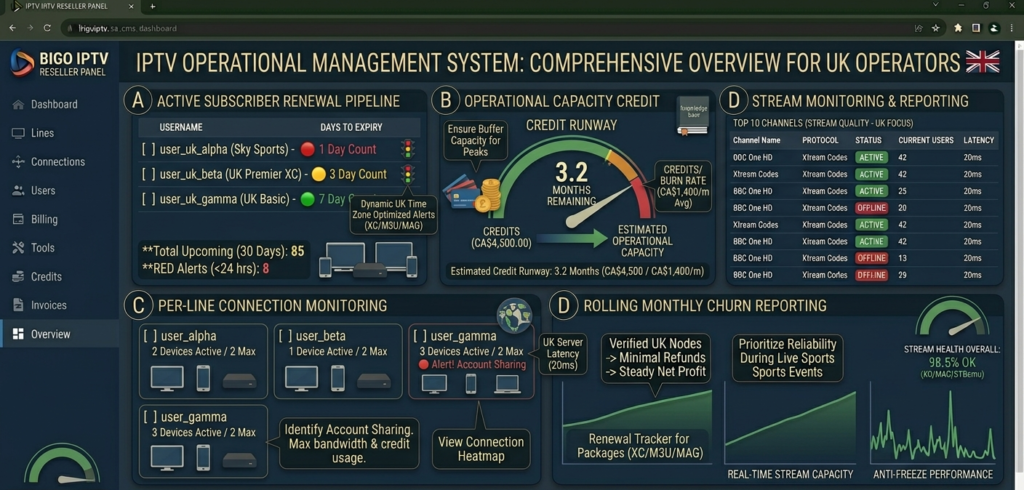
IPTV reseller management system showing subscriber renewal pipeline, credit balance dashboard, connection limit monitoring, and monthly churn reporting for UK operators
Subscriber Data and Relationship Tracking
This is the pillar most resellers handle worst, not because it’s technically complex, but because it feels like admin rather than business-building, and admin gets deprioritised until it becomes urgent.
A proper subscriber tracking system maintains, at minimum, the following data for each subscriber: full name and contact details, subscription start date, current line expiry date, payment history, device type and connection method, any support interactions, and referral source. That last one, referral source, is data most resellers never capture, despite the fact that it’s essential for understanding which acquisition channels are producing your best long-term subscribers.
The practical value of comprehensive subscriber data becomes most apparent during three scenarios:
Renewal conversations: knowing a subscriber’s history, device setup, and any previous issues means your renewal conversation is personalised and informed rather than generic. Personalised renewal conversations convert at meaningfully higher rates.
Support interactions: when a subscriber contacts you with a problem, having their complete account history instantly accessible means you can diagnose and respond faster. Speed of resolution is the strongest predictor of whether a support interaction retains or loses a subscriber.
Churn analysis: when subscribers don’t renew, their historical data tells you patterns. Are churned subscribers disproportionately on MAG boxes? Did they join during a specific promotion? Were there unresolved support tickets in their history? Without data, churn is a mystery. With data, it’s a solvable problem.
Automated Renewal and Billing Systems
Manual billing is the operational equivalent of manually calculating your fuel consumption by counting petrol station visits. Technically possible, practically unsustainable above any meaningful scale.
The renewal and billing function of your IPTV management system should operate with minimal manual intervention. Here’s what that looks like in practice:
- Seven days before expiry: automated invoice generated and sent to subscriber with renewal instructions and payment link.
- Three days before expiry: automated reminder sent if payment not received.
- One day before expiry: final automated reminder with urgency framing.
- Day of expiry: if payment not received, line suspended (not deleted, since suspension allows quick reactivation when payment arrives) and personalised follow-up initiated.
- Three days post-expiry: if still unpaid, line deletion and formal churn recording.
This sequence, running automatically across your entire subscriber base, eliminates the manual chase process and captures renewals that manual systems miss because of timing gaps. The difference in renewal rate between a manual chase process and a well-configured automated sequence is typically 8 to 12 percentage points, which at 100 subscribers and £8 monthly retail represents £64 to £96 in additional monthly revenue from the same subscriber base.
Annual Revenue Gain from Automation = Retention Rate Improvement × Subscribers × Retail Price × 12
At 10% retention improvement across 100 subscribers at £8 retail:
= 0.10 × 100 × £8 × 12 = £960 additional annual revenue
That’s nearly £1,000 in annual revenue recovered purely from systematic renewal automation, without acquiring a single new subscriber.
Performance Monitoring and Quality Assurance
Stream quality monitoring is the management system pillar most resellers treat as their provider’s problem. And it is their provider’s problem. But it’s also your problem, because subscriber complaints land with you regardless of where the fault lies.
An adequate quality monitoring capability for a UK reseller operation includes:
Regular manual stream checks during peak demand windows. The 3pm Saturday football window is non-negotiable. If you’re not personally checking stream quality during peak demand, you’re discovering outages from subscriber complaints rather than proactive monitoring. That reactive posture costs you both time and subscriber trust.
Uptime tracking by provider: maintaining a simple log of outage events, duration, and affected subscriber counts. This data serves two purposes: it tells you whether your provider’s uptime claims are accurate, and it gives you the factual basis for any credit or compensation discussions.
Subscriber-reported issue logging: every buffering complaint, stream drop report, and login issue should be logged with date, time, and affected line. Patterns in this data will often surface infrastructure issues before they become critical. A cluster of buffering reports from STBEmu users on a specific evening might indicate a device-compatibility issue with a recent panel update, for instance.
Pro Tip: Create a simple shared spreadsheet or use a free ticketing tool to log every subscriber-reported technical issue with date, time, affected device type, and resolution. After three months, review the patterns. In my experience, 70% of recurring technical complaints trace back to two or three identifiable root causes, and knowing those causes allows you to address them proactively rather than responding to the same issue repeatedly.
Reporting, Analytics and Business Decision-Making
The reporting layer of your IPTV management system is what transforms operational data into business intelligence. Without it, you’re making decisions about pricing, provider selection, and growth strategy based on intuition rather than evidence.
The minimum viable reporting set for a UK reseller operation:
- Monthly subscriber count trend: net subscriber growth or decline, distinguishing between new acquisitions and retained renewals.
- Monthly churn rate: percentage of subscribers who didn’t renew. Tracked over time, this is your primary business health indicator.
- Revenue per subscriber: average monthly revenue divided by active subscriber count. If this is declining, you have pricing pressure or discount creep occurring.
- Credit utilisation rate: credits consumed versus credits purchased over a rolling 90-day period. Significant gaps indicate over-purchasing relative to growth, which ties up capital unnecessarily.
Support ticket volume and resolution time: the operational cost of your subscriber base, measured in support interactions. Rising ticket volume without subscriber count growth signals a worsening service quality issue.
These five metrics, tracked consistently and reviewed monthly, give you the data foundation to make genuine business decisions rather than educated guesses.
UK-Specific System Requirements
An IPTV management system built for the UK market needs to address several specific requirements that generic international platforms often don’t account for.
UK GDPR compliance: subscriber personal data stored in your management system falls under UK GDPR requirements. Cloud-based systems that store data on non-UK servers need to demonstrate adequate data protection standards. This isn’t optional, and the penalties for non-compliance aren’t trivial.
British English throughout: every subscriber-facing communication generated by your management system should use British English conventions. Date formats (DD/MM/YYYY not MM/DD/YYYY), currency (£ not $), spelling (optimise not optimize), and tone should all be calibrated for a British audience.
BST-aware scheduling: automated communications, renewal sequences, and reporting time stamps must correctly handle the British Summer Time offset from late March through late October. A renewal reminder that fires at midnight UTC rather than midnight BST arrives an hour out of expected schedule during summer, a small error that aggregates into subscriber confusion at scale.
Peak demand awareness: your monitoring and support processes need to be specifically calibrated around UK sporting demand peaks. Premier League weekends, major cup fixtures, and international tournaments all create predictable high-demand windows that your management system should treat as heightened-alertness periods, not routine operational days.
Building Your Management Stack at Each Growth Stage
The right management system architecture depends on where you are in your reseller journey. Here’s how to match your stack to your stage:
0-40 subscribers: Panel dashboard plus a single well-maintained spreadsheet covering subscriber details, expiry dates, and payment status. Manual renewal chasing is manageable. Focus on getting your panel right rather than over-engineering the management layer.
40-100 subscribers: Introduce a dedicated subscriber tracking tool or CRM, even a free one, to replace the spreadsheet. Add automated renewal reminders at a minimum. The time saved on manual chasing at this stage pays for itself within the first month.
100-200 subscribers: Full billing automation, stream quality monitoring, and structured reporting become essential rather than optional. Evaluate whether your panel provider’s native management tools are adequate for this scale, or whether supplementary tools are required.
200+ subscribers: Enterprise-level IPTV management systems or fully integrated reseller platforms become worth evaluating. At this scale, the operational efficiency gap between a fragmented stack and an integrated platform translates directly into margin, through reduced support overhead, better retention rates, and more accurate business decision-making.
The Real Cost of Getting This Wrong
Let me be specific about what poor IPTV management system infrastructure costs a typical UK reseller operation at 100 subscribers, because the abstract case is less compelling than the arithmetic.
Missed renewals from poor tracking: Average 5% of renewals missed monthly due to tracking gaps. At 100 subscribers and £8 retail, that’s £40 monthly or £480 annually from tracking failure alone.
Elevated churn from poor renewal automation: 4% additional monthly churn versus a well-automated system. At 100 subscribers, 4 additional churned subscribers monthly at £8 retail represents £32 monthly or £384 annually in avoidable revenue loss.
Management time cost: 12 hours monthly on manual processes that automation eliminates, valued at £12/hour = £144 monthly or £1,728 annually in time cost.
Total annual cost of poor management system at 100 subscribers:
£480 + £384 + £1,728 = £2,592 per year
That figure, £2,592 annually, is what inadequate management infrastructure costs a 100-subscriber operation. It’s also the ROI case for investing properly in your management system, because most of it is recoverable through the right tools and processes.
Honest Recommendation
The management system conversation always brings resellers to the same realisation eventually: the panel they chose is either built to support proper business operations or it isn’t. A panel that provides only the minimum (line creation and a credit balance display) forces you to build the entire management stack yourself from supplementary tools. A panel that’s designed with reseller business operations in mind provides meaningful management capability natively, reducing the integration overhead and operational gaps.
For UK resellers who want a panel built with the full operational picture in mind, one that handles subscriber management, credit tracking, and the kind of reporting visibility that supports genuine business decision-making, britishseller.co.uk is the recommendation I keep returning to. It’s where I’d point a reseller who’s done the three-hour reconciliation exercise I described at the start of this guide and has decided, quite reasonably, that they’re never doing that again.
Reseller Success Checklist
- Audit all five operational pillars against your current setup: line management, subscriber tracking, billing automation, stream monitoring, and reporting. Document which pillars are currently handled by manual processes and prioritise closing those gaps in order of business impact, starting with renewal tracking and billing automation.
- Implement the full automated renewal sequence before you reach 60 subscribers: seven-day alert, three-day reminder, day-of suspension, three-day post-expiry deletion. Setting this up before you need it takes the same amount of time as setting it up during a crisis, but produces dramatically better outcomes.
- Capture referral source data for every new subscriber from day one. This is the subscriber data point most resellers never collect, and it’s the one that tells you which acquisition channels produce your best long-term, lowest-churn customers. Three months of this data is worth more than any amount of intuition about where to focus your marketing.
- Run the five core business metrics monthly without exception: subscriber count trend, churn rate, revenue per subscriber, credit utilisation rate, and support ticket volume. Twelve months of consistent data transforms your ability to make informed decisions about every aspect of the business.
- Calculate what your current management system is costing you annually: missed renewals, elevated churn, and time cost of manual processes. Use the methodology in this guide. In my experience, most resellers are surprised by how large the number is, and that surprise is usually the motivation to finally invest in doing it properly.