What Is IPTV? The Plain-English Answer Every Reseller Needs
IPTV is television delivered through your internet connection instead of a satellite dish, aerial, or cable box, the same way Netflix delivers films, but for live channels including sport. That single idea is the foundation everything else in this business sits on: the panels, the credits, the reseller model, all of it. Resellers who can explain that sentence clearly, and back it up with honest expectations about reliability, are the ones who convert prospects and keep them.
The question that started my entire IPTV journey came from my brother-in-law at a family dinner in 2019. He’d heard I was “doing something with streaming” and wanted to know what IPTV actually was. I gave him the textbook answer, Internet Protocol Television, delivery of television content over IP networks, and watched his eyes glaze over in real time.
So I tried again. “You know how Netflix delivers films through your internet connection instead of a satellite dish or cable? IPTV does the same thing, but for live television, including sport.”
He leaned forward. “Including the football?”
“Including the football.”
He became my third subscriber.
Understanding what IPTV is, in terms that actually mean something to real people, is the foundation of every successful UK IPTV reseller business. It’s how you explain your service to prospective subscribers, how you answer their questions confidently, and how you position the value of what you’re selling. Get this wrong and you’ll struggle to convert even genuinely interested prospects. Get it right and the conversation practically closes itself.
This guide covers what IPTV is technically, commercially, and practically, for both resellers building a business and subscribers trying to understand what they’re signing up for.
Diagram explaining what IPTV is showing how television content travels from upstream servers through internet connection to subscriber devices including smart TVs, MAG boxes, Fire TV sticks, and mobile phones in UK homes
What IPTV Actually Means, in Plain English
IPTV stands for Internet Protocol Television. Strip away the acronym and it means exactly what it sounds like: television delivered through your internet connection rather than through a satellite dish, aerial, or physical cable.
That’s the entire concept. Everything else, the panels, the apps, the credits, the reseller business model, is built on top of that single foundational idea.
The reason IPTV has grown from a niche technology into a mainstream product used by millions of UK households is straightforward: internet connections have become fast enough and reliable enough to deliver high-quality video streams consistently, while traditional television infrastructure has remained expensive, inflexible, and increasingly frustrating for viewers who want to watch what they want, when they want, on the device they choose.
Traditional satellite or cable television locks you into a package. You pay for hundreds of channels you never watch in order to access the dozen you actually want. The hardware is usually proprietary, the contracts are long, and the pricing reflects a market that historically had little competition.
IPTV delivers television content through the same broadband connection you already pay for, through an app on a device you already own, without a long-term contract or proprietary hardware requirement. For British subscribers who’ve been paying premium rates for bundled television packages that overdeliver on quantity and underdeliver on value, the appeal is immediate and obvious.
Pro Tip: When explaining what IPTV is to a prospective subscriber, always anchor the explanation to something they already understand. “It’s like Netflix, but for live television including sport” works for most British adults. “It’s like what you’d get with a satellite subscription, but through your broadband instead” works for the demographic more familiar with traditional pay-TV. The technology doesn’t need explaining, the value proposition does.
The Delivery Chain, Explained Without the Jargon
Understanding how IPTV works at a functional level, not just the marketing description, is what separates resellers who can troubleshoot subscriber issues confidently from those who have to escalate everything to their provider.
The delivery chain has four key components:
- Upstream content sources are where the television streams originate. These are server-side operations that capture, encode, and broadcast live television content in digital format. As a reseller, you have no direct relationship with this layer, it’s several steps upstream from you, managed by your panel provider’s suppliers.
- CDN infrastructure, Content Delivery Network, is the distribution layer that takes streams from their origin point and delivers them to subscribers across different geographical locations with minimal latency. A well-designed CDN for UK subscribers uses edge nodes located in or near the UK, so that streams travel the shortest possible distance from server to subscriber. This is why panel CDN architecture matters so significantly for British reseller operations.
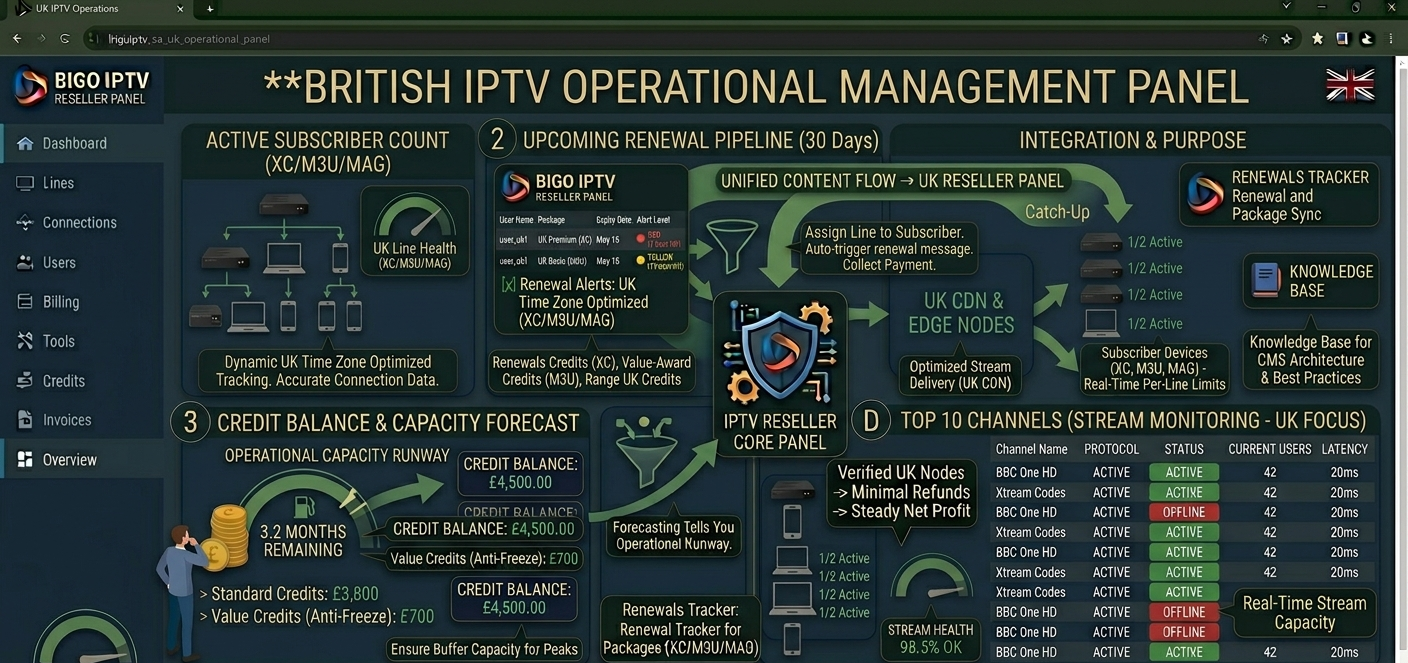
- The reseller panel is the management layer where you operate. It’s the system that creates and manages subscriber lines, controls access credentials, handles credit accounting, and provides the dashboard you use to run your business day-to-day.
- The subscriber’s device and app is the final mile, the application on the subscriber’s chosen device that connects to the panel using their credentials, retrieves the stream from the CDN, and displays it on screen.
- When something goes wrong for a subscriber, buffering, stream failure, EPG inaccuracy, the fault can sit at any of these four layers. Understanding the architecture helps you diagnose which layer is responsible and respond appropriately rather than defaulting to “it must be my provider” for every issue.
- Stream quality, put simply, is a function of upstream reliability, CDN performance, panel stability, device capability, and subscriber broadband, all added together.
- All five variables contribute to the quality of the subscriber’s viewing experience. A perfect upstream source delivered through an excellent CDN to a capable device on a strong broadband connection can still produce a poor experience if the panel is unstable. And a stable panel with excellent CDN infrastructure can still buffer if the subscriber’s broadband connection is inadequate or their device is underpowered.
- This multi-variable reality is why diagnosing IPTV issues requires asking the right questions rather than jumping to conclusions, and why resellers who understand the architecture provide better support than those who treat every complaint as a provider problem.
IPTV vs. Traditional Television: The Real Differences
British subscribers comparing IPTV against traditional television alternatives make this comparison constantly, and as a reseller, you’ll be part of that conversation regularly. Here’s how the products genuinely differ.
Here’s how the two compare directly:
| Dimension | Traditional pay-TV | IPTV subscription |
|---|---|---|
| Delivery method | Satellite dish or physical cable | Broadband internet connection |
| Hardware required | Proprietary set-top box | Any compatible device |
| Contract length | 12 to 24 months typical | Monthly, usually no contract |
| Price point | £30 to £80+ monthly | £6 to £12 monthly typically |
| Channel selection | Fixed packages | Varies by provider |
| Flexibility | Low, package-based | High, subscription-based |
| Setup complexity | Professional installation often required | Self-setup via app |
| EPG/catch-up | Generally reliable | Varies by provider quality |
The price comparison is where IPTV makes its most immediate commercial case to British subscribers. At £8 monthly for an IPTV subscription versus £40 to £80 monthly for a comparable traditional pay-TV package, the savings are substantial enough to be the conversation opener in many subscriber acquisition discussions.
The flexibility comparison matters significantly to a British audience that’s increasingly resistant to long-term contracts following years of exit fee disputes with telecommunications providers. Monthly IPTV subscriptions with no contract commitment appeal directly to that contract fatigue.
The reliability comparison is where honest resellers need to be straightforward. A well-run IPTV service on quality infrastructure is genuinely reliable, but it’s not as infrastructurally robust as a satellite signal or a physical cable connection. Peak demand periods, particularly Premier League Saturdays, stress IPTV infrastructure in ways that satellite and cable are immune to. Choosing the right panel mitigates this significantly, but it’s an honest distinction that resellers should acknowledge rather than paper over.
Pro Tip: Never oversell IPTV reliability to prospective subscribers by implying it’s identical to satellite or cable infrastructure. Set honest expectations: “The service is very reliable on normal days and on most match days, there are occasional peak-demand periods where high traffic affects any streaming service, but a good provider minimises this significantly.” Subscribers who’ve been given honest expectations are far more forgiving of occasional minor issues than those who were promised perfection and received anything less.
How the Reseller Business Model Actually Works
For readers approaching this from a business rather than consumer perspective, understanding the IPTV Panel reseller model is the next logical step after understanding what IPTV is.
The reseller model works in three layers. At the top, panel providers build and maintain the technical infrastructure, servers, CDN, anti-freeze systems, panel software, and sell access to that infrastructure to resellers in the form of credits. Each credit represents the cost of maintaining one active subscriber line for one month.
Resellers, the middle layer, purchase credits in bulk from panel providers at wholesale prices, then sell subscription access to end subscribers at retail prices. The margin between credit cost and retail price is the reseller’s gross profit. Resellers handle subscriber acquisition, account management, payment collection, and first-line support.
End subscribers, the third layer, pay a monthly subscription fee and receive access to IPTV streams through their chosen device and application.
The economics are what make this model commercially interesting. Credit costs in the UK market typically sit between £1.80 and £2.80 per line per month at reseller wholesale rates. Retail subscription prices in the British market sit broadly between £6 and £12 monthly. The margin between these two figures, after accounting for overheads and a modest refund provision, produces net monthly profits that range from meaningful side income at 50 subscribers to genuinely significant business income above 200 subscribers.
Here’s how the maths works: monthly net profit equals subscribers multiplied by retail price, minus credits multiplied by credit cost, minus refunds, minus overheads.
At 100 subscribers, £8 retail, £2.40 credit cost, 5% refund rate, £30 overheads: that’s (100 × £8) minus (100 × £2.40) minus (£800 × 0.05) minus £30, which is £800 minus £240 minus £40 minus £30, giving £490 monthly net profit.
At 200 subscribers with volume-tier credit pricing at £2.10: that’s (200 × £8) minus (200 × £2.10) minus (£1,600 × 0.05) minus £30, which is £1,600 minus £420 minus £80 minus £30, giving £1,070 monthly net profit.
The scaling effect of volume credit pricing combined with fixed overhead costs produces materially better margins at higher subscriber counts, which is the commercial logic that makes growing an IPTV reseller business financially worthwhile.
What British Subscribers Use IPTV For
Understanding subscriber use cases shapes everything from your panel selection to your support processes to how you communicate the service’s value.
Live sport is the primary driver of British IPTV demand, by a considerable margin. Premier League football generates the largest and most concentrated demand spikes. Championship and lower-league football, European competition, international fixtures, boxing events, cricket, Formula 1, and rugby all contribute additional demand at their respective peak moments. The 3pm Saturday blackout, the domestic broadcast restriction on live football during this window, specifically drives British viewers toward IPTV alternatives every single week of the football season.
Live entertainment programming, reality television, talent competitions, award shows, drives a secondary subscriber use case that’s less intense but more consistent than sport. These viewers tend to watch on a more distributed schedule and generate lower peak demand but higher average daily stream minutes.
International content is a significant driver for British subscribers with family or cultural connections to other countries. South Asian content, cricket, Bollywood films, regional language programming, drives substantial IPTV demand among British Asian communities. Middle Eastern, Eastern European, and African content similarly drives demand within the respective diaspora communities that make up a meaningful part of Britain’s diverse population.
VOD and catch-up has grown from an ancillary feature to a genuine use case for many British IPTV subscribers who’ve become accustomed to on-demand viewing from Netflix and similar services and expect the same flexibility from their IPTV subscription.
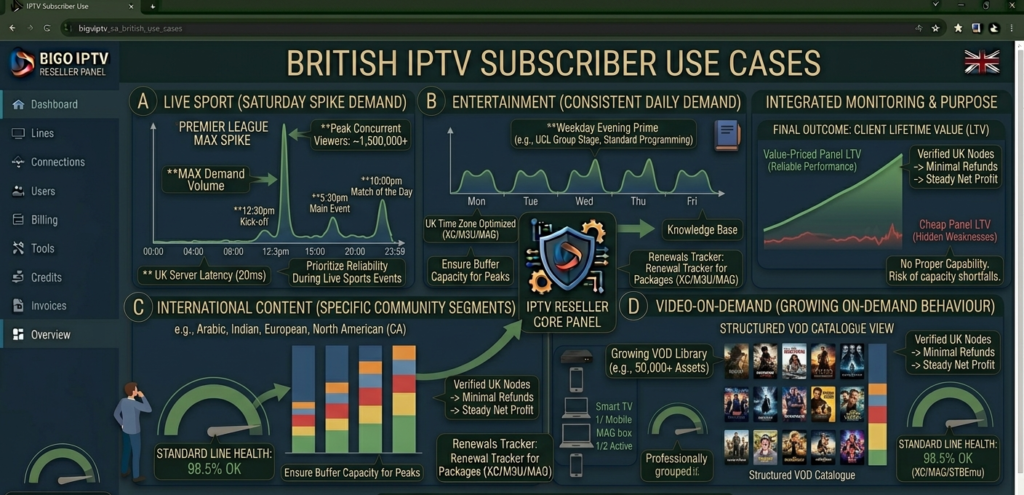
Chart showing UK IPTV subscriber use cases by demand volume — live sport, entertainment, international content, and VOD — illustrating the viewing patterns that British IPTV resellers should plan their infrastructure and content management around
The Devices That Run IPTV in UK Homes
The British IPTV subscriber uses a genuinely diverse device ecosystem, and as a reseller, you need to support all of it.
MAG boxes are dedicated IPTV set-top boxes that connect to the television via HDMI and access the internet via Ethernet or WiFi. They use a portal-based connection method where the subscriber enters a portal URL rather than credentials. MAG boxes have been popular in the UK IPTV market for years and remain common among subscribers who want a dedicated device with a familiar set-top box experience.
Android TV devices, including Amazon Fire TV sticks, Nvidia Shield, and various Android TV boxes, run applications like TiviMate, IPTV Smarters Pro, and GSE Smart IPTV. These are the most versatile IPTV delivery method, supporting all major connection protocols, Xtream Codes, M3U, and in some cases portal-based connections. Fire TV sticks are particularly prevalent in the UK market.
Smart TVs, primarily Samsung and LG, support IPTV through native applications like Smart IPTV (Samsung, LG) and other TV-native players. These use MAC address-based activation rather than credential login, creating specific management requirements for resellers.
STBEmu is an Android application that emulates MAG box behaviour, allowing subscribers to use the portal-based connection method on Android devices without purchasing a physical MAG box. It’s popular among technically confident subscribers who want MAG-style navigation on a device they already own.
Mobile devices, smartphones and tablets running Android or iOS, support IPTV through various applications including IPTV Smarters, GSE Smart IPTV, and others. Mobile viewing is increasingly common as a secondary screen rather than a primary viewing method.
Understanding which device each subscriber uses is essential for effective support, because the setup process, troubleshooting path, and common failure modes differ significantly between device types.
Telling a Good Service Apart From a Bad One
This is the question that directly translates into subscriber acquisition conversations, and the honest answer is what builds your credibility with prospective customers who’ve been burned before.
A good IPTV service delivers consistent stream quality during peak demand periods, specifically during live sport on Saturday afternoons, which is the most demanding test of British IPTV infrastructure. It maintains accurate EPG scheduling with correct UK time zone handling. It offers a functional VOD library with reliable playback. It provides responsive support that acknowledges and resolves issues promptly. And it runs on infrastructure that’s specifically sized for peak British demand, not just average load.
A poor IPTV service buffers during high-demand periods, has EPG data that’s perpetually wrong or delayed, lists VOD titles that return playback errors, and provides support that either doesn’t respond or responds with generic non-answers. These services are typically underpinned by oversold infrastructure, inadequate CDN architecture, or upstream sourcing from unstable providers.
The honest reality is that the British IPTV market contains both. Price is not a reliable indicator, some excellent services are competitively priced, and some terrible services charge premium rates for poor infrastructure. The evaluation framework that actually works is the one covered throughout this guide: test during peak demand, verify infrastructure specifics, clock support response times, and find independent evidence from other operators who’ve used the service over time.
Pro Tip: When a prospective subscriber asks “how do I know your service is any good?”, don’t reach for a features list. Describe what you’ve done to verify the infrastructure: “I tested this on three different devices during a Premier League Saturday afternoon before I offered it to anyone. The streams held clean throughout. I also tested the support response time and had answers within an hour.” Specific evidence beats general claims every time with subscribers who’ve experienced poor service before.
The Business Opportunity: Why UK Resellers Choose IPTV
The British IPTV reseller opportunity is compelling for several converging reasons that make it different from most digital side income models.
The demand is organic and growing. British households are actively seeking alternatives to expensive traditional pay-TV packages, not because of any marketing campaign, but because the value proposition of IPTV versus legacy television is increasingly obvious to mainstream consumers. You’re not creating demand; you’re serving it.
The startup costs are low relative to the potential returns. A reseller panel account, a modest initial credit purchase, and basic communication tools represent the total capital requirement. There’s no product development, no inventory, no physical fulfilment. The business scales with subscriber count rather than with capital investment.
The recurring revenue model creates financial stability that project-based income doesn’t. A subscriber who renews monthly is predictable revenue. A subscriber base of 100+ people renewing monthly is a genuinely stable income stream that compounds as you add to it and improve your retention.
The skills required, customer service, basic technical support, simple marketing, are accessible to most people without specialist training. The learning curve is real but manageable, particularly with the right panel infrastructure doing the heavy technical lifting.
For UK resellers who want to start or grow their IPTV business on verified, stable infrastructure, with transparent credit economics, proper management tools, and a track record of operational reliability during British peak demand periods, britishseller.co.uk is the platform that consistently delivers what the business requires. It’s where I’d send anyone who’s understood what IPTV is and is now ready to build something real with that knowledge.
Common Misconceptions About IPTV
“IPTV requires a special internet connection.” It doesn’t. Any standard UK broadband connection capable of 10Mbps or above can reliably support IPTV streaming. The vast majority of British broadband connections, fibre or FTTC, comfortably exceed this threshold.
“IPTV is only for technically confident people.” The modern IPTV ecosystem, Smart IPTV on Samsung TVs, simple app setups on Fire TV sticks, MAG box portal connections, is accessible to subscribers with very limited technical confidence if they’re properly supported during onboarding.
“All IPTV services are the same.” Demonstrably untrue, as anyone who’s compared a well-run panel with UK-optimised infrastructure to a cheap oversold service during a Premier League Saturday will confirm immediately. Infrastructure quality, CDN architecture, anti-freeze implementation, and content management quality vary enormously.
“IPTV will always buffer.” A well-run IPTV service on proper infrastructure doesn’t buffer meaningfully under normal conditions. Peak demand stress is real and specific to certain high-demand windows, but it’s manageable with the right panel. The “IPTV always buffers” perception is a legacy of the early market when infrastructure standards were significantly lower than they are today.
Honest Recommendation
Understanding what IPTV is, technically, commercially, and practically, is the foundation on which everything else in this business rests. Resellers who can explain the product clearly, support it confidently, and position its value honestly are the ones who build subscriber bases that grow through referrals rather than shrinking through churn.
The next step after understanding the product is choosing the infrastructure that actually delivers it to the standard British subscribers expect. That decision, more than any other, determines the trajectory of your reseller business.
What Is IPTV: UK Reseller Success Checklist
- Master the plain-English explanation before your first subscriber conversation: “It’s like Netflix but for live television including sport, delivered through your broadband connection” is the sentence that opens most British subscriber conversations. Have it ready, practised, and genuine, not rehearsed.
- Understand the four-layer delivery chain: upstream content, CDN infrastructure, UK IPTV reseller panel, subscriber device. When something goes wrong for a subscriber, knowing which layer is responsible tells you how to respond and whether the fix is on your side or your provider’s.
- Know your subscriber device landscape before you acquire subscribers: identify which devices your target demographic uses. Smart TVs, MAG boxes, Fire TV sticks, and STBEmu all require different setup support and have different common failure modes. Knowing them all in advance makes you a better reseller from day one.
- Set honest subscriber expectations from the first conversation: never promise satellite-grade reliability. Do promise reliable everyday performance, responsive support, and transparent communication when issues occur. Subscribers who received honest expectations are significantly more forgiving of occasional minor issues than those who were promised perfection.
- Evaluate your panel against the quality criteria in this guide before committing: peak demand performance, UK CDN coverage, EPG accuracy, and support responsiveness are the four dimensions that determine whether your IPTV service delivers what British subscribers actually experience as good. Test all four before you acquire your first paying subscriber, not after you’ve acquired fifty.