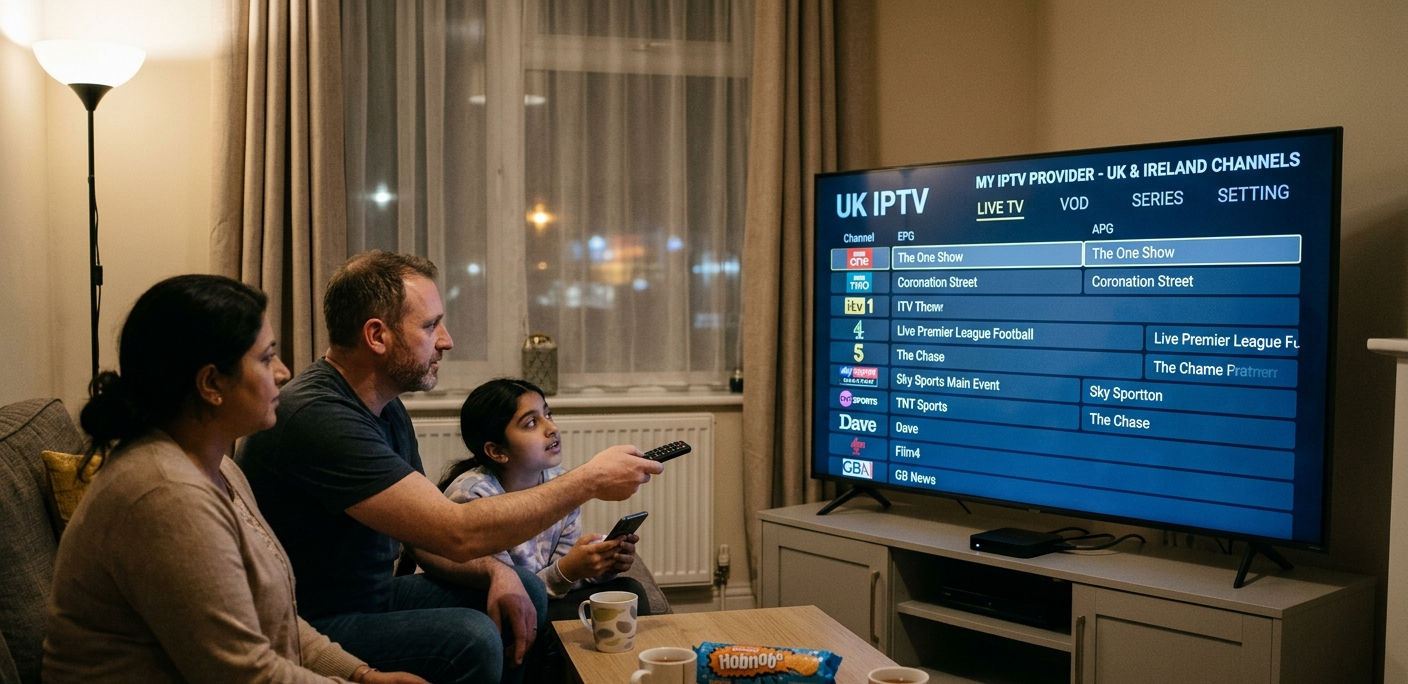
I remember the exact date because it was during a mid-week European fixture, the kind of match where half your subscriber base is watching simultaneously and the other half are checking in periodically just to make sure things are working.
She rang, didn’t message. That was the first sign it was serious. Eight months of smooth payments, zero complaints, always renewed early. And now she was telling me her stream had frozen four times in the last hour, her husband had given up and gone to bed, and she wanted a refund for the month. Not a credit. A refund.
I gave it to her without argument. What I couldn’t give back was the trust. She never renewed.
Table of Contents
ToggleThat customer was my wake-up call about what UK IPTV actually demands from a IPTV reseller who’s serious about building something sustainable, not just flogging credits and hoping the provider holds up. The UK market is specific, unforgiving, and absolutely worth understanding properly before you invest significant time or money into it.
Why the UK IPTV Market Is Unlike Any Other
Spend five minutes in any IPTV reseller forum and you’ll find providers confidently offering “worldwide” packages that supposedly handle every market equally. In my experience, that claim almost always falls apart the moment you stress-test it against actual UK demand patterns.
The UK IPTV landscape has several characteristics that make it genuinely distinct. First, there’s the football calendar, specifically the Premier League, which generates demand spikes unlike anything in comparable markets. The 3pm Saturday blackout, a uniquely British broadcasting quirk that prevents domestic transmission of most early afternoon fixtures, creates a concentrated burst of IPTV demand at a very specific time every weekend from August through May.
Then there’s the expectation level. British customers, perhaps shaped by decades of reliable broadcast television, have a remarkably low tolerance for stream instability. A viewer in some markets will accept occasional buffering as part of the deal. Many UK customers will not. They want it to work like their television, instantly, consistently, without fuss.
For UK IPTV resellers, this means your provider’s infrastructure needs to be optimised specifically for British traffic patterns. Servers geographically proximate to the UK reduce latency. CDN nodes configured for concurrent load during peak windows matter. Anti-freeze protocols that can recover within a few seconds on standard fibre connections are non-negotiable.
Pro Tip: When evaluating any provider for the UK IPTV market, don’t just ask about overall uptime figures. Ask specifically about performance during Saturday afternoon windows. A provider who can’t answer that question with confidence is a provider who hasn’t been paying attention to the right metrics.
Breaking Down What “Reliable” Actually Means
This word gets used so loosely in the UK IPTV space that it’s almost lost meaning. Every provider on Telegram claims to be reliable. Let me give you a more useful framework.
Reliability, properly understood, has three components: uptime consistency, peak load performance, and recovery speed.
Uptime consistency is what most people mean when they say reliable, the percentage of time the service is actually accessible. For a UK IPTV subscription service to be genuinely viable as a business, you need a provider sustaining 99.3% or above on a rolling 30-day basis. Below that, your refund rate starts climbing faster than your margins can absorb.
Peak load performance is separate and arguably more important in the UK context. A panel that delivers 99.5% uptime measured across all hours looks excellent, until you discover it achieves that figure by performing brilliantly at 3am and collapsing under demand during Saturday lunchtime. Averaged uptime statistics can mask catastrophic peak-hour failures.
Recovery speed is how quickly the system restores normal service after a stream dropout. This is where anti-freeze technology earns its keep. A properly implemented anti-freeze system buffers stream data continuously, so a two or three second network hiccup becomes invisible to the viewer rather than a frozen screen requiring manual restart.
The honest way to score a provider weights peak hours more heavily than off-peak hours, then multiplies that blended figure by a recovery speed factor. Averaged uptime alone hides too much.
How I Vet Providers Now
After losing that customer, and frankly after losing several more before I tightened my approach, I developed a vetting process that I run without exception before committing meaningful credit purchases to any UK IPTV provider.
First, I request a trial line and test it across multiple devices simultaneously. MAG box, Android device running STBEmu, and a smart TV application, all running concurrently. If a provider’s infrastructure struggles with three simultaneous streams on a trial account, imagine what happens at scale.
Second, I test during a live event. Not a recorded stream, not a quiet Tuesday evening. A live fixture with significant UK viewership. The difference in server behaviour between recorded and live content is substantial, live streams require constant transcoding and put real pressure on CDN distribution in ways that replayed content simply doesn’t replicate.
Third, I ask explicit questions about overselling. How many total active connections does their infrastructure support? How many reseller accounts are drawing from that shared infrastructure? The calculation isn’t complicated: your safe credit purchase volume is roughly the provider’s total capacity divided by their number of active resellers, multiplied by 0.7.
That 0.7 buffer accounts for the reality that everyone’s peak hours overlap. A provider who won’t answer this question directly is a provider who knows the answer is uncomfortable.
Pro Tip: Run your trial vetting during a weekend with at least two Premier League fixtures. If you’re evaluating a provider during an international break when domestic football is quieter, you’re testing them under atypically low demand, which tells you almost nothing useful about their performance when you actually need them.
Building a Subscriber Base That Doesn’t Churn
The UK IPTV reseller space has a churn problem that people don’t talk about honestly enough. Monthly subscriber turnover rates of 15-25% are common among resellers who haven’t invested in the customer relationship side of the business. That level of churn means you’re essentially running a treadmill, constantly acquiring new customers just to replace the ones walking out.
Reducing churn in the UK IPTV market comes down to three things: consistent stream quality, responsive communication, and appropriate expectation setting from the beginning.
That last point is one I underestimated when I first started. IPTV is not a guaranteed broadcast service. There will occasionally be brief disruptions, particularly during exceptionally high-demand events. Customers who understand this before they subscribe are dramatically more patient when it happens than customers who were sold a promise of perfection.
The resellers I’ve seen build genuinely stable, growing businesses in the UK market are the ones who treat their subscriber base like a relationship rather than a transaction. They communicate proactively when issues occur. They don’t wait for customers to notice, they message first, acknowledge the problem, and provide a timeline.
That approach costs time. It pays back in retention rates that make the maths of running a UK IPTV business actually sustainable.
The Pricing Problem Most UK IPTV Resellers Get Wrong
There is a segment of the UK IPTV market engaged in a race to the bottom on pricing that I find genuinely baffling from a business perspective. Resellers undercutting each other to offer the cheapest monthly rate, apparently without working out whether those rates actually generate viable margins after credits, support time, and inevitable refunds are accounted for.
The sustainable pricing model for UK IPTV isn’t built around being cheapest. It’s built around being most reliable. A customer paying £12 per month for a service that never fails is not shopping around for an £8 alternative. A customer paying £8 for a service that buffers every Saturday absolutely is.
Your minimum viable price is roughly your credit cost, support time value, and refund provision combined, divided by your active subscribers, then multiplied by 1.35. That 1.35 multiplier represents a 35% margin target, modest, but enough to absorb the operational realities of running a UK IPTV reseller business without haemorrhaging money every time a provider has a difficult weekend.
Pro Tip: Calculate your effective hourly rate from your IPTV business every three months. Include all support time, not just the obvious tasks. Most resellers who claim to be making good money are surprised to discover what their actual hourly return looks like when support overhead is properly accounted for. It either confirms you’re pricing correctly or tells you something urgently needs to change.
Legal Awareness: What Every UK Reseller Should Understand
This section exists because I’d be doing you a disservice by not including it. The UK IPTV reseller space operates in legally complex territory. The distribution of subscription access to streams that include copyrighted content without appropriate licensing is an area that UK regulatory and legal bodies have become increasingly active around.
I’m not a solicitor and this isn’t legal advice. What I will say is that operating without understanding the landscape is a risk that serious operators take seriously. Staying informed about developments in UK digital law, understanding what responsible operation looks like, and making informed decisions about how you structure your activity are not optional considerations for anyone building something they intend to last.
Why Infrastructure Is the Real Competitive Edge
Everything I’ve described in this article points towards one central conclusion: in the UK IPTV market, infrastructure quality is the competitive advantage that actually matters. Not the lowest price. Not the most aggressive marketing. The service that works on Saturday afternoon when everyone else’s doesn’t.
britishseller.co.uk has built its proposition specifically around the UK IPTV reseller context, which means the infrastructure decisions, the credit structures, and the support responsiveness are calibrated for British demand patterns rather than adapted from a template designed elsewhere. For resellers who’ve cycled through providers and are tired of discovering their weaknesses at the worst possible moment, it’s worth a serious look.
Trial it during a live match. Make your judgment based on that.
IPTV Reseller Success Checklist
- Vet providers specifically against UK peak demand. General uptime figures are insufficient, test during Premier League windows and judge performance accordingly.
- Weight your pricing for sustainability, not market competition. Calculate your true cost per subscriber including support time before setting any price point.
- Set honest expectations with customers before they subscribe. Customers who understand IPTV’s occasional limitations are dramatically more loyal than those sold impossible guarantees.
- Communicate proactively when issues occur. Message customers before they message you. The perception of being in control of a problem is almost as valuable as actually solving it quickly.
- Reassess your provider every quarter. The UK IPTV infrastructure landscape shifts. A provider who was excellent six months ago may have oversold capacity since then, regular performance reviews protect your subscriber base.