The Client I Lost, and What It Taught Me About Reselling IPTV
Becoming a profitable reseller for IPTV comes down to three things: understanding the credit and margin economics, picking a panel provider with genuine UK infrastructure, and knowing enough about the technical side to actually support your clients. Skip any one of those and you won’t last long, as I found out the hard way.
The first client I ever lost wasn’t because of buffering. It wasn’t a server crash, a frozen stream, or even a billing dispute. I lost him because I couldn’t answer a single technical question he asked during the setup call. He wanted to know why his MAG box kept throwing an authentication error, and I sat there in silence, frantically Googling while pretending to “check the backend.”
He never came back. And honestly, fair enough.
That moment was the turning point for me as a reseller for IPTV. I realised that selling subscriptions is the easy part, anyone with a panel login and a WhatsApp account can do that. What separates the resellers who build sustainable income from those who flame out inside three months is knowledge, infrastructure, and choosing the right foundation from day one.
Table of Contents
ToggleThis guide covers all three. No fluff, no recycled advice from forums. Just what I’ve learned from actually running this thing in the UK market.
What Does It Actually Mean to Be a Reseller for IPTV?
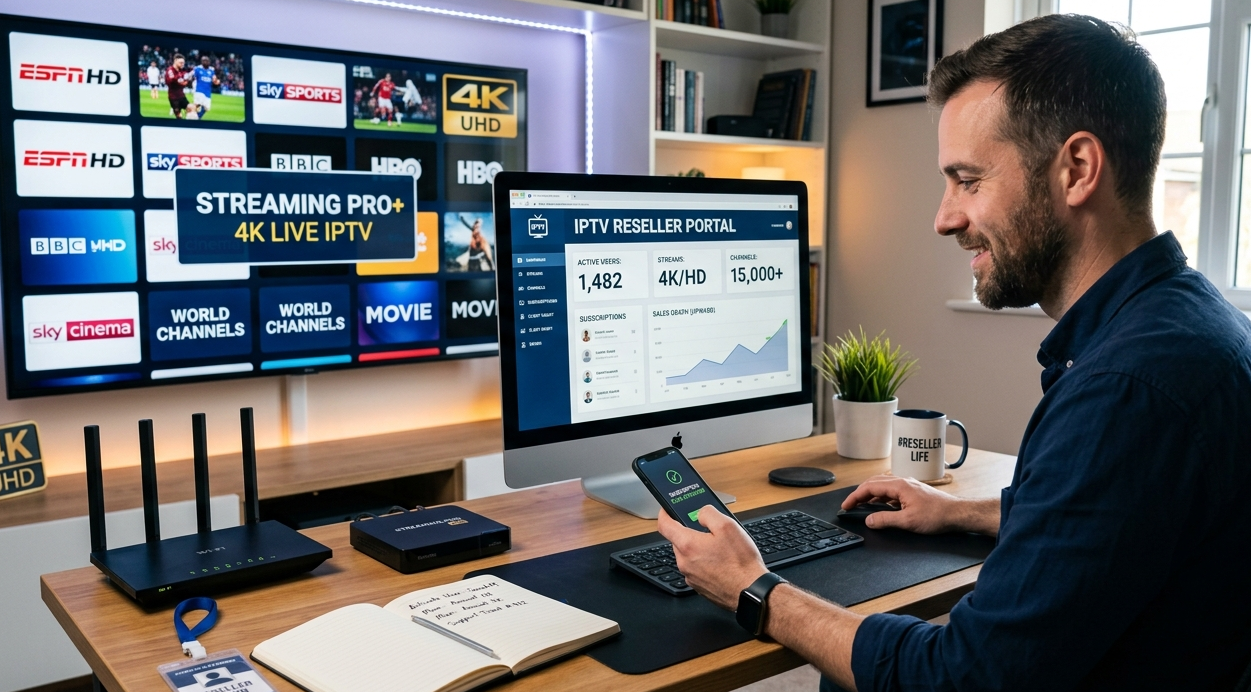
Being a reseller for IPTV means you sit in the middle layer of the distribution chain. You’re not building servers, encoding streams, or managing content libraries. You’re purchasing access, in the form of credits, from a panel provider, and using those credits to create subscription lines for end clients.
Your clients connect their devices, Firestick, MAG box, Android box, STBEmu, IPTV Smarters Pro, to the stream using either an M3U playlist URL or Xtream Codes credentials. You manage their accounts through a panel dashboard: setting expiry dates, adjusting connection limits, checking who’s active, and handling renewals.
The business model is clean. Low overhead, no physical product, recurring revenue. But none of that matters if the streams are unstable or the panel you’re using is held together with hope and a prayer.
Pro Tip: Before you approach a single potential client, spend at least two weeks using the service yourself across multiple devices and during peak hours, particularly Saturday and Sunday afternoons during the football season. What you experience as a user is exactly what your clients will experience.
Credits, Lines, and Margins: How the Money Actually Works
Credits are the unit of currency in the reseller world. You buy them in bulk from your panel provider, and you spend them to activate subscription lines. The standard model is one credit per month per connection, so a 12-month single-connection line costs 12 credits.
Your margin is the difference between what you pay per credit and what you charge the client per month, multiplied across your active subscriber base.
Here’s the core formula I use to evaluate any new panel deal:
Monthly Net Profit = (Active Lines × Avg. Sub Price) − (Monthly Credits Used × Cost Per Credit) − Overheads
Let’s put real numbers to it. If you’re buying credits at £0.65 each and selling 6-month packages at £35, your gross per subscriber is approximately:
Credits used: 6 × £0.65 = £3.90
Revenue: £35.00
Gross margin per subscriber: £31.10
At 80 active subscribers, that’s roughly £2,488 gross per six-month cycle, before any costs for payment processing, marketing, or support tools. Not bad for a side operation. Scale to 200 subscribers and you’re looking at a serious income stream.
The key variable is churn. Every client who leaves before renewal eats into those margins. Keep churn below 15% monthly and the numbers work in your favour. Push above that and you’re on a treadmill.
The One Decision That Determines Whether You Survive as a Reseller
I cannot overstate this. The panel provider you choose is the single most consequential decision you’ll make as a reseller for IPTV. Everything else, your pricing, your marketing, your customer service, is downstream of this one choice.
Here’s what I evaluate before committing to any provider:
Infrastructure and Server Location
UK clients expect low latency. Streams delivered through UK-based or UK-optimised CDN nodes will always outperform those routed from distant servers, especially during concurrent load spikes on Premier League matchdays. Ask your provider specifically whether they have UK server presence. If they can’t give you a straight answer, walk away.
Anti-Freeze and Failover
These are non-negotiable in 2026. Anti-freeze buffers the stream slightly to absorb minor packet loss without visible interruption on the client’s screen. Failover automatically redirects to a backup stream source if the primary goes down. A provider without both is selling you a liability, not a product.
Credit Flexibility
Look for providers who offer bulk credit pricing without aggressive expiry conditions. Credits that expire in 30 or 60 days will burn you if your subscriber growth is gradual, and it usually is at the start.
Support Quality
Test it before you buy. Send a message at 9pm on a Friday. If you get a useful response within an hour, that’s a provider who understands the IPTV business, because that’s exactly when problems happen. If you’re waiting until Monday, find someone else.
Pro Tip: Never rely solely on Telegram support groups for provider recommendations. Many recommendations in those groups are affiliate-driven. Find resellers who’ve been operating for over a year and ask them privately what they’ve stuck with, and why.
Technical Foundations Every Reseller Must Understand
You don’t need to be a network engineer. But you do need to understand enough to troubleshoot basic issues, explain what’s happening to clients, and spot when a provider is feeding you nonsense.
M3U vs Xtream Codes: M3U is a playlist file format that can be loaded into most IPTV players. Xtream Codes is a login-based system (server URL, username, password) that’s more stable and harder to share unauthorised. For UK clients using TiviMate or IPTV Smarters Pro, Xtream Codes is the preferred delivery method.
EPG (Electronic Programme Guide): this is the TV guide overlay your clients see when browsing channels. A poor or missing EPG generates more support tickets than almost anything else. Confirm EPG quality before signing up, test it on a Firestick and on a MAG box, as rendering differs between devices.
Concurrent Connections: every line you create has a connection limit, typically one or two. If a client tries to connect a third device simultaneously, they’ll get an authentication error. This is by design, but clients need to understand it upfront or they’ll raise support tickets every time it happens.
Bandwidth and Stability: a full HD stream typically requires 10 to 25 Mbps of stable throughput. 4K streams can push 50 Mbps or higher. Your clients need sufficient home broadband for this, if someone is on a congested ADSL connection, no IPTV panel on earth will save them from buffering.
Pro Tip: Create a simple one-page setup guide for new clients covering device setup, EPG loading, connection limits, and basic troubleshooting steps. It takes 30 minutes to write and saves you hours of support messages every month.
Growing a UK Client Base the Smart, Quiet Way
The UK IPTV market is lucrative but not without legal grey areas. I’m not going to pretend otherwise. What I will say is that the resellers who operate longest are those who are discreet, professional, and who don’t make loud public claims about their service.
Word of mouth is the most sustainable acquisition channel in this business. One satisfied client in a group of mates generates referrals. Focus your energy on delivering exceptional service to your initial 20 to 30 subscribers, and growth tends to follow naturally.
Avoid mass advertising on public platforms. Keep your operation lean, professional, and referral-led. That’s not just common sense, it’s how the most profitable UK IPTV resellers I know have operated for years without incident.
Scaling From 20 to 200 Subscribers
The jump from 20 to 200 is where most IPTV UK resellers either consolidate into a proper business or collapse under the operational weight.
At 20 subscribers, you can manage everything manually, renewals, support, account creation. At 100+, you cannot. Here’s what I put in place before I hit 80 subscribers: a dedicated support channel, not your personal WhatsApp but a separate business number or app, plus automated renewal reminders sent seven days and two days before expiry. A clear refund policy communicated at the point of sale. And critically, a backup panel provider with credits already loaded, ready to activate if my primary goes down.
That last point matters more than anything else at scale. A single provider outage across 150 active subscribers is a customer service catastrophe. Having a backup you can migrate clients to within 30 minutes is the difference between a rough evening and a business-ending event.
The Panel I Use and Why
After going through three different panel providers in my first year, including one who vanished with a month’s worth of credits and another whose streams collapsed every Saturday, I’ve been with britishseller.co.uk for long enough to trust it.
The infrastructure handles UK peak demand without breaking a sweat. Anti-freeze and failover are standard. The credit system is straightforward and bulk pricing is fair. Most importantly, support is responsive at the times that actually matter, evenings and weekends, when your clients are watching and problems surface.
I’m not telling you it’s perfect, because nothing in this industry is. What I’m telling you is that it’s solid, consistent, and built for the UK market, which is more than I can say for most of what I tested before it.
If you’re starting out or looking to switch panels, it’s the place I’d point you first.
IPTV Reseller Success Checklist
- Test your panel for a minimum of two weeks before onboarding clients, across multiple devices, during live football, and at weekend peak hours.
- Know your credit costs and subscriber pricing before you sell a single line, run the profit formula and understand your break-even point.
- Confirm UK server presence, CDN delivery, anti-freeze, and failover with your provider before committing, get specifics, not marketing language.
- Set up a separate support channel and written renewal/refund policy before you hit 30 subscribers, doing it retroactively is chaotic.
- Load credits on a backup panel before you need it, because the night your primary goes down will always be a Saturday, always be during a big match, and always be the worst possible time to be scrambling for alternatives