IPTV vs Cable TV for Football Fans in 2026
A neighbour of mine missed the winning goal in a cup final last spring. Not because his service crashed. Because his cable feed ran roughly eight seconds behind the pub across the street, and he heard the whole street roar before his own screen caught up. That delay is the part nobody puts on a billboard, and it tells you almost everything about where live sport is heading.
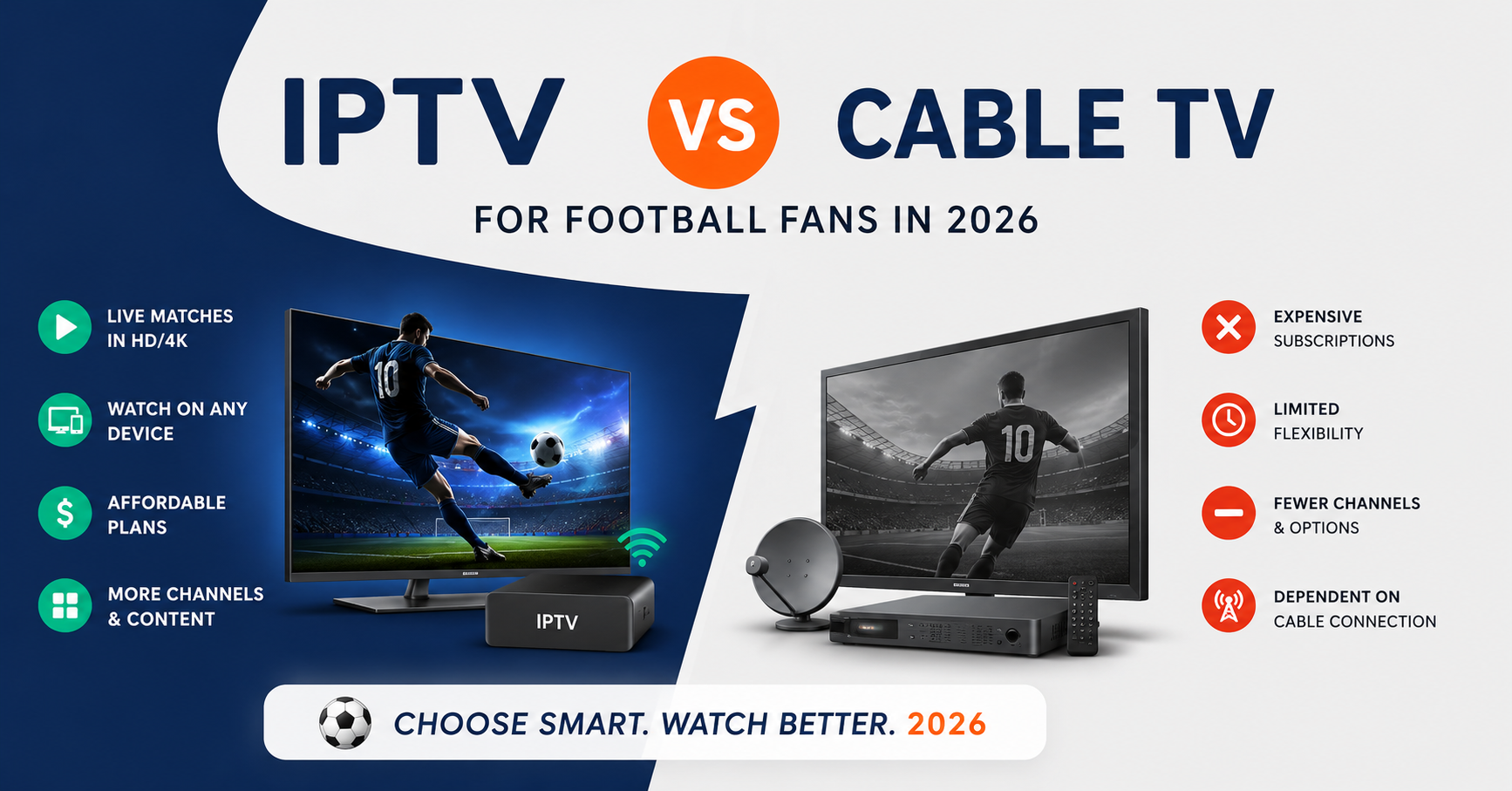
So here is the short answer before I bury you in detail. For football fans in 2026, IPTV usually wins on price, channel choice and the sheer number of matches you can reach in one place. Cable still wins on raw stability during the biggest broadcast events, and on never having to think about your internet connection. If your home broadband is solid and you watch a lot of football across different leagues, IPTV is the smarter spend. If you have shaky internet or you only want the two or three channels your national broadcaster carries, cable earns its keep.
The cause of most disappointment in this debate is not the technology. It is mismatched expectations. People compare a cheap IPTV stream on weak WiFi against a premium cable box and conclude one is broken. The honest comparison is harder, and that is what the rest of this article is for.
What Actually Travels Down The Wire
Cable television sends every channel to your home at once as a broadcast signal. Your box simply tunes to the one you want. Nothing is requested, nothing is fetched. That is why cable feels instant and why it almost never stutters during a packed Saturday fixture list. The signal does not care how many neighbours are watching.
IPTV works the opposite way. Each stream is delivered over the internet as data, usually chopped into small segments using HLS, and reassembled by your player. This is flexible and cheap to scale, but it introduces something cable does not have: latency, the gap between the live event and your screen. Well run IPTV keeps that gap small. Poorly run IPTV lets it drift, and on a goal that is the difference between celebrating with everyone else and celebrating alone.
Pro Tip:
If your IPTV feed is more than ten seconds behind live during big matches, the problem is rarely your internet. It is usually the provider running a single overloaded source with no proper segment buffering. Test a different channel on the same service. If only sport lags, it is their infrastructure, not your line.
The Cost Difference Nobody Breaks Down Honestly
Most comparisons stop at the monthly price. That misses where the money actually goes. Cable bundles charge you for hundreds of channels you will never open, plus equipment rental, plus the sports add on that always seems to cost extra precisely when the season starts.
| Typical Cable Setup | Typical IPTV Setup |
|---|---|
| Base bundle plus sports tier | Single subscription, sport included |
| Box rental monthly fee | Use your own device |
| Locked twelve month contract | Often month to month or yearly |
| One or two regional broadcasters | Multiple countries and leagues |
| Installation appointment needed | Active within minutes |
A football fan who wants Premier League, La Liga, Serie A and the odd international fixture will pay a premium on cable to stitch those together, often across more than one provider. IPTV tends to collapse all of that into one bill. That is the genuine saving, not the headline number.
Why Reliability Is Not As Simple As Cable Wins
I have watched people repeat that cable is always more reliable as if it were a law of physics. It is not. Cable is more consistent in the home because the signal is already there. But cable is also at the mercy of the broadcaster’s own rights and regional blackouts, which is why fans regularly find their team’s match simply unavailable on a service they are paying for.
IPTV’s reliability is a different shape. It depends on the operator’s back end: how many sources they run, whether they have automatic failover, whether they balance load when a hundred thousand people log on at kickoff. A serious provider with backup uplinks and active monitoring can stay up through a final that buckles a weaker rival. A cheap one will freeze on the half hour mark every time. The variance is the point. Cable gives you a predictable floor. IPTV gives you a higher ceiling but a wider range.
The Sports Traffic Spike Problem
Here is something we noticed during a major tournament a couple of years back. ISP behaviour changes during huge matches. Traffic engineering kicks in, some providers throttle video heavy connections during peak hours, and routes that were fast at noon become congested by evening kickoff. Cable sidesteps this entirely because it does not ride your internet connection. IPTV lives or dies by it.
This is also where the gap between a hobbyist provider and a real operator becomes brutal. During one international fixture, we watched a single source service collapse under load while a multi source setup with proper geo routing barely registered the spike. Same match, same evening, completely different experience for the customer.
Pro Tip:
Before a tournament, run a streaming test at the actual time you will watch, not in the quiet afternoon. Peak hour throttling is invisible until everyone is online at once. If your provider buffers only at 8pm on match nights, you have found your real reliability problem.
For Anyone Thinking About Reselling, Not Just Watching
There is a second audience reading this. Plenty of football fans eventually wonder whether the thing they pay for monthly could become something they sell. The IPTV reseller market exists precisely because demand for live sport outstrips what traditional broadcasters offer in one place.
If that is you, understand what you are actually buying into. A reseller does not own the infrastructure. A UK IPTV reseller buys panel credits from a panel owner and resells access, usually through a reseller panel that handles customer creation, renewals and credit allocation. The credit reseller model lets you start small. The sub reseller model lets you build a small distribution network under you. None of it works, though, if the underlying IPTV operator runs weak infrastructure, because every outage lands on your customers and your reputation.
The IPTV reseller business looks simple from outside and gets complicated fast. A good IPTV reseller panel gives you control over your customer base. A bad one gives you support tickets at midnight during a cup final. After reviewing hundreds of reseller complaints over the years, the pattern is always the same: people choose a panel owner on price, then discover during the first big match why the cheap IPTV management platform was cheap.
What Support Tickets Reveal About The Real Difference
You learn more about a service from its complaints than its marketing. Cable complaints cluster around billing, contracts and blackouts. IPTV complaints cluster around buffering, app setup and match day freezes. Notice that cable’s problems are commercial and IPTV’s problems are technical. That distinction matters when you choose.
A mistake we repeatedly see is fans blaming the IPTV service for what is actually a device or network issue. An old streaming stick with limited memory will choke on a high bitrate football feed that a modern box handles fine. Weak WiFi two rooms from the router will stutter regardless of how good the provider is. The service gets the blame, the router deserves it.
Pro Tip:
For live football specifically, a wired connection to your player beats premium WiFi nearly every time. One IPTV reseller cut his customers’ match day complaints noticeably just by sending a single setup message recommending an ethernet cable for sport. The fix cost nothing and saved the relationship.
Device And Setup Realities
Cable hands you a box and walks away. IPTV asks you to choose, and that freedom confuses newcomers. The same subscription can run on a phone, a smart TV app, a dedicated box, or a player like a third party app on an Android device. Each behaves slightly differently on a fast football stream.
A short, honest device ranking for live sport:
- Dedicated Android box on ethernet: most reliable for high bitrate matches
- Modern smart TV app on strong WiFi: good, occasionally fussy with updates
- Streaming stick: fine for casual viewing, strains on peak quality sport
- Phone or tablet: convenient, never your main match day screen
The lesson is that IPTV quality is a chain. Provider, internet, device and player all have to hold. Cable only asks the box to hold. That is the trade you are making.
The 2026 Picture: Blocking, AI And The Arms Race
The landscape has shifted. ISPs and rights holders now lean on AI driven traffic fingerprinting and more aggressive DNS poisoning to disrupt unofficial streams, especially around marquee fixtures. This is why serious operators in 2026 run multi uplink redundancy and rotate DNS routing rather than relying on a single path. Cable obviously avoids this whole fight, since it is the official broadcast pipe.
For the everyday fan, the practical takeaway is simple. The quality gap between a professionally run IPTV service and a cheap one is wider in 2026 than it has ever been, precisely because the cheap ones cannot keep up with the blocking arms race. The middle has hollowed out. You now get genuinely excellent or genuinely frustrating, with less in between.
Frequently Asked Questions
Is IPTV vs Cable TV really a fair comparison for live football?
Yes, but only when you compare like for like. A well run IPTV service against premium cable is a close contest, with IPTV ahead on cost and choice and cable ahead on raw consistency. A cheap stream against premium cable is not a fair fight, which is where most of the confusion in the IPTV vs Cable TV debate comes from.
Does IPTV vs Cable TV matter more for some leagues than others?
It does. Cable often carries only your national broadcaster’s matches, so foreign leagues and international fixtures are where IPTV vs Cable TV tilts hardest toward IPTV. If you only follow one domestic competition, cable may cover you. Follow multiple leagues and the gap widens fast.
Why does my football stream lag behind real time?
Latency comes from how IPTV segments and delivers data. A small delay is normal and fine. A large one usually means the provider is running an overloaded single source without proper buffering. Test another channel; if only sport lags, the infrastructure is the cause, not your connection.
Is IPTV cheaper than cable for a serious football fan?
Usually, yes. Cable charges for bundles, box rental and separate sports tiers, and often needs more than one provider to cover several leagues. IPTV tends to fold everything into one subscription, which is where the real saving sits rather than in the advertised monthly figure.
Can I make money as an IPTV reseller from football demand?
You can, but it depends entirely on the IPTV operator behind your IPTV reseller panel. A credit reseller buys panel credits and resells access; a sub reseller builds a network underneath. The model works only if the panel owner runs strong infrastructure, because every match day outage becomes your problem.
What makes a good IPTV reseller panel for sports customers?
Stability first. A good IPTV reseller panel sits on infrastructure with failover, load balancing and active monitoring, so it survives the kickoff traffic spike. Customer management tools, clean credit allocation and fast renewals matter too, but none of it helps if the streams freeze when the IPTV business owner needs them most.
Will cable disappear because of IPTV?
Not soon. Cable keeps a loyal base who value never thinking about their internet, and it stays immune to the DNS poisoning and blocking that affect unofficial streams. The two are likely to coexist for years, serving different priorities rather than one simply replacing the other.
Does internet speed alone decide IPTV quality?
No. Speed matters, but stability, your device, the player and the provider’s back end all matter as much. A modest stable connection on a wired box often beats a fast but congested one on weak WiFi, especially during peak match day traffic.
Action Checklist For Subscribers
- Test your stream at the exact time you watch football, not in quiet hours
- Use a wired connection to your player for live matches where possible
- Match your device to your bitrate; retire old streaming sticks for sport
- Confirm your provider covers every league you actually follow before paying
- Keep your national broadcaster as a backup for blackout affected fixtures
Action Checklist For Resellers
- Choose your panel owner on infrastructure quality, not on cheapest panel credits
- Confirm the reseller panel has failover and load balancing before match season
- Send new customers a one line ethernet recommendation to cut match day tickets
- Track which complaints spike during big games to spot infrastructure weakness
- Keep a small credit buffer so you can onboard fast during tournament demand
Action Checklist For Sub Resellers
- Verify the IPTV reseller above you runs stable sources before building under them
- Set clear renewal reminders so customers do not lapse mid season
- Test every server you resell during a real peak kickoff, not in testing
- Document your support responses so common football issues resolve in minutes
- Grow your distribution network gradually; never outpace your support capacity
The Verdict For 2026
Strip away the noise and the IPTV vs Cable TV decision for football fans comes down to two questions. How reliable is your home internet, and how many leagues do you actually watch. Strong broadband and a hunger for matches across competitions point clearly to IPTV, where one subscription replaces a stack of cable add ons. Patchy internet and a single domestic league point to cable, where the signal is simply already in the wall.
What has changed in 2026 is the stakes. The blocking arms race has widened the gap between professional and amateur IPTV, so the choice is less about IPTV vs Cable TV in the abstract and more about which specific operator you trust with your match day. A well run service from a serious provider like britishseller.co.uk behaves nothing like a cheap stream, and that distinction now matters more than the old IPTV vs Cable TV argument ever did. Choose the infrastructure, not the slogan, and your football weekends sort themselves out.
The single most useful lesson here is that reliability lives in the back end you cannot see, not the price you can. Whether you watch or resell, judge any football service by how it behaves at kickoff during the biggest match of the season, because that is the only test that ever told the truth.