
I had 60 active lines. Money was coming in. Then my upstream supplier vanished — no warning, no refund, no response. Every single one of those lines went dead simultaneously. I had no backup panel, no redundancy, and no real understanding of the infrastructure chain sitting beneath my business.
That was the moment I stopped treating IPTV reselling as a passive income stream and started treating it like the operational business it actually is. If you’re asking how IPTV reseller works — truly works, at the infrastructure level — this guide How IPTV Reseller Works will give you the answer I wish someone had given me before that night.
How IPTV Reseller Works: The Credit-Based Panel Model Explained
At its core, the IPTV reseller model operates on a credit system. You purchase a block of credits from a panel provider. Each credit typically activates one subscription line for one month. You sell that line to an end customer at a marked-up price. The difference between your credit cost and your selling price is your gross margin — before accounting for churn, support overhead, and infrastructure costs.
In How IPTV Reseller Works The panel itself is the operational hub of your entire business. It’s where you create lines, assign packages, monitor connection status, and manage renewals. A well-built reseller panel gives you full visibility over every active subscription — connection logs, device type, last-seen timestamps, and bandwidth consumption per line.
What most new resellers don’t realise is that the panel is also where your risk concentrates. If your panel provider has poor upstream infrastructure, every one of your customers feels it simultaneously. Understanding how IPTV reseller works means understanding that your reputation is entirely downstream of someone else’s server decisions — unless you choose your panel platform with the same rigour you’d apply to any critical business dependency.
Panels Prime operates on exactly this model, with a panel architecture designed for resellers who need reliability at scale, not just a cheap credit bundle.
The Upstream Chain: What Actually Sits Above Your Panel
Pro Tip: Most resellers see only their panel dashboard. The smartest ones map the full upstream chain — content origin, CDN layer, panel middleware, and ISP delivery path — before they commit to any supplier. One weak link anywhere in that chain becomes your support ticket at 3PM on a Saturday.
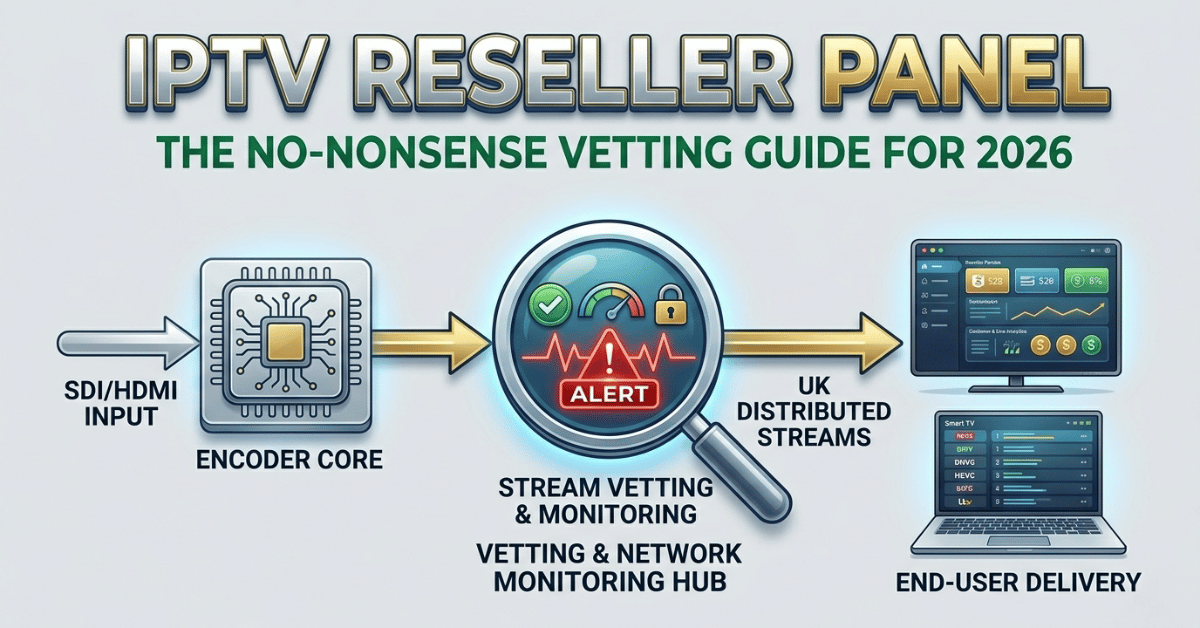
Understanding how IPTV reseller works at a deeper level requires mapping the infrastructure layers above your panel:
- Origin Servers — Where the stream content is encoded and first distributed. UK-based 10Gbps+ uplink servers at this layer are critical for low-latency delivery to British households on FTTP connections.
- CDN / Edge Layer — Content delivery nodes that cache and distribute streams geographically. Quality CDN architecture reduces HLS latency and prevents buffer-bloat during concurrent load spikes.
- Panel Middleware — The software layer your reseller dashboard sits on. This handles authentication, line validation, and connection management.
- ISP Delivery Path — The final mile between your customer’s router and the stream. In 2026, AI-driven ISP traffic shaping algorithms actively profile this path for streaming signatures.
Every layer introduces a potential failure point. The resellers who scale successfully are the ones who understand which layers they control, which they depend on, and how to mitigate risk at each level.
How IPTV Reseller Profit Actually Calculates — The Real Formula
Before you scale, you need to understand your actual unit economics. Most resellers calculate profit as simply (selling price minus credit cost). That number is dangerously misleading.
True Reseller Profitability Formula:
TPM=(P−C)×L−(CR×L×P)−STPM = (P – C) \times L – (CR \times L \times P) – S
Where:
- TPM = True Profit per Month
- P = Price charged per line per month
- C = Credit cost per line
- L = Total active lines
- CR = Monthly churn rate (as decimal, e.g. 0.12 for 12%)
- S = Monthly support and operational overhead cost
When you run this formula honestly — including a realistic churn rate — many resellers discover their actual margins are 30–40% lower than their headline numbers suggest. A subscription sold at £8/month with a £2 credit cost looks like £6 profit. Factor in 15% monthly churn and a £50/month support overhead across 50 lines, and the picture changes considerably.
This is why reducing churn through infrastructure quality is a direct profit lever — not just a customer service nicety.
Why IPTV Reseller Churn Psychology Is More Dangerous Than Technical Failures
| Churn Trigger | Reseller Perception | Customer Reality |
|---|---|---|
| Single buffering event during peak | “Minor technical issue” | “Service doesn’t work — cancelling” |
| Stream down for 20 minutes | “Resolved quickly” | “Already asked for refund” |
| Slow channel switch time | “Not my infrastructure” | “Cheaper alternative looks better” |
| No response to support query | “Busy period” | “Never using this again” |
Understanding how IPTV reseller works at the customer psychology level is just as important as the technical architecture. UK customers — particularly those paying for premium sports coverage — have a zero-tolerance threshold for failure during high-value events.
In How IPTV Reseller Works The data is consistent across operators I’ve spoken to: a single bad experience during a major fixture causes an immediate cancellation rate of 20–35% in the affected customer cohort. Those customers rarely return, and they frequently share negative feedback in the same communities where you’re acquiring new subscribers.
The practical implication is straightforward — every pound invested in upstream infrastructure quality returns multiples in reduced acquisition cost, because you’re retaining customers instead of constantly replacing them.
How IPTV Reseller Scaling Works: The Sub-Reseller Tier Advantage
Pro Tip: The fastest-growing How IPTV Reseller Works operations don’t scale by selling more lines directly — they scale by recruiting sub-resellers who each manage their own customer base. Your job becomes credit management and infrastructure oversight, not individual customer support.
Once you understand how IPTV reseller works at the unit level, the next growth stage is building a distribution tier beneath you. A sub-reseller structure allows you to:
- Wholesale credits to trusted sub-resellers at a margin above your cost
- Remove yourself from day-to-day customer support entirely
- Scale active lines without proportionally scaling your own workload
- Build a recurring revenue stream that compounds monthly
The panel you operate on must natively support sub-reseller account creation, permission levels, and credit allocation controls. Without these features, managing multiple sub-resellers becomes an administrative burden that erodes the margin advantage.
Panels Prime supports multi-tier reseller hierarchies with granular permission controls, making it one of the few UK-focused platforms genuinely built for operators planning to scale beyond direct sales.
The 2026 ISP Blocking Reality Every IPTV Reseller Needs to Plan For
DNS poisoning has become the dominant enforcement mechanism deployed by UK ISPs in 2026. Unlike deep packet inspection — which requires significant computational overhead — DNS-level intervention is cheap, scalable, and increasingly automated using AI-driven domain reputation scoring.
What this means practically: stream delivery domains that appear on enforcement lists get poisoned at the ISP’s resolver level. Your customers on major UK ISPs type nothing wrong, click nothing wrong, and still get a dead stream — because the domain resolves to a blocked endpoint before the request ever reaches your panel.
Protecting your customer base requires two things. First, your panel platform must rotate delivery domains automatically rather than relying on static endpoints. Second, your customers need basic guidance on using non-ISP DNS resolvers — a one-page setup guide reduces this class of support ticket by a significant margin in my experience.
IPTV Reseller Success Checklist: 5 Execution Steps
Map your upstream chain — identify every infrastructure layer above your panel before committing credits to a new supplier
Run the TPM formula — calculate true monthly profit including churn rate before setting your pricing structure
Choose a panel with sub-reseller support — if you can’t delegate distribution, your growth ceiling is your own available hours
Build a DNS guidance document — send it to every new customer on onboarding to preempt the most common support ticket category
Set credit alert thresholds — never let your panel reach zero credits during peak hours; automate top-up notifications at 20% remaining balance
Panels Prime provides reseller panel management software. It does not host, store, or distribute media content. Resellers are solely responsible for ensuring their operations comply with applicable laws and regulations.