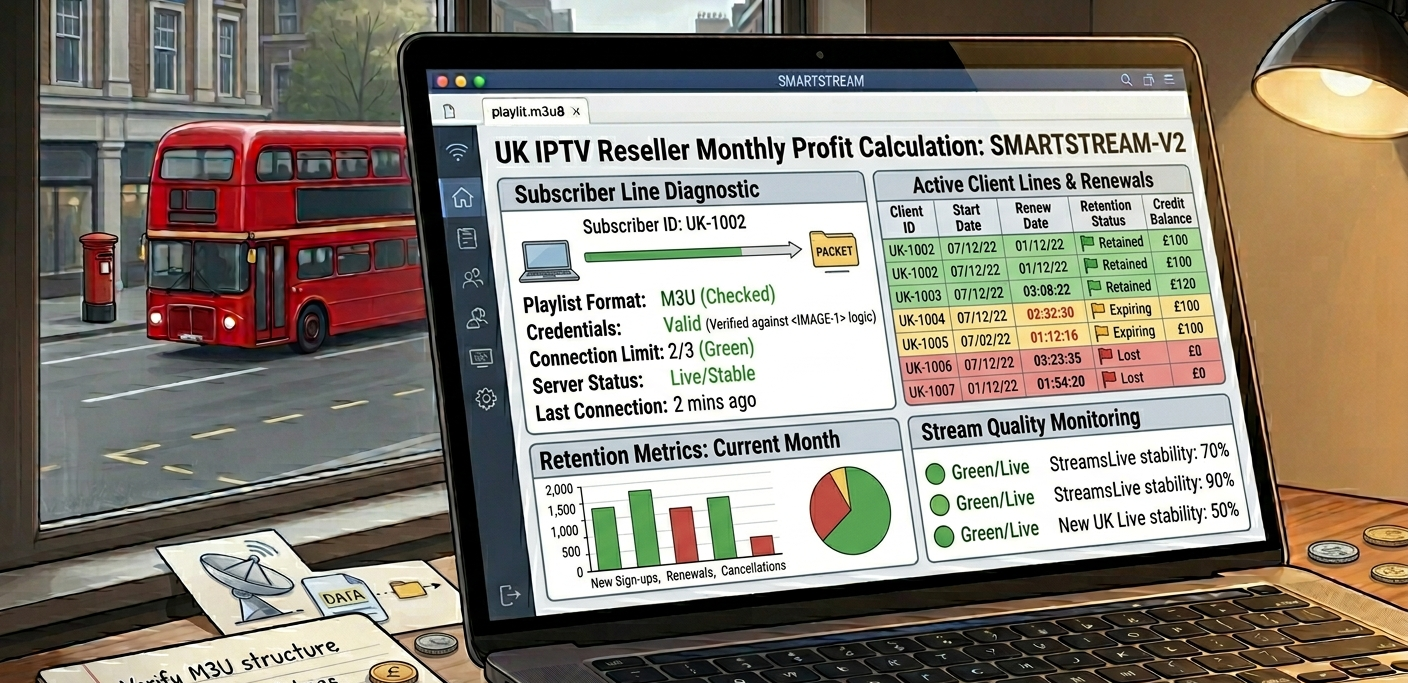
I had a customer base of eighty-three active UK IPTV subscription lines. Renewal month arrived. Forty-one of them didn’t renew. No complaints beforehand, no warning signs on the dashboard, no support tickets. Just silence — and then forty-one fewer direct debits. When I actually dug into the data, the pattern was brutal in its clarity: every non-renewal had experienced at least two buffering events during premium sports coverage in the preceding thirty days. Not hours of downtime. Two incidents. That was enough.
That month changed how I think about the UK IPTV subscription business entirely. Selling a line is the easy part. Retaining it through every fixture, every peak load event, and every ISP enforcement push — that is the actual business. Everything I’ve built since then has been engineered around that single insight: retention is the only metric that compounds.
Why UK IPTV Subscription Demand Patterns Are Unlike Any Other Market
The UK IPTV subscription market is structurally unique because demand is not evenly distributed across time. It clusters — hard — around live premium sports events, creating synchronised load spikes that expose infrastructure weaknesses in ways that no amount of off-peak testing will reveal. A panel that handles 200 concurrent lines on a Wednesday evening will behave completely differently when those same 200 customers all open the same premium sports stream at 12:30 on a Saturday.
This demand pattern is compounded by how the UK residential broadband landscape has evolved in 2026. FTTP rollout has given millions of UK households symmetrical gigabit connections. Customers are no longer bandwidth-constrained — they expect 4K HEVC stream quality as a baseline, not a premium. When your infrastructure delivers anything less during a high-stakes fixture, the cognitive comparison to a £50/month licensed alternative happens instantly and automatically. You are always one bad stream away from that comparison being made consciously.
Understanding this demand topology is the starting point for building a UK IPTV subscription business that retains customers rather than perpetually replacing them.
How UK IPTV Subscription Pricing Should Actually Be Structured
Pro Tip: Single-tier flat pricing is a retention trap. Customers who pay the same amount for a basic package as a power user paying for 4K and multi-screen feel no loyalty gradient — there’s no upgrade path that deepens their commitment to your service. Tiered pricing creates both margin expansion and psychological lock-in simultaneously.
Most resellers launch with a single price point and never revisit it. This is a structural mistake that limits both revenue per customer and retention psychology. A properly structured UK IPTV subscription pricing model operates across at least three tiers:
- Entry tier — SD/HD single connection, no VOD, lower monthly price. Designed to acquire price-sensitive customers with a pathway to upgrade.
- Standard tier — Full HD, VOD access, single connection. Your volume tier — where most customers will land and where your credit economics need to be tightest.
- Premium tier — 4K HEVC, multi-screen (2–3 connections), priority support response. Higher margin, higher retention — customers at this tier churn at roughly half the rate of entry-tier customers in my experience.
The credit arithmetic matters here. A premium-tier line may cost you 40% more in credits than a standard line, but if it retains for 14 months versus 6, the lifetime value calculation is not even close.
The Infrastructure Reality Behind a Stable UK IPTV Subscription
A UK IPTV subscription is only as stable as the weakest link in the delivery chain beneath it. In 2026, that weakest link is rarely the panel itself — it’s the upstream origin infrastructure and how it handles concurrent load from UK-specific demand spikes.
Concurrent Load Capacity Formula:
MaxCL=UplinkBWStreamBitrate×SafetyFactorMaxCL = \frac{UplinkBW}{StreamBitrate \times SafetyFactor}
Where:
- MaxCL = Maximum concurrent lines before degradation begins
- UplinkBW = Total available uplink bandwidth in Mbps
- StreamBitrate = Average bitrate per stream (HD ≈ 8Mbps, 4K HEVC ≈ 25Mbps)
- SafetyFactor = Overhead multiplier, typically 1.3–1.5 for production environments
Running this calculation against your panel’s actual uplink capacity tells you exactly how many concurrent streams your infrastructure can handle before buffer-bloat begins. Most resellers never run this number. They discover it the hard way during a peak event when customers start reporting issues simultaneously.
UK-based 10Gbps+ uplink servers dramatically shift this calculation in your favour — a 10Gbps uplink can theoretically support over 400 simultaneous 4K HEVC streams before reaching the safety threshold. That headroom is what separates professional-grade infrastructure from consumer-grade panel hosting.
ISP Blocking and the UK IPTV Subscription Delivery Risk in 2026
| Threat Type | Frequency in 2026 | Customer Visible Impact | Reseller Action Required |
|---|---|---|---|
| DNS Poisoning | High — AI-automated | Complete stream failure | Domain rotation + DNS guidance |
| Behavioural Traffic Shaping | Very High | Intermittent buffering | VPN recommendation at onboarding |
| IP Range Blocking | Moderate | Connection refused errors | CDN diversity + IP rotation |
| Deep Packet Inspection | Low but increasing | Selective throttling | Encrypted delivery paths |
| Court-Order Domain Blocks | Low | Site/panel access failure | Mirror domains + direct IP access |
The table above reflects the actual threat distribution I’m tracking across UK ISP enforcement activity in 2026. The critical insight here is that DNS poisoning and behavioural traffic shaping — both of which are now largely AI-automated by major UK ISPs — account for the overwhelming majority of customer-facing stream failures that resellers incorrectly attribute to panel or upstream problems.
Read More: IPTV Reseller Guide
A customer on a major UK ISP connection who is not using a VPN and not on a non-ISP DNS resolver is exposed to both of these threat categories simultaneously, every time they open their UK IPTV subscription. Addressing this at onboarding is not optional infrastructure advice — it is direct churn prevention.
Renewal Psychology: Why UK IPTV Subscription Customers Actually Cancel
[Image: IPTV Subscription Customer Lifecycle Churn Point Diagram] Alt text: UK IPTV subscription customer lifecycle showing key churn trigger points and retention interventions
Pro Tip: The highest-risk moment in any UK IPTV subscription lifecycle is not the first bad stream event — it’s the silence after it. Customers who experience a failure and receive no proactive communication from you will quietly cancel at renewal. A single WhatsApp or Telegram message acknowledging the issue and confirming resolution can recover 60–70% of those customers before they make the decision to leave.
Understanding churn psychology is as operationally important as understanding load balancing. The cancellation decision for a UK IPTV subscription customer rarely happens at the moment of failure — it happens later, during the low-emotion window when they’re deciding whether to renew. By that point, the negative experience has crystallised into a belief that the service is unreliable. Your job is to interrupt that crystallisation before it sets.
The most effective retention interventions are proactive and specific. Not a generic “we had some issues” broadcast — but a targeted message to the specific customer cohort affected by a specific event, sent within 24 hours, with a clear confirmation that the issue is resolved and optionally a credit extension as goodwill. Resellers who implement this protocol consistently retain 55–65% of customers who would otherwise silently churn at their next renewal date.
Panels Prime provides connection log visibility at the line level, meaning you can identify exactly which lines experienced degraded service during a specific time window — giving you the targeting data to run this retention intervention accurately rather than broadcasting to your entire customer base.
Scaling a UK IPTV Subscription Business Past the 500-Line Threshold
Crossing 500 active lines is where the operational model of a UK IPTV subscription business has to change structurally. Manual credit management, informal customer communication, and single-panel operation — all of which are manageable at 100 lines — become active liabilities at scale.
The scaling architecture that works at 500+ lines is built around three operational shifts. First, credit automation: your panel must alert and ideally auto-replenish credits based on consumption thresholds, not manual monitoring. Running out of credits during a peak event at this scale is a catastrophic customer experience failure that no amount of support messaging can fully recover. Second, sub-reseller distribution: rather than managing 500 customer relationships directly.
A tiered sub-reseller structure allows you to wholesale credits to 10 sub-resellers each managing 50 lines, transforming your role from customer support operator to wholesale infrastructure provider. Third, formal renewal automation: every subscription renewal must be handled by your panel’s automated system with customer-facing reminder communication built in — manual renewal chasing at 500+ lines is operationally unsustainable.
UK IPTV Subscription Reseller Success Checklist
Implement three-tier pricing immediately — entry, standard, and premium tiers improve both margin and retention; single-tier pricing leaves revenue and loyalty on the table
Run the MaxCL formula against your uplink — know your infrastructure’s true concurrent line ceiling before a peak event reveals it under live conditions
Build a proactive failure communication protocol — identify affected lines within hours of any stream degradation event and message those customers directly before they reach renewal decision point
Deliver VPN and DNS guidance at onboarding — not on request; automatically, to every new subscriber, as standard documentation that protects against the two highest-frequency ISP threat vectors
Audit your panel’s credit alert and renewal automation — at any scale above 100 lines, manual credit management is an operational risk; automate threshold alerts and customer renewal reminders as a baseline requirement
Panels Prime provides reseller panel management software. It does not host, store, or distribute media content. Resellers are solely responsible for ensuring their operations comply with applicable laws and regulations.