Table of Contents
ToggleThe Friday Evening My Supplier Went Dark
I remember the exact moment I realised my supplier was finished. It was a Friday evening, not even a major fixture, and my panel went dark. No streams. No support response. The Telegram group I’d been using to communicate with them had been deleted. Forty-three active client lines. Gone. I spent that entire weekend manually issuing refunds, apologising to clients I’d spent months building trust with, and desperately testing backup options I should have had ready months earlier. The supplier had taken my credit top-up payment four days prior.
That experience taught me more about IPTV suppliers than any guide ever could. If you’re in the process of finding a supplier right now, or you’re questioning whether your current one is actually reliable, this article is the honest, experience-backed breakdown you need.
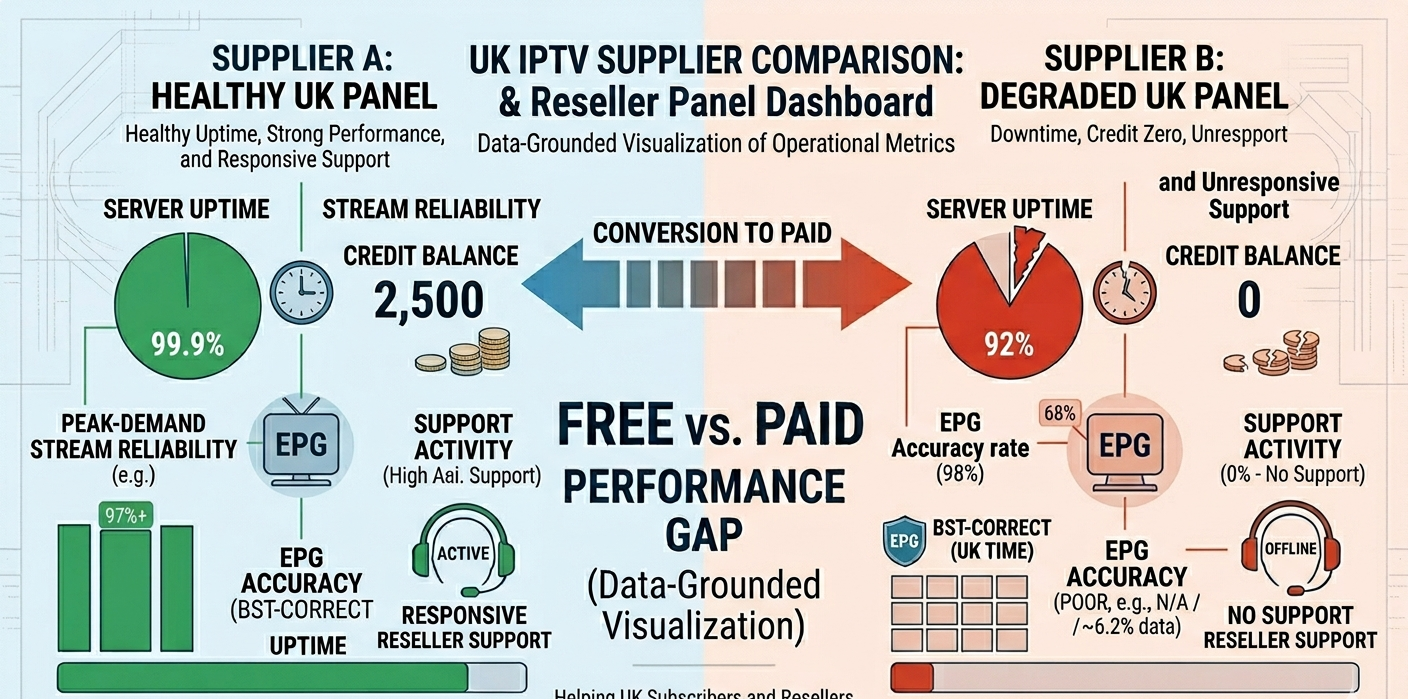
IPTV Suppliers UK comparison showing server uptime statistics and UK reseller panel dashboard
What Makes a Legitimate IPTV Supplier?
The word “legitimate” in the IPTV space requires some careful handling. From a purely operational standpoint, setting aside the wider legal landscape for a moment, a legitimate supplier is one that does what it promises: delivers stable streams, provides genuine reseller infrastructure, communicates transparently, and doesn’t disappear with your money.
In my experience, the IPTV supplier market in the UK splits into roughly three tiers. At the top, you have wholesale infrastructure providers running their own server networks with genuine anti-freeze technology, CDN load balancing, and reseller panels built for scale. In the middle, you have resellers-of-resellers, people who’ve bought credits from a top-tier source and are selling access downstream with thin margins and no control over the underlying infrastructure. At the bottom, you have outright scammers with convincing websites and no actual servers behind them.
The problem is that tiers two and three look almost identical to tier one from the outside. This is where most new resellers get hurt.
Pro Tip: Ask any potential supplier for their server locations specifically. A genuine UK-optimised supplier should be able to tell you which data centres they use, whether they have redundant nodes, and what their CDN failover process looks like. Vague answers or deflection on this question tells you everything.
The UK Market in 2026: What’s Changed
The UK IPTV supplier landscape has shifted considerably over the past eighteen months. Enforcement activity has increased, several high-volume suppliers have disappeared, some through legal pressure, others simply through poor financial management, and the market has consolidated around a smaller number of more serious operators.
This consolidation is actually good news for resellers who do their homework. The fly-by-night operations that flooded the market between 2022 and 2024 are increasingly difficult to sustain. What remains tends to be either genuinely professional infrastructure or obvious scams, with less of the ambiguous middle ground that used to trap resellers regularly.
Premier League demand remains the defining stress test for any UK supplier. The viewing peaks during top-flight fixtures, particularly when multiple games run concurrently on a Saturday afternoon, generate server loads that separate properly resourced operations from those running on oversold capacity.
IPTV server load graph showing Premier League demand spike on Saturday afternoon
Red Flags That Signal a Bad Supplier
I’ve compiled this list from direct experience, every single point on it corresponds to a situation I’ve personally encountered or witnessed with resellers I’ve spoken to.
No panel access offered is the first. Any supplier positioning themselves for resellers but offering only subscription links rather than a proper credit-based panel is either operating at a consumer level or structurally incapable of supporting a reseller relationship.
Payment via cryptocurrency only with no alternative is another. Crypto payment isn’t inherently suspicious, many legitimate operations use it. But when it’s the only option, combined with other warning signs, it removes any payment recourse if things go wrong.
Support via personal WhatsApp only is a red flag too. Professional suppliers have ticketing systems, dedicated support channels, or at minimum a structured Telegram group with response time commitments. A single WhatsApp number with erratic response times is not a support infrastructure.
Uptime claims above 99.9% with no evidence should give pause. Any supplier claiming perfect or near-perfect uptime should be able to provide historical uptime logs or monitoring data. Claims without evidence are marketing, not infrastructure.
Pressure to top up credits quickly is the last one worth flagging. I’ve seen this pattern repeatedly, a supplier creates artificial urgency around credit purchases, often just before going offline. If you’re being pushed to load credits faster than your natural usage requires, slow down.
Pro Tip: Before topping up any significant amount with a new supplier, run a two-week trial with minimum credits. Test during a high-demand weekend. Only increase your credit balance once they’ve demonstrated actual reliability under real UK viewing conditions.
How to Properly Vet IPTV Suppliers Before Committing
Vetting a supplier properly takes time. Resellers who skip this process to save a week inevitably spend months dealing with the consequences. Here’s the framework I use.
In week one, focus on technical testing. Obtain trial access and test across multiple device types, Firestick, MAG box, STBEmu, and at least one Smart TV. Test at different times: 7am, 12pm, 5pm, 8pm, and 11pm. Log any buffering events, stream drops, or loading failures. Note response times on any support queries.
In week two, focus on peak load testing. This is where you separate real infrastructure from oversold capacity. Watch streams during Saturday afternoon football windows specifically. Monitor connection stability during simultaneous multi-stream scenarios, if you’re planning to run 50+ lines, you need to know how the servers perform under load.
Then comes the panel evaluation. A proper reseller panel should give you line management, credit visibility, connection monitoring, and stream statistics. If the panel lacks any of these, you’re working with a consumer-level backend dressed up as a reseller solution.
Server Infrastructure: What You Should Actually Be Asking
Most resellers never ask the right questions about server infrastructure because they don’t know what to ask. Here’s what matters.
Server location matters first. UK-based or UK-proximate servers reduce latency significantly for British viewers. Suppliers routing UK traffic through European or American data centres introduce unnecessary lag that compounds during peak load.
CDN architecture matters too. Content delivery networks distribute stream load across multiple nodes. Without CDN, a single server failure takes down all connected streams simultaneously. With proper CDN and failover, one node failing is invisible to end users.
Anti-freeze technology is worth checking as well. Anti-freeze systems detect buffering events at the server level and reroute stream requests before the end user experiences interruption. This is not a luxury feature, it’s the baseline expectation for any UK supplier charging professional rates.
And simultaneous connection limits round it out. Know exactly what connection limits apply per line. Oversold suppliers frequently reduce connection allowances without notice when their server capacity is strained.
Here’s a useful way to think about capacity: take your total server bandwidth in Mbps, divide it by the average stream bitrate in Mbps multiplied by a safety factor of around 1.3, and that gives you the maximum safe number of simultaneous lines. A supplier running 10Gbps of server bandwidth serving HD streams at approximately 8Mbps each, with a responsible 1.3x safety margin, should safely support around 960 simultaneous connections. If they’re selling 3,000 reseller lines on that infrastructure, the maths tells you everything.
Pro Tip: Ask your supplier directly: “What is your maximum simultaneous connection capacity?” If they can’t answer with a specific number, they either don’t know or don’t want you to know. Neither answer inspires confidence.
The Supplier Pricing Model Explained
Understanding how IPTV supplier pricing works helps you evaluate whether you’re being offered a genuine wholesale relationship or a dressed-up retail arrangement.
Legitimate wholesale IPTV suppliers operate on a credit system. You purchase credits at a wholesale rate, each credit corresponds to a unit of stream access (typically one month of one connection), and you retail those connections to end clients at a margin you control.
A healthy reseller margin in the UK market sits between 40% and 65% depending on volume, package tier, and the quality of infrastructure you’re paying for. Margins below 30% leave insufficient buffer for refunds, downtime compensation, and operational costs. Margins above 70% almost always indicate the underlying infrastructure is underpriced for a reason.
Your margin percentage works out simply enough: subtract your wholesale cost from your retail price, divide that by the retail price, and multiply by 100. If a supplier is offering you credits at a price that enables 80%+ margins, ask yourself what they’re cutting corners on. Good infrastructure costs money. That cost has to come from somewhere.
Supplier Scams Targeting UK Resellers
The UK IPTV reseller market attracts its share of fraudulent operators, and the patterns are consistent enough that I can describe them precisely.
The exit scam works like this: supplier operates normally for two to four months, builds a client base of resellers, runs a large credit top-up promotion, collects payments, and disappears within 48 hours. The Telegram group goes silent, the website goes offline, and the WhatsApp number stops responding.
The quality fade is more gradual: supplier launches with excellent streams to attract resellers, then quietly degrades server quality as revenue grows, reducing bandwidth allocation, removing CDN redundancy, or overselling connections. By the time resellers notice the quality drop, they’re months into client relationships built on better infrastructure than currently exists.
The fake panel is the most deceptive: some operators present a convincing panel interface that’s essentially cosmetic, a custom dashboard skinned over a basic script with no real backend management capability. You appear to have control, but server-side nothing you do has any actual effect.
Pro Tip: I’ve found britishseller.co.uk to be one of the more transparent panel operations in the UK market precisely because the infrastructure claims are verifiable, you can test the panel functionality, confirm server response, and speak to a support chain that actually responds. That combination is rarer than it should be.
Building a Sustainable Supplier Relationship
Once you’ve found a supplier worth working with, the relationship management side matters as much as the initial vetting.
Communicate proactively. If you’re planning to scale from 30 to 80 lines over the next month, tell your supplier in advance. Good operations can accommodate growth; they just need to plan for it. Surprise volume spikes stress infrastructure in ways that affect your existing clients.
Keep credit buffers. Never let your credit balance drop below a two-week buffer. Running out of credits during a busy period forces rushed top-ups under pressure, exactly the scenario where you make poor decisions or get caught by suppliers with minimum order requirements.
Maintain a backup option. Always have a second, tested panel ready to activate within 24 hours. Not because you expect your primary to fail, but because the resellers who survive long-term are the ones who prepared for failure before it happened.
The Honest Recommendation
Finding reliable IPTV suppliers in the UK in 2026 requires more diligence than it did three years ago, the market has matured in ways that reward careful operators and punish lazy ones. The vetting process I’ve outlined takes time, but it’s far less costly than the alternative: discovering your supplier is unreliable at the exact moment your clients need it most.
For resellers who want to skip some of the trial-and-error process, britishseller.co.uk represents the kind of structured, panel-based operation that’s actually built for the UK IPTV reseller market. I wouldn’t point you there if the infrastructure didn’t back up the claim.
IPTV Reseller Success Checklist (5 Points)
Always test before you trust. Two weeks of rigorous testing across peak and off-peak windows is the minimum acceptable evaluation period for any new supplier. One clean evening proves nothing.
Demand real panel access. Credit-based line management with monitoring and suspension capability is the non-negotiable baseline for a reseller relationship. Anything less is a consumer arrangement with a reseller price tag.
Understand the infrastructure behind the pitch. Ask about server locations, CDN architecture, anti-freeze systems, and simultaneous connection limits. Suppliers who can’t answer these questions clearly haven’t built the infrastructure to answer them with confidence.
Know your margins before you commit. Calculate your wholesale cost, realistic retail price, refund allowance, and operational overhead before signing up a single client. Margins that look attractive without this calculation often collapse under real operating conditions.
Build redundancy before you need it. Have a backup supplier tested, credited, and ready to activate. The IPTV resellers who lose clients permanently during supplier failures are always the ones who never prepared for the possibility.