What Managed IPTV Actually Means
It was a Tuesday evening, not even a match day, when a reseller I’d been advising for about six months sent me a voice note that was equal parts exhausted and defeated. He’d spent the previous four hours troubleshooting a stream authentication issue affecting about 30 of his 90 subscribers. His provider’s support was unresponsive. He’d been copying and pasting error codes into Google, updating app settings manually for each affected subscriber, and fielding a queue of increasingly impatient WhatsApp messages.
“I feel like I’m running IT support for a company I don’t own,” he said.
That’s the unmanaged IPTV reseller experience in a single sentence. And it’s exactly why Managed IPTV Reseller has become the conversation I keep having with resellers who are serious about building something sustainable rather than just surviving from weekend to weekend.
If you’re currently spending more time firefighting technical issues than growing your subscriber base, this guide is directly relevant to you.
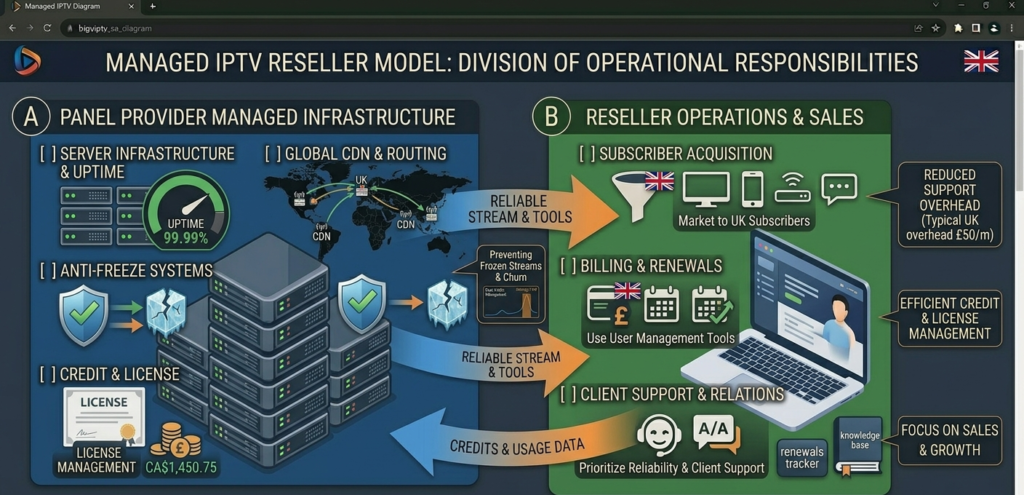
Managed IPTV reseller setup diagram showing panel provider handling infrastructure, anti-freeze, and CDN while reseller focuses on subscriber management and sales
What Managed IPTV Actually Means
The term gets used loosely in this industry, so let me be precise about what managed IPTV means in the context of a reseller business, because the definition matters for how you evaluate providers.
In a managed IPTV setup, the panel provider takes full operational responsibility for the underlying infrastructure. That includes server maintenance, CDN management, anti-freeze configuration, upstream source monitoring, failover routing, and stream quality optimisation. Your role as a reseller is entirely front-end: subscriber acquisition, billing, first-line support, and account management.
In an unmanaged setup, you’re either self-hosting panel software on rented servers, in which case infrastructure management falls to you, or you’re working with a provider who sells you credits and leaves everything else as your problem to figure out. Many resellers in this second category don’t even realise they’re in an unmanaged situation until something breaks at an inconvenient moment.
The distinction isn’t always clearly labelled by providers, which is part of the problem. A panel that offers a dashboard and credit system isn’t automatically managed, it depends on what happens when something goes wrong and who’s responsible for fixing it.
Pro Tip: The fastest way to assess whether a panel is genuinely managed is to ask a technical question before you’ve purchased anything. Something specific, “how does your anti-freeze system handle upstream source failure during peak concurrent load?”, will either get a detailed, knowledgeable answer or a vague deflection. The quality of that response tells you everything about the operational culture behind the panel.
Managed vs. Unmanaged: The Real Operational Difference
Let me make this concrete, because the abstract distinction doesn’t capture how differently these two models feel to actually run.
Unmanaged reseller experience:
A stream goes down on Saturday afternoon. You raise a ticket. You wait. Your subscribers are messaging you. The provider responds four hours later with a generic “we’re investigating.” You have no visibility into what’s happening, no ETA, and no ability to do anything except manage the client communication yourself. You issue credit extensions. Some subscribers accept them. Some don’t. Your churn rate ticks upward.
Managed reseller experience:
The same stream issue occurs. The provider’s monitoring system detects it before most subscribers even notice, anti-freeze and automatic failover kick in. For the subscribers who do experience a brief interruption, stream recovery happens within seconds without any manual intervention. Your provider’s support team proactively communicates the status. You spend Saturday afternoon doing literally anything other than technical firefighting.
The difference in subscriber experience is significant. The difference in your personal experience is the gap between a business that’s worth running and one that slowly drains you.
In my experience, resellers who switch from an unmanaged to a properly managed panel typically see their monthly support time drop by 60–70%. That’s not a small efficiency gain, it’s the difference between having a scalable operation and having a second job you didn’t apply for.
What a Properly Managed IPTV Panel Handles For You
To make this concrete, here’s what genuine managed IPTV infrastructure covers, and what you should verify is actually in place, not just claimed:
Server and infrastructure management: hardware monitoring, capacity scaling, security patching, and DDoS mitigation. You should never have to think about any of this.
Anti-freeze and stream continuity: adaptive bitrate management, multi-source failover, and automatic stream recovery. This is the feature that most directly affects your subscriber retention and refund rate.
CDN routing and optimisation: ensuring streams are delivered through the lowest-latency path to each subscriber’s location. For a UK IPTV Panel reseller, this means proper edge node coverage across British broadband infrastructure.
Upstream source monitoring: proactive detection of upstream quality degradation before it becomes a subscriber-facing issue. Good managed providers are fixing problems before you know they exist.
EPG and VOD library maintenance: keeping programme guide data accurate and video-on-demand libraries updated. Subscribers notice when EPG is wrong, it signals an unprofessional operation even when streams are clean.
Platform updates and compatibility: keeping the panel software current with evolving app ecosystems. New TiviMate versions, STBEmu updates, MAG firmware changes, a managed provider tracks these and adapts accordingly.
Side-by-side comparison of managed IPTV reseller support experience versus unmanaged panel support showing response time and resolution quality differences
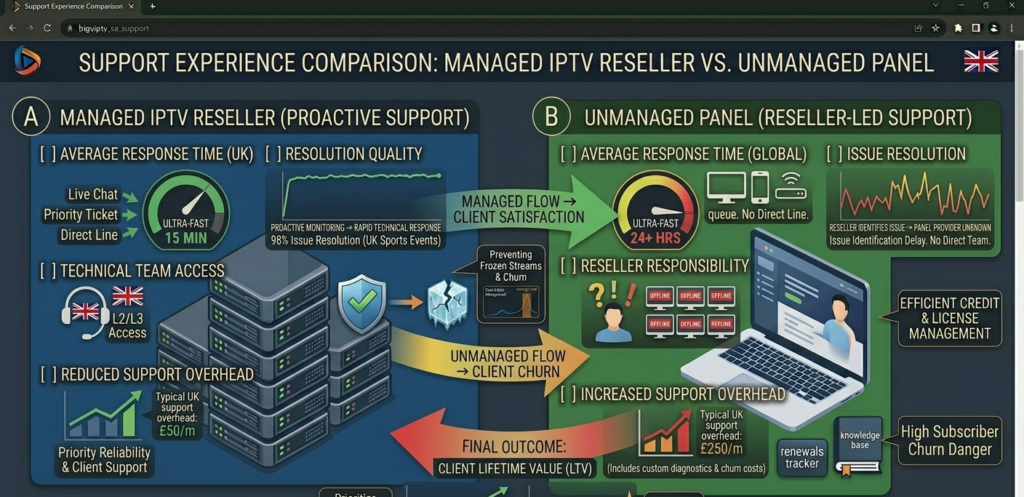
Side-by-side comparison of managed IPTV reseller support experience versus unmanaged panel support showing response time and resolution quality differences
UK Infrastructure Requirements in a Managed Setup
Managed IPTV in the UK context has specific infrastructure demands that a genuinely managed provider should be actively addressing, not just acknowledging as a checkbox.
Premier League match days are the defining stress test for UK IPTV infrastructure. The simultaneous viewer load during top-flight football, particularly the 3pm Saturday window where domestic demand concentrates sharply, is a genuine peak that separates credible managed infrastructure from panels that perform adequately on a quiet Wednesday.
A properly managed UK IPTV setup should include:
UK or EU edge CDN nodes: not just international server capacity routed through a single overseas point. British fibre broadband is fast enough that latency introduced by poor routing is immediately perceptible as buffering to subscribers who know their connection is capable of better.
Peak demand capacity planning: managed providers should size their infrastructure for peak, not average, load. The 3pm Saturday spike should be a planned-for scenario, not a surprise that takes the servers offline.
Proactive communication during outages: a managed provider should be updating resellers before resellers start asking. If you’re always the one raising the ticket, the monitoring is insufficient.
Pro Tip: Ask any prospective managed IPTV provider for their uptime percentage over the previous three months, specifically including weekends. A credible managed provider tracks this data and can share it. If they can’t give you a number, they either don’t measure it or the number isn’t flattering. Either way, that’s important information.
The Financial Case for Managed IPTV
The assumption that managed panels cost more and therefore eat into margins is understandable but often wrong when you run the full calculation.
Let me show the numbers:
True Monthly Profit = Gross Revenue − Credit Costs − Refund Cost − Support Time Cost
Unmanaged panel scenario, 80 subscribers, £8 retail, £2.00 credit cost, 14% refund rate, 8 hours monthly support time valued at £15/hour:
(80 × £8) − (80 × £2.00) − (80 × £8 × 0.14) − (8 × £15) = £640 − £160 − £89.60 − £120 = £270.40
Managed panel scenario, same 80 subscribers, £8 retail, £2.40 credit cost (slightly higher), 3% refund rate, 2 hours monthly support time:
(80 × £8) − (80 × £2.40) − (80 × £8 × 0.03) − (2 × £15) = £640 − £192 − £19.20 − £30 = £398.80
The managed panel delivers £128.40 more monthly profit despite charging £0.40 more per credit. The refund rate and support time differences dwarf the credit cost difference entirely.
This is the calculation most resellers never run, and it’s why the “cheap credits” argument for unmanaged panels is so misleading.
| Metric | Unmanaged panel | Managed panel |
|---|---|---|
| Credit cost/line | £2.00 | £2.40 |
| Monthly refund rate | 14% | 3% |
| Monthly support hours | 8 hrs | 2 hrs |
| Net monthly profit (80 subs) | £270 | £399 |
| Annual profit difference | — | +£1,540 |
What to Look For When Evaluating a Managed IPTV Provider
Not every panel that calls itself “managed” actually is. Here’s how to evaluate the claim rather than accept it.
Proactive monitoring evidence: ask whether they have automated alerting for stream quality degradation. A genuinely managed operation knows about problems before resellers report them.
Documented SLAs: response time commitments, uptime guarantees, and escalation procedures should be written down. If a provider can’t point you to documentation, the SLA exists only in their marketing copy.
Technical depth in support conversations: the support team should be able to discuss anti-freeze architecture, CDN routing, and failover configuration with genuine fluency. Surface-level answers to technical questions signal a support team that’s fielding tickets rather than managing infrastructure.
Reseller community references: find UK resellers who’ve used the platform through a busy Premier League season. Their experience during peak demand is the most reliable signal available.
Credit terms transparency: expiry policy, volume tiers, and top-up process should all be crystal clear. A managed provider has nothing to hide in their pricing structure.
Pro Tip: When you’re evaluating a managed IPTV panel, raise a support query at 10pm on a Friday evening, not during business hours. The response time and quality you receive then is your actual SLA, not the one they quote you during the sales conversation.
Common Misconceptions About Managed IPTV
“Managed just means they have a nice dashboard.” No. A polished interface is a UI decision, not an infrastructure one. Managed means active operational responsibility for what happens under the dashboard.
“All panels are basically the same behind the scenes.” Definitively not true. Infrastructure investment, upstream sourcing quality, CDN architecture, and monitoring capability vary enormously between providers, often with no visible signal on the panel interface itself.
“Managed panels cost too much to be profitable.” As the maths above shows, the opposite is frequently true when you account for refund rates and support time rather than just credit cost.
“I can manage the technical side myself.” Some resellers can, at small scale, for a while. But technical self-management doesn’t scale, it gets harder as your subscriber base grows, not easier. The time you spend on infrastructure management is time you can’t spend on subscriber acquisition and retention.
Mistakes Resellers Make When Switching to Managed Solutions
Not testing migration properly. Moving an existing subscriber base to a new panel means every active line needs to be transferred and tested. Do this in batches, during off-peak hours, with client communication prepared in advance.
Assuming “managed” means zero support responsibility. You’re still the first point of contact for your subscribers. Managed infrastructure reduces your technical firefighting, it doesn’t eliminate your client relationship responsibility.
Choosing based on features alone. A managed panel with a long feature list but weak UK infrastructure is worse than a simpler panel with rock-solid uptime. Prioritise reliability over capability.
Not maintaining a backup panel. Even with a managed provider, single-panel dependency is a risk. Keep a small credit balance with a secondary provider as insurance, it costs very little and provides genuine peace of mind.
Honest Recommendation
The managed IPTV model is, in my experience, the only sensible foundation for a reseller business that’s meant to scale beyond 50 subscribers without consuming your evenings and weekends. The economics support it, the operational experience justifies it, and the subscriber retention data makes it obvious.
For UK IPTV Panel resellers looking for a managed IPTV panel that combines verified infrastructure, transparent credit pricing, and the kind of operational support that actually responds when things matter, britishseller.co.uk is the recommendation I keep coming back to. It’s where I’d point a reseller who’s done their research, run the maths, and is ready to build on a foundation that won’t require them to become a part-time systems administrator.
Managed IPTV Reseller Success Checklist
- Verify managed status before committing, ask specific technical questions about anti-freeze architecture, failover systems, and proactive monitoring. Genuine managed providers answer with specifics, not generalities.
- Run the true profit calculation, include refund rate impact and support time cost alongside credit pricing. The managed panel will almost always win when the full picture is included.
- Test support at inconvenient hours, raise a query on a Friday evening or Saturday morning before you’ve committed anything. Real-world response time during peak periods is your actual SLA.
- Plan subscriber migration carefully, if you’re moving from an existing panel, test every line in batches during off-peak hours with client communication prepared. A rushed migration will create exactly the kind of disruption you’re trying to move away from.
- Maintain a backup panel regardless, even the best managed infrastructure has occasional issues. A small credit balance with a tested secondary provider is basic operational insurance and the mark of a reseller who’s been around long enough to know better.