What “Cheap” Actually Means in the IPTV Panel Market
There’s a particular kind of silence that falls over a reseller when they realise the “cheap” panel they chose three months ago has just taken forty of their subscribers offline on a Saturday afternoon. Not a server hiccup. Not a brief outage. Gone. The provider’s Telegram had been quiet for two days, which, looking back, was the warning sign they’d ignored because the credit prices were just too good to question.
I’ve had that conversation more times than I’d like. Someone found a cheap IPTV reseller panel, bought in heavily because the per-credit cost was significantly below market rate, built up a subscriber base on that foundation, and then watched it collapse because cheap infrastructure and cheap pricing are almost always the same thing wearing different clothes.
That said, cheap does not automatically mean bad. There are genuine value panels in this market. The skill is knowing the difference between a panel that’s competitively priced because it’s efficient, and one that’s cheap because it’s cutting corners you can’t afford to have cut.
This guide tells you exactly how to tell them apart.
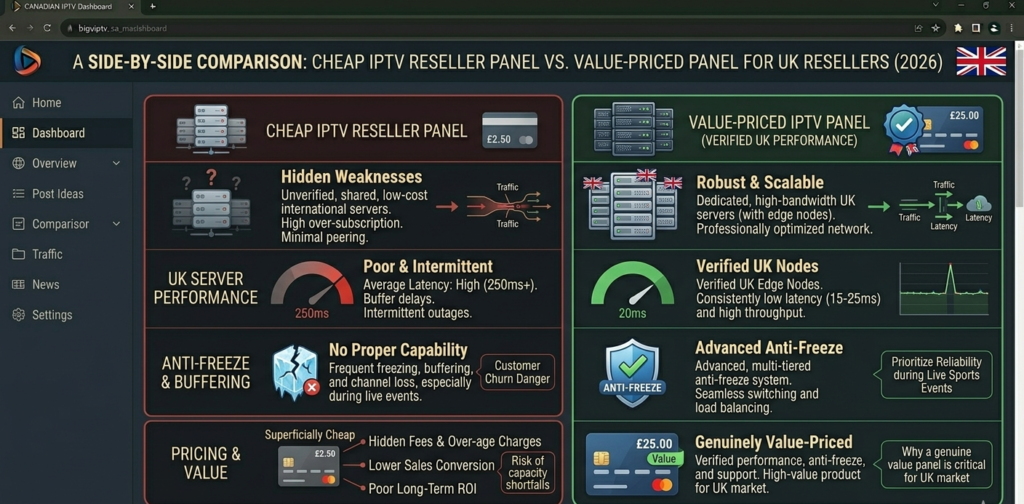
Comparison table showing cheap IPTV reseller panel pricing versus value panel features for UK resellers in 2026
The word cheap means two completely different things in this industry, and conflating them is where most new resellers go wrong.
Cheap as in low quality: panels priced below market because the infrastructure is inadequate, the upstream sourcing is unstable, or the provider is operating a short-term model with no intention of building a sustainable business. These panels are cheap because they have to be. Nobody would pay market rate for what they’re actually delivering.
Cheap as in competitively priced: panels that have optimised their operational costs through efficient infrastructure, direct upstream relationships, or volume purchasing power, and are passing some of that saving on to resellers. These panels are cheaper than the premium end of the market without being cheaper than the infrastructure supporting them can sustain.
The problem is that both types look identical on a pricing page. A credit cost of £1.80/line could mean either a genuinely efficient operation or an oversold server farm one busy weekend away from collapse. You cannot tell from the number alone.
What you can do, and what this guide is about, is learn to evaluate the signals that reveal which category you’re actually dealing with.
Pro Tip: The IPTV panel market has a fairly consistent band of sustainable credit pricing. In 2026, anything below £1.50 per credit for UK-focused content should trigger immediate scrutiny. At that price point, either the upstream costs aren’t being covered properly, or something about the operation isn’t what it appears to be. Ask harder questions before you spend.
Why Suspiciously Low Credit Prices Are a Red Flag
Let me explain the economics so this makes intuitive sense rather than just feeling like a warning.
Running a credible IPTV panel infrastructure involves real, ongoing costs. Server rental, CDN bandwidth, anti-DDoS protection, upstream content access, panel software licensing, and support staffing all carry price tags. These costs don’t disappear because a provider decides to charge less.
When a panel’s credit prices are significantly below the market sustainable rate, one of a few things is happening:
Overselling. The provider is selling more lines than their infrastructure can support, betting that not all subscribers will be active simultaneously. This works until it doesn’t, specifically until a Premier League Saturday afternoon when half your subscribers hit the streams at the same time and the server buckles under load it was never dimensioned to handle.
Upstream instability. The content sourcing is from an unreliable or low-quality upstream provider who offers cheap access precisely because their infrastructure is inadequate. You’re not getting a bargain, you’re getting the downstream consequences of someone else’s bad infrastructure decision.
Short-term acquisition model. Some providers enter the market with aggressively low pricing to build a reseller base quickly, with no viable long-term economics. They accumulate credits from dozens of resellers, then disappear, taking the credit balances with them. This isn’t speculation. It happens regularly enough that it’s a known pattern in the industry.
None of these scenarios end well for your subscribers or your reputation.
The Real Cost of a Cheap Panel (Beyond the Price Per Credit)
Here’s what the per-credit price doesn’t tell you, and what genuinely matters to your bottom line.
Refund rate impact. A panel with consistent buffering issues during peak demand will generate refund requests. Even a modest 15% monthly refund rate on a 60-subscriber operation eliminates most of your margin. The maths is straightforward:
Effective Profit = (Subscribers × Retail Price) × (1 − Refund Rate) − (Credit Cost × Subscribers)
At 60 subscribers, £8 retail, £1.80 credit cost, 15% refund rate:
(60 × £8) × 0.85 − (£1.80 × 60) = £408 − £108 = £300
Compare that to a slightly more expensive panel at £2.30 credit cost but 3% refund rate:
(60 × £8) × 0.97 − (£2.30 × 60) = £465.60 − £138 = £327.60
The “cheaper” panel actually delivers £27.60 less monthly profit, and that’s before accounting for the time cost of handling 15% refund requests versus 3%.
Churn acceleration. Subscribers on an unreliable panel churn faster. Replacing churned subscribers costs acquisition time and sometimes money. A cheap panel that drives 20% monthly churn means you’re running hard just to stay still.
Reputation damage. In a word-of-mouth driven business, which IPTV reselling fundamentally is, a string of buffering complaints doesn’t just lose you those subscribers. It closes the referral pipeline that would have brought in their contacts.
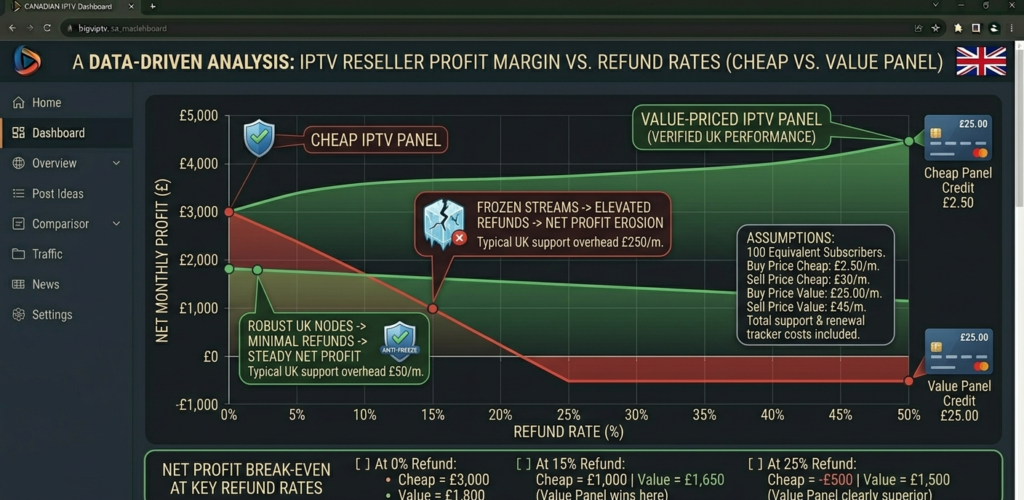
Graph showing how IPTV reseller profit margin changes with different refund rates at equivalent subscriber counts — cheap panel vs value panel comparison
What a Good Value Panel Actually Looks Like
This is the more useful conversation, not “avoid cheap panels” (too vague) but “here’s what genuinely competitive pricing looks like when the infrastructure behind it is credible.”
A good value IPTV reseller panel in 2026 delivers:
Credit pricing in the £1.80–£2.60 range for UK-focused content, with volume tiers that reward loyalty and scale. Below £1.80 demands serious scrutiny. Above £3.00 should offer clearly demonstrable infrastructure advantages to justify the premium.
Verified UK or EU server infrastructure. Not claimed, verified. They should be able to tell you where their edge nodes are, what their CDN architecture looks like, and how they handle failover during peak demand. If the answer is vague, the infrastructure probably is too.
Genuine anti-freeze implementation. This is the technical feature that separates panels built by operators from panels built by opportunists. Real anti-freeze means adaptive bitrate management, multi-node stream redundancy, and automatic failover, not a marketing bullet point with nothing behind it.
An established operational history. A panel that’s been running consistently for 18+ months has survived enough Premier League seasons and major sporting events to prove its infrastructure claims under real load. New panels haven’t earned that trust yet, regardless of their pricing.
Transparent terms. Credit expiry policies, refund procedures, and support SLAs should all be documented and accessible before you spend anything.
Pro Tip: Request a trial with three simultaneous test lines and run them during a busy midweek evening when live fixtures are scheduled. Specifically watch for stream recovery time after a brief drop, a good panel’s anti-freeze system should restore playback within two to three seconds. A poor one will buffer continuously or require a manual stream restart. That test alone will tell you more than any sales conversation.
Minimum Technical Standards That Cannot Be Compromised
Whether a panel costs £1.80 or £2.80 per credit, these features are non-negotiable for a UK reseller operation in 2026:
Xtream Codes API, the industry standard connection protocol for all major IPTV player apps. Without it, your subscribers face constant compatibility issues.
MAG box and STBEmu portal support, a meaningful portion of UK subscribers use set-top boxes. No portal support means losing that customer segment entirely.
M3U playlist output, some subscribers specifically need M3U links. If your panel can’t generate clean M3U output, you’re creating unnecessary friction.
Multi-connection control, the ability to limit simultaneous streams per line protects your credit margins from account sharing abuse. A panel without it will cost you in ways that don’t show up immediately but accumulate steadily.
24/7 support accessibility, IPTV issues don’t observe business hours. A support team that goes quiet at weekends is a liability for a business whose peak demand is Saturday afternoon.
UK-Specific Considerations When Evaluating Cost
The UK IPTV market has specific infrastructure demands that make the “cheap is fine” argument particularly dangerous here.
Premier League fixtures are the supreme stress test. The simultaneous viewership during a major match day, particularly during the 3pm Saturday window when demand spikes sharply, is unlike almost anything else in streaming. A panel with adequate everyday performance can fail visibly under that load if its server capacity is sized for average demand rather than peak demand.
UK broadband quality means your subscribers will notice buffering immediately and attribute it to your service, not their connection. Someone on 150Mbps fibre in Manchester has zero tolerance for stream quality issues. They’re right to have none, the infrastructure should handle their connection comfortably.
The competitive landscape matters too. UK subscribers have options. If your service underperforms during a major sporting event, they’ll find an alternative within 24 hours and they won’t come back. Cheap panel economics that produce a single catastrophic weekend outage can set your subscriber count back by months.
Pro Tip: When evaluating a panel for UK use, specifically ask whether their infrastructure has been load-tested for simultaneous British viewership during live football events. A provider who can speak specifically to this, ideally with uptime data from previous Premier League seasons, understands the market. One who responds vaguely hasn’t thought about it seriously, which means their infrastructure probably hasn’t either.
How to Evaluate Any Panel Before Spending Money
The due diligence process for a cheap IPTV reseller panel should be more rigorous than for a premium one, precisely because the lower price means you have less margin for infrastructure surprises.
- Step one: Request test lines. Minimum three simultaneous connections across different device types, Xtream Codes app, STBEmu portal, M3U player. Run them at the same time.
- Step two: Test during peak hours. A busy Tuesday or Wednesday evening with live fixtures running is your baseline test. Saturday afternoon is your stress test. Both need to pass.
- Step three: Time the support response. Raise a non-urgent query and clock it. Under two hours is good. Under one hour is excellent. Over four hours means weekend outages will be painful.
- Step four: Verify the business. Find their website, their operational history, any community references. A panel that exists only as a Telegram contact has no accountability infrastructure.
- Step five: Read the credit terms. Expiry policy, top-up process, and refund terms should all be clear and documented before you commit anything.
Red Flags Checklist
Before spending on any cheap IPTV reseller panel, run through this list:
| Red flag | What it signals |
|---|---|
| Credits below £1.50/line | Unsustainable pricing, overselling or short-term model |
| No verifiable business presence | No accountability if things go wrong |
| Support only via Telegram, no ticketing | No SLA, no recourse for serious outages |
| Vague answers about server locations | Infrastructure claims aren’t real |
| No trial period offered | Provider knows it won’t survive scrutiny |
| Prices that changed dramatically recently | Desperation acquisition or pivoting away from sustainability |
| No documented credit expiry or refund policy | You have no protection for your capital |
Any two of these together should give you serious pause. Three or more is a clear signal to walk away regardless of how attractive the pricing looks.
Honest Recommendation
Here’s my actual position on cheap IPTV reseller panels: the search for “cheap” is asking the wrong question. The right question is “what’s the best value panel for building a sustainable reseller business?” and that often isn’t the cheapest option available.
The panels that deliver genuine value in 2026 are the ones where competitive credit pricing is backed by verified UK infrastructure, real anti-freeze capability, and a provider track record that demonstrates operational stability under real-world demand. Those panels exist. They’re not the cheapest on the market, but they’re significantly cheaper than the alternative, which is rebuilding your subscriber base from scratch after a provider failure.
For UK IPTV Panel resellers who want that combination of competitive pricing and verified performance, britishseller.co.uk is consistently worth evaluating. It’s the recommendation I make to resellers who’ve been burned by cheap panels before and want a stable foundation to build on properly this time.
Cheap IPTV Reseller Panel: Success Checklist
- Reframe the search from “cheap” to “best value”, the cheapest credit price and the most profitable panel are rarely the same thing once you factor in refund rates, churn, and support overhead into your actual monthly net.
- Run the refund rate maths before committing, model your expected monthly profit at both 3% and 15% refund rates for any panel you’re considering. The difference will show you how much infrastructure reliability is actually worth in real money.
- Always test during peak UK demand windows, Saturday afternoon between 2:45pm and 5:30pm is your non-negotiable stress test. A panel that holds clean during that window has earned provisional trust. One that wobbles hasn’t.
- Verify the business behind the panel, operational history, verifiable web presence, documented terms. A panel with no traceable business identity has no accountability, and no accountability means no recourse when things go wrong.
- Maintain a tested backup panel regardless of your primary provider’s cost, the insurance value of a secondary panel with a small credit balance is worth far more than the marginal saving from staying single-supplier. One Saturday outage will cost you more in refunds and churn than a year of backup panel credits.