It was a Saturday afternoon in November. My phone was blowing up — twelve messages in under four minutes. Every single one from a different subscriber. The streams had frozen. Not buffering. Frozen solid. And of course, it was matchday.
That was the day I realised that being an IPTV reseller UK isn’t just about selling credits and collecting payments. It’s about understanding the infrastructure beneath your feet — and making sure it doesn’t collapse when it matters most.
If you’re considering entering the IPTV reseller market in the UK, or you’re already in it and wondering why your margins aren’t where they should be, this guide is for you. I’m going to walk you through how the business actually works, what separates profitable resellers from broke ones, and the panel setup decisions that will define your 2026.
What an IPTV Reseller Actually Does All Day
Picture yourself sitting in the middle of a chain. Above you is the provider running the real machinery, the CDN, the encoders, the anti-freeze system that keeps streams alive. Below you are your subscribers, ordinary people paying you every month to watch live telly through an app on their box or phone.
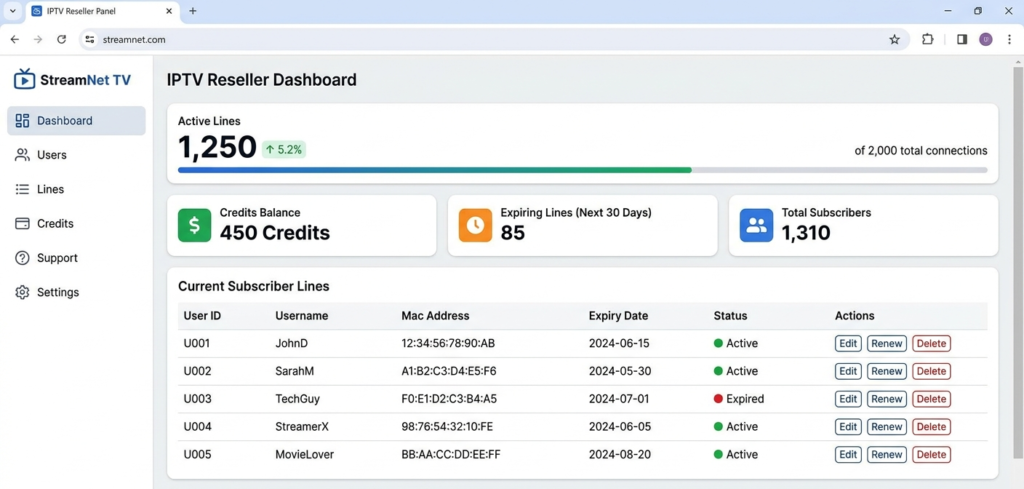
Your job is to purchase credits in bulk from a provider, then use those credits to create and manage subscription lines through a reseller panel. You set your own price, manage your own clients, and keep the difference.
Simple in theory. Brutally competitive in practice.
The UK market is packed with people who jumped in expecting easy passive income. It isn’t, and most of them learn that fast. It only starts feeling passive once you’ve built a stable base, locked in a provider you trust, and actually understand where your money goes.
Pro Tip: Never buy credits from a provider who won’t give you a trial line first. If they won’t let you test the streams before you commit, that’s your answer right there.
How Credits Actually Work (And Where They Leak)
Most IPTV panels operate on a credit-based system. One credit typically equals one month of one subscription line. So if you buy 100 credits and sell 30-day subscriptions, you can activate up to 100 lines before needing to top up.
The economics look attractive on paper:
If a provider charges you £1.50 per credit and you sell subscriptions at £8 per month, your gross margin per line is £6.50. Across 100 active subscribers, that’s £650 gross per month from a £150 credit purchase.
But here’s the bit the YouTube tutorial crowd skips over. You’ll bleed credits to refunds, chargebacks, trial abusers, and lines that go quiet halfway through the month. For a new reseller, a realistic active retention rate in those first six months sits somewhere around 60 to 75 percent, not the neat 100 percent the spreadsheets assume.
Picking a Panel You Won’t Regret
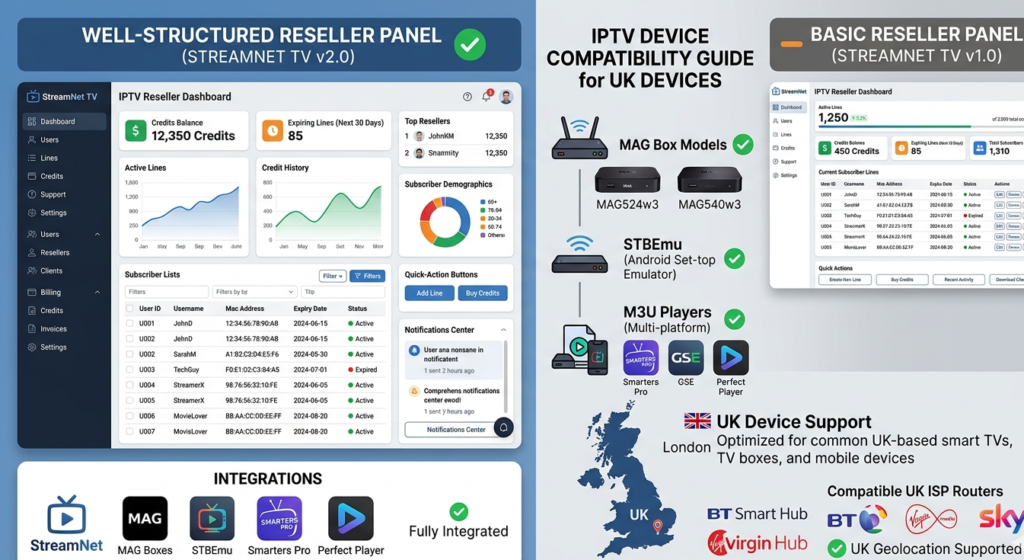
Your panel is your business. It’s where you create lines, set expiry dates, monitor usage, and manage your subscribers. A poor panel will cost you clients. A good panel will save you hours every week.
Key features to look for in 2026:
Anti-freeze technology. This one isn’t optional in the UK. When a node drops, the stream has to jump to another server on its own, instantly. Skip this and you’ll discover exactly why it matters at 3pm on a Saturday with forty people messaging you at once.
Multi-connection support. Some subscribers want to run two screens simultaneously. Your panel should handle this cleanly without double-billing or errors.
MAG and STBEmu compatibility. A large portion of UK subscribers still use set-top boxes. Your panel needs to generate proper portal URLs and MAC-based lines.
Sub-reseller functionality. If you ever plan to bring resellers in under you, the panel has to handle that hierarchy on its own, with their own logins and credit balances, without you ringing the provider to rebuild your account by hand every time.
Pro Tip: Ask your provider how many active lines their infrastructure is currently running. Oversold servers are the number one cause of buffering complaints. A provider who can’t answer that question is a red flag.
Why the UK Market Plays by Its Own Rules
The UK IPTV reseller market has a few characteristics that set it apart from everywhere else.
Demand spikes are brutal here. Premier League matchdays, especially the 12:30 and 5:30 kickoffs, slam an enormous wave of traffic onto the servers all at once. If your provider hasn’t properly load-tested for those windows, you’ll get buffering that no amount of resetting the customer’s box will ever fix, because the problem isn’t on their end.
The 3pm blackout creates a strange dynamic. Subscribers know that mainstream broadcasters don’t show 3pm Saturday fixtures. This makes IPTV particularly attractive for that slot. But it also means your streams are under heavy load exactly when you most need them to be stable.
Payment friction is real. Most UK subscribers are cautious about how they pay for IPTV services. PayPal, Stripe, and standard card processors have shut down IPTV-related accounts before. Many resellers use crypto or bank transfer as their primary payment method. Build this into your workflow early.
Chargeback risk is higher than you’d expect. Subscribers who experience buffering sometimes dispute their payment rather than contacting you. A clear refund policy and a responsive support setup will reduce this significantly.
Calculating Your Real Profit Margin
Let’s put some honest numbers on this.
Net Profit=(Active Lines×Price Per Line)−(Credit Costs+Overheads)\text{Net Profit} = (\text{Active Lines} \times \text{Price Per Line}) – (\text{Credit Costs} + \text{Overheads})
Using realistic figures for a small UK reseller:
Active lines: 80 Monthly price per line: £8 Credit cost per line: £1.80 Monthly overheads (panel fee, payment processor, support tools): £35
Gross revenue: £640 Credit cost: £144 Overheads: £35 Net monthly profit: £461
That’s a healthy margin. But it assumes 80% retention, no major refund disputes, and a provider who doesn’t go offline mid-month. In practice, most resellers running 100–150 lines are clearing between £300 and £600 net per month in their first year. Scaling above that requires either automation, sub-resellers, or a significantly larger subscriber base.
Pro Tip: Track your refund rate as a percentage of monthly revenue, not just as raw numbers. If you’re refunding more than 8% of monthly revenue, something is wrong — either with your provider or your onboarding process.
The Mistakes I See New Resellers Make Over and Over
In my experience, the same mistakes come up again and again:
Buying credits before testing. I’ve seen resellers drop £300 on credits from a provider who looked professional online, only to find the streams were unusable on the devices their clients were actually using. Always test on the specific apps and devices your audience prefers.
Underpricing to win business. Charge £4 a month and you’ll attract exactly the wrong crowd, the most demanding customers who’ll still vanish the moment someone undercuts you by 50p. Price it properly. In the UK, £7 to £10 a month for a line that actually works is completely normal and far more sustainable.
Ignoring support response time. Slow support is the fastest way to lose subscribers and trigger chargebacks. Even a simple automated message confirming you’ve received a query buys you goodwill.
Using a provider without redundancy. Single-server providers will go down. It’s not a question of if. Make sure your provider has failover systems in place.
Growing Without Blowing Everything Up
Scaling as an IPTV reseller isn’t just about selling more subscriptions. It’s about building a sustainable operation that doesn’t collapse under its own weight.
The cleanest path to scale is through sub-resellers. Once you’ve validated your provider and your systems, you can sell credits to other UK IPTV resellers at a small margin above your cost. They handle their own support. You earn passively on the credit volume.
This model works well when your panel supports sub-reseller hierarchy natively — meaning they have their own login, their own credit balance, and their own subscriber management, without touching your account directly.
Automation starts to really matter as you grow. If you’re still hand-creating lines and firing off login details over WhatsApp at 11pm every night, you don’t have a business, you’ve got a job that never clocks off. Even a basic order flow that ties your payment page to your panel’s API, so lines get made and delivered automatically, buys back hours of your life.
How to Spot a Provider That Won’t Burn You
This is where most resellers come unstuck. On the surface every provider looks the same: near-identical panels, near-identical credit pricing, the same confident claims about uptime plastered everywhere.
What actually separates them:
Server infrastructure. Where are the servers? UK-hosted or UK-CDN providers will perform better for British subscribers than servers routed through central Europe.
Uptime transparency. A credible provider will share uptime history. Anything below 99% over the past 30 days should raise questions.
Support responsiveness. If it takes 24 hours to get a response on a trial enquiry, imagine what support looks like when 40 of your subscribers are offline on a Sunday evening.
Credit flexibility. Can you start small? A provider that forces a brand-new reseller to buy 500 credits upfront is either chasing volume over relationships or quietly doesn’t back its own product enough to let you test the water first.
If you’re looking for a starting point, britishseller.co.uk is worth a look. I’ve seen newer resellers in the UK market use their panel structure as a foundation without the typical onboarding headaches — credits are straightforward, the panel is clean, and the support doesn’t disappear after the sale.
✅ IPTV Reseller Success Checklist
1. Test before you invest. Always run trial lines on the exact devices your subscribers use before purchasing a credit package.
2. Price for sustainability, not volume. Charge what the service is worth. Underpricing destroys margins and attracts high-maintenance clients.
3. Build a support workflow before you launch. Even a simple FAQ document and a clear response-time promise will reduce refund disputes dramatically.
4. Understand your credit economics. Know your cost per line, your average active retention rate, and your monthly overhead — before you commit to any provider.
5. Choose redundancy over price. A slightly more expensive provider with genuine anti-freeze and failover capability will save you more in lost clients than the margin difference is worth.
The IPTV reseller business in 2026 is still very much alive in the UK — but it rewards operators who treat it like a real business rather than a side hustle. Get the infrastructure right, price intelligently, and be the reseller whose streams don’t freeze when it matters.
That’s the whole game.