I saw it as a straightforward revenue opportunity. My customer base was asking about 4K. My panel provider had added a 4K tier. I migrated thirty of my highest-value customers to 4K UK IPTV packages on a Thursday, collected the premium pricing, and felt confident heading into the weekend fixture schedule. By Saturday afternoon, my Telegram support thread was a disaster. Pixelation. Constant buffering. Streams dropping every eight to twelve minutes. Not on every channel, but on every 4K channel, on every customer, simultaneously.
The problem wasn’t the streams themselves. It was that my upstream infrastructure had provisioned 4K as a content category without provisioning the bandwidth capacity required to deliver it at concurrent scale. Each 4K HEVC stream was consuming 18-25Mbps. Thirty concurrent streams meant 540-750Mbps of sustained throughput demand, on shared infrastructure with no load balancing and a total uplink capacity that couldn’t absorb it. I lost eleven customers that weekend. Not because 4K doesn’t work. Because I deployed it without understanding what 4K UK IPTV actually demands at the infrastructure level. This is the guide to 4K UK IPTV I needed before that Thursday.
Why 4K Is a Fundamentally Different Infrastructure Problem
Delivering 4K UK IPTV is not a linear scaling exercise from HD. It is a categorical infrastructure shift that touches every layer of the delivery stack simultaneously, from origin encoding to CDN edge capacity to customer device processing overhead. UK IPTV Resellers who treat it as simply “HD but better quality” will encounter the failure mode I described above, usually during the worst possible moment.
The core technical reality is HEVC encoding. H.265, the codec standard behind all credible 4K UK IPTV delivery, achieves its compression efficiency through significantly greater computational complexity than H.264. This means origin servers require substantially more processing capacity per stream to encode in real time. It means CDN edge nodes require higher throughput capacity per concurrent connection. And it means customer devices require hardware HEVC decoding capability, a requirement that eliminates a meaningful proportion of older Android boxes and first-generation Fire Stick devices from your compatible hardware list entirely.
The FTTP rollout across UK households has removed bandwidth as a customer-side bottleneck for most subscribers. A customer on a 100Mbps+ FTTP connection can easily absorb a 25Mbps 4K HEVC stream. The bottleneck in 2026 is almost never the customer’s last-mile connection, it is the upstream infrastructure between your panel and the CDN edge node serving that customer’s region.
The Bandwidth Mathematics Every 4K UK IPTV Reseller Must Understand
Pro Tip: Before adding 4K to your panel offering, calculate your infrastructure’s actual concurrent 4K capacity using real bitrate numbers, not your provider’s marketing claims. A provider advertising “4K support” on shared 1Gbps infrastructure can deliver stable quality to approximately 40 concurrent streams before buffer-bloat onset. At 41 streams, everyone degrades simultaneously. Know your ceiling before you sell past it.
The arithmetic of 4K UK IPTV delivery is unforgiving precisely because HEVC bitrates are not fixed, they are variable, peaking during high-motion scenes like fast football play or action sequences.
Your maximum concurrent 4K capacity works out to your total uplink bandwidth, multiplied by a 0.75 safety factor that reserves 25% headroom for burst traffic, divided by the peak bitrate of a single 4K HEVC stream, typically 20-28Mbps for live content.
On a UK-based 10Gbps+ uplink server, which is the infrastructure baseline any serious 4K UK IPTV operation should be operating from, this works out to a theoretical maximum of approximately 267-375 concurrent 4K streams at the safety threshold. On a shared 1Gbps uplink, that ceiling drops to 26-37 concurrent streams. The difference between these two infrastructure tiers is not a matter of quality preference, it is the difference between a scalable 4K business and one that fails every time it passes forty active lines during peak hours.
Device Compatibility: The Problem Your Customers Will Blame on You
The device compatibility dimension of 4K UK IPTV is where IPTV resellers lose customers to frustration that is entirely outside their infrastructure control, but entirely within their ability to prevent through proper onboarding communication. H.265 hardware decoding is not universal across the device ecosystem your UK customer base is using.
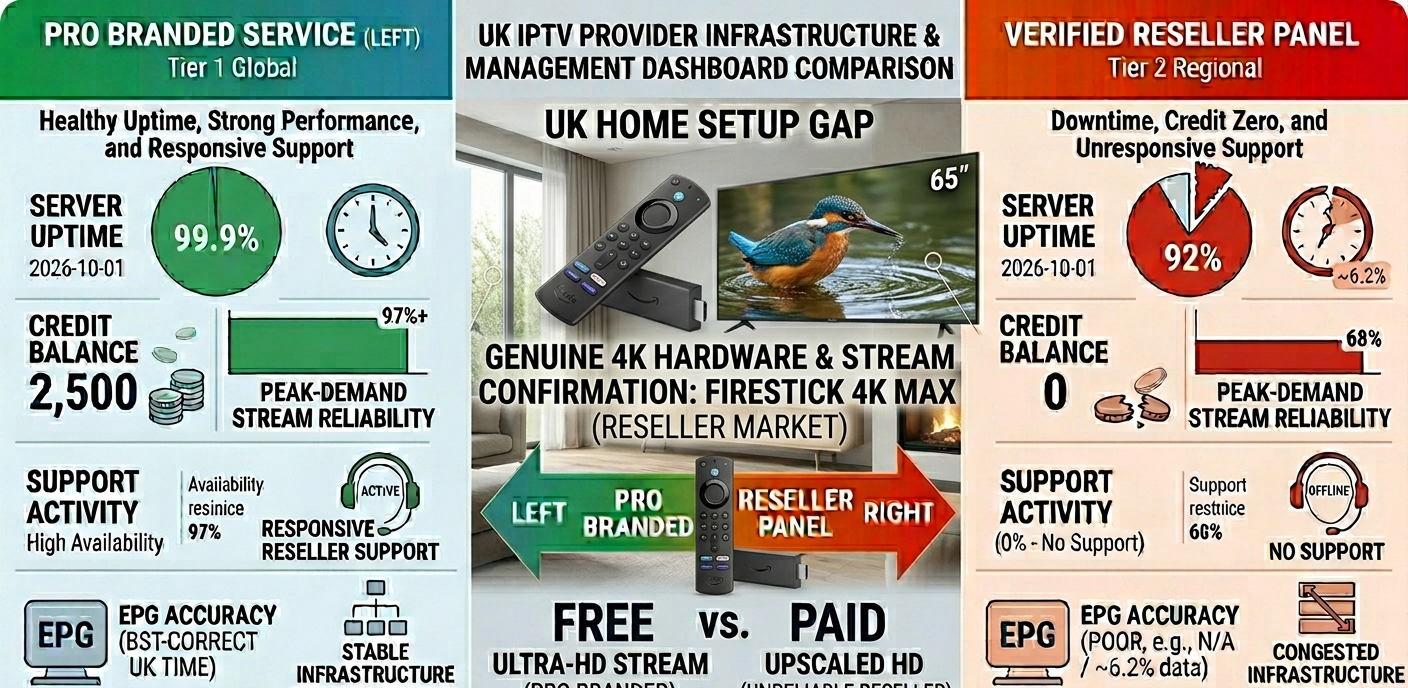
Devices with confirmed hardware HEVC decoding, and therefore reliable 4K UK IPTV playback, include the Fire Stick 4K and 4K Max, the NVIDIA Shield, most Android TV boxes released after 2020 with Amlogic S905X3 or newer chipsets, and Apple TV 4K. Devices that lack hardware HEVC support and will struggle or fail with 4K streams include the original Fire Stick HD, older MAG boxes, and first-generation Android boxes running processors from 2017 or earlier.
The practical consequence: a customer on an incompatible device who purchases your 4K UK IPTV package will experience constant buffering regardless of how good your infrastructure is. They will submit support tickets. They will demand refunds. And they will attribute the failure to your service quality rather than their hardware. Preventing this requires a device compatibility check as a mandatory step in your 4K package onboarding process, not a note buried in your FAQ.
ISP Throttling of 4K UK IPTV: The 2026 Enforcement Dimension
| Threat vector | Impact on HD streams | Impact on 4K HEVC streams | Severity multiplier |
|---|---|---|---|
| Behavioural traffic shaping | Moderate buffering | Catastrophic, stream collapses | 3-4x worse |
| Bandwidth throttling | Intermittent quality drop | Unwatchable within 60 seconds | 4-5x worse |
| DNS poisoning | Complete failure | Complete failure | Equal impact |
| Deep packet inspection | Selective degradation | Immediate detection and throttle | 2-3x worse |
| IP range blocking | Connection refused | Connection refused | Equal impact |
The severity multiplier column tells the critical story. Every ISP enforcement mechanism that causes moderate disruption to HD streams causes catastrophic disruption to 4K HEVC delivery, because 4K has zero buffer tolerance. An HD stream can absorb a 20% bandwidth reduction through adaptive bitrate switching and remain watchable. A 4K HEVC stream at peak bitrate has no lower adaptive tier to fall back to. Any meaningful bandwidth reduction causes immediate, visible quality collapse.
This asymmetry means that 4K UK IPTV customers require VPN guidance as a non-negotiable part of their onboarding, not an optional recommendation. A customer on a major UK ISP connection watching 4K without VPN protection is exposed to enforcement mechanisms that will make their premium package undeliverable during exactly the peak moments they are paying for.
Player Configuration for Stable 4K UK IPTV Delivery
Pro Tip: TiviMate’s hardware decoding setting is disabled by default on many Android devices. A customer with a capable 4K device who is experiencing buffering on HEVC streams almost certainly has software decoding active, which overwhelms the CPU and causes the exact symptoms they’re attributing to your infrastructure. A one-line configuration fix resolves it instantly. Build this into your 4K onboarding guide as step one.
Player configuration is the most underestimated variable in 4K UK IPTV delivery quality. Even on capable hardware with excellent infrastructure and a clean ISP path, a misconfigured player will produce buffering, audio sync issues, and frame dropping that is completely indistinguishable from an infrastructure failure from the customer’s perspective.
The three configuration parameters that matter most for 4K UK IPTV stability across TiviMate and IPTV Smarters Pro are hardware decoding activation, buffer size allocation, and stream reconnection timeout settings. Hardware decoding must be explicitly enabled, it does not default to on. Buffer size should be set to a minimum of 15 seconds for live 4K content to absorb the segment fetch variability inherent in HEVC delivery. And reconnection timeout should be set aggressively short, under five seconds, so that a momentary stream interruption triggers an immediate reconnection attempt rather than leaving the customer staring at a frozen or blank screen waiting for a longer timeout to expire.
Panels Prime provides panel-level documentation for 4K player configuration across all major supported applications, reducing the support burden on resellers while improving the customer experience from day one of their premium package.
Read More: IPTV Reseller Panel
Scaling Profitably: The Credit Economics at Premium Tier
Selling 4K UK IPTV is only profitable if the premium you charge genuinely covers the infrastructure cost differential, not just the credit cost differential. Most resellers making the transition to 4K pricing correctly account for the higher credit cost per 4K line. Almost none correctly account for the higher churn cost when 4K delivery underperforms, the additional support overhead from device compatibility and player configuration issues, and the infrastructure headroom required to deliver concurrent 4K streams during peak events without degradation.
The correctly constructed 4K pricing model must build in a minimum 40% gross margin above credit cost before accounting for churn and support overhead, because those two costs are structurally higher for 4K customers than for HD customers. A 4K customer who experiences a single catastrophic buffering event during a major fixture cancels faster and with less recourse to goodwill than an HD customer experiencing equivalent disruption. The expectation premium they paid creates a corresponding intolerance premium for failure.
4K UK IPTV Reseller Success Checklist
Run the MaxCC formula before selling your first 4K line, know your infrastructure’s true concurrent 4K ceiling and build your sales volume ceiling 25% below it to preserve headroom during peak events
Implement mandatory device compatibility screening at 4K onboarding, a pre-purchase compatibility check prevents the single largest category of 4K support tickets before they are generated
Include hardware decoding activation in your 4K setup guide, a disabled hardware decoder on a capable device is the most common cause of 4K buffering complaints that have nothing to do with your infrastructure
Make VPN onboarding mandatory for 4K customers, the ISP enforcement severity multiplier against HEVC streams means unprotected 4K customers are disproportionately exposed to stream failure during peak hours
Price 4K with a minimum 40% gross margin above credit cost, before churn and support overhead; the premium experience expectation creates a premium failure cost that standard HD pricing models do not account for
Panels Prime provides reseller panel management software. It does not host, store, or distribute media content. Resellers are solely responsible for ensuring their operations comply with applicable laws and regulations.