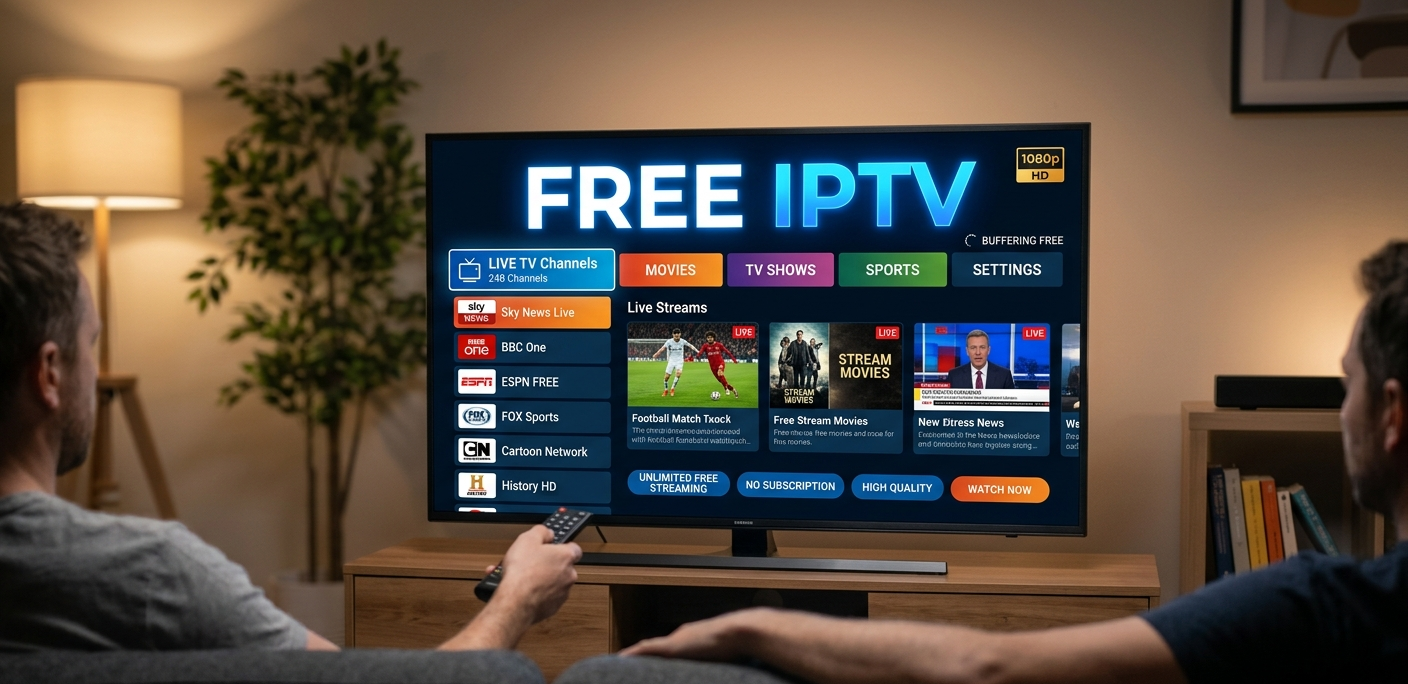
The first time I came across free IPTV, I thought I’d stumbled onto something genius. A Telegram link, a playlist URL, paste it into your player and suddenly hundreds of channels — live sport, films, the lot — all for absolutely nothing. I spent about three weeks convinced I was the smartest person in the room.
Then my router started behaving oddly. Connections dropping. One morning I noticed outbound traffic spikes I couldn’t account for. Nothing catastrophic, but enough to make me look closer at what I’d actually installed on my network. That free IPTV app I’d been running? It had permissions I’d never consciously granted and was phoning home to servers I couldn’t identify.
Free IPTV. Right.
If you’re reading this as someone already in the reseller space, you might be wondering why this even matters to you — your customers want to know about it, and some of them are going to ask whether they should just use a free service instead of paying you. This article is for that conversation.
Table of Contents
- What Free IPTV Actually Is (Technically Speaking)
- The Real Costs Hidden Inside “Free”
- Why Free IPTV Is a Reseller’s Unexpected Ally
- Stream Quality: The Numbers Don’t Lie
- The Security Problem Nobody Wants to Talk About
- What Serious Viewers Eventually Figure Out
- Where Paid IPTV Wins Every Single Time
What Free IPTV Actually Is (Technically Speaking)
Let’s be precise about this, because the term gets used loosely. Free IPTV typically refers to one of three things: publicly available M3U playlists scraped from open-source repositories, pirated stream aggregators disguised as legitimate apps, or trial lines from resellers that expire after 24–48 hours.
The first category — scraped playlists — is genuinely free and genuinely terrible. These pull streams from whatever sources happen to be publicly exposed at that moment. Uptime is essentially random. There’s no CDN behind it, no anti-freeze protocol, no server maintenance. You’re watching a stream that someone else accidentally left open, and it’ll vanish the moment they notice.
The second category is where things get darker. Apps distributed outside official stores, often promoted heavily on social media and Telegram, bundle IPTV access with software that has no business being on your device. These aren’t built by enthusiasts — they’re built by people who understand that a user distracted by free content is a user who isn’t reading app permissions.
The third — trial lines — is actually legitimate and how any reputable reseller should be operating. But that’s not really “free,” that’s a commercial taster.
Pro Tip: When a customer asks you about free IPTV, don’t dismiss it defensively. Acknowledge it exists, explain the technical reality calmly, then show them the difference in stream stability using real numbers. That conversation converts far better than a sales pitch.
The Real Costs Hidden Inside “Free”
Here’s a formula worth keeping in your back pocket when this topic comes up:
True Cost of Free IPTV=Data Risk Value+Time Lost to Buffering+Device Replacement Risk+Opportunity Cost of Unreliable AccessTrue\ Cost\ of\ Free\ IPTV = Data\ Risk\ Value + Time\ Lost\ to\ Buffering + Device\ Replacement\ Risk + Opportunity\ Cost\ of\ Unreliable\ Access
None of those variables are zero. The data risk alone — particularly for households using the same network for banking, work VPNs, or anything sensitive — is significant. Free IPTV apps operating as data harvesting tools aren’t a conspiracy theory; it’s a documented pattern in the wider streaming app ecosystem.
Time lost to buffering is the one that grates on people most viscerally. I’ve had customers come to me after six months of free services specifically because they’d had enough of watching the crucial moment of a match through a freeze-frame followed by a skip. The 3pm Premier League window — already blacked out from domestic broadcast — becomes genuinely unwatchable on free playlist sources during peak load. The servers simply can’t handle it.
And then there’s the churn on devices. Sideloaded APKs on Firesticks, sketchy apps on Android boxes — these things accumulate background processes, degrade performance over time, and in worst cases brick the device entirely when an automatic update pushes corrupted code. I’ve seen it happen.
Why Free IPTV Is a Reseller’s Unexpected Ally
This might seem counterintuitive, but stay with me. Every person who spends three months fighting with a free playlist before giving up is a warm lead walking towards paid IPTV. They’ve already decided they want the content — they just tried to get it for nothing and discovered that doesn’t actually work.
In my experience, the customers who’ve previously tried free services are often the most loyal paying subscribers. They’ve already made the mental comparison. They know what bad looks like. When you give them something stable, with proper MAG box support or clean STBEmu portal setup, and it just works during a Saturday evening boxing match — that’s a customer who doesn’t need convincing again.
The trick is positioning yourself correctly when they arrive. Don’t gloat. Don’t lecture. Just be the solution they were looking for three months ago.
Pro Tip: Add a simple line to your onboarding message acknowledging that some customers have tried free options before. Something like “if you’ve used free playlists previously, you’ll immediately notice the difference in stream consistency.” It validates their journey without being smug, and it primes them to appreciate what they’re paying for.
Stream Quality: The Numbers Don’t Lie
Let me put some real context around this. A properly provisioned paid IPTV service running through a reliable panel with UK-optimised servers should be delivering:
- Uptime of 99.3% or above across a rolling 30-day window
- Anti-freeze buffering that recovers within 2–4 seconds on a standard fibre connection
- Concurrent stream handling that doesn’t degrade during Premier League peak windows
- Consistent HD delivery to MAG boxes, Firesticks, and smart TV applications simultaneously
Free IPTV sources? In honest terms, you’re looking at uptime somewhere between 60–75% on a good week. During high-demand events, that drops further. There’s no anti-freeze system because there’s no infrastructure behind it — just raw streams exposed to whatever traffic finds them.
The bitrate instability alone makes free sources unusable for sport. A compressed, fluctuating stream during fast-movement footage — which is every single football match — produces exactly the kind of pixelation and macro-blocking that makes people throw things at their televisions.
The Security Problem Nobody Wants to Talk About
I’ll be direct here because I think this gets glossed over too often in the interest of keeping articles comfortable to read.
Several widely-distributed free IPTV applications have been analysed by cybersecurity researchers and found to contain code that exfiltrates device identifiers, network information, and in some documented cases, credentials stored on the same device. This isn’t hypothetical. The attack surface is wide because the typical free IPTV user isn’t thinking about network security — they’re thinking about the match starting in twenty minutes.
For resellers, this matters because your customers trust your recommendations. If someone asks you about a free app and you shrug and say “yeah, give it a go,” you’re implicitly endorsing whatever comes bundled with it. That’s a reputational risk you don’t need.
Pro Tip: Keep a short, simple explanation ready for security-conscious customers — particularly those who work from home and use their home network for professional purposes. Frame it as looking out for them, not selling to them. It lands better and it’s true.
What Serious Viewers Eventually Figure Out
The pattern is remarkably consistent. Someone discovers free IPTV, uses it enthusiastically for a few weeks, hits a wall — usually during a major sporting event when the streams collapse under load — and starts asking around for something more reliable. The question shifts from “how do I get it for free” to “who actually has a stable service.”
That question, increasingly, leads people to UK-specific resellers who understand the local demand landscape. And that’s the market you’re operating in.
Where Paid IPTV Wins Every Single Time
Reliability during peak demand. Actual support when something goes wrong. Device compatibility that’s been tested rather than assumed. Credits that represent real infrastructure rather than borrowed bandwidth from someone else’s exposed server.
If you’re a reseller looking for a panel partner that actually holds up when it matters — not just on a Wednesday afternoon but on the weekends that count — britishseller.co.uk is worth a proper look. The difference between a provider optimised for UK viewing patterns and a generic international one becomes very obvious very quickly when Saturday rolls around.
Run your trial during a match. That’s always been my advice. Everything else is just talk.
✅ IPTV Reseller Success Checklist
1. Use free IPTV comparisons as a sales tool, not a threat. Customers who’ve been burned by free services convert well — meet them where they are and let the quality speak.
2. Never recommend unverified free apps to curious customers. The security implications are real and your reputation travels with those recommendations.
3. Benchmark your provider during peak demand windows. Saturday afternoons and mid-week European fixtures are your stress tests — not idle Tuesday mornings.
4. Lead with reliability, not price. The customer who chose you because you were cheapest will leave the moment someone cheaper appears. The customer who chose you because things never freeze is stickier.
5. Understand what your panel is actually built on. Anti-freeze protocols, CDN architecture, concurrent capacity — know these before a customer asks, not after a stream failure forces the conversation.