Is IPTV Legal? The Question Every Reseller Should Ask Before They Start
Is IPTV legal? The technology itself is completely legal, it’s just internet-delivered television. What’s illegal is streaming or reselling content you don’t hold the rights to distribute. The distinction sounds simple, but it’s exactly what catches people out, like this reseller in Birmingham.
Let me tell you first about a conversation I had with a UK IPTV reseller in Birmingham last year. Sharp bloke, decent client base, making a few hundred quid a month on the side. Then one morning he woke up to find his provider had vanished overnight, no panel access, no refund, no explanation. His clients were furious. He lost around £1,400 in pre-paid credits and nearly his entire customer list.
Was he doing anything illegal? Not intentionally, but he hadn’t done his homework either. And in this industry, ignorance isn’t a defence, legally or commercially.
So let’s have the conversation properly.
Table of Contents
ToggleIPTV in Plain English: What We’re Actually Talking About
IPTV simply means delivering television content over an internet connection rather than through a traditional aerial, satellite dish, or cable. That’s it. The technology itself is entirely neutral, it’s how Netflix works, how Disney+ works, how BBC iPlayer works.
The legality question isn’t about the technology. It’s about the content being delivered and whether the operator holds the rights to distribute it.
That distinction matters enormously, and it’s where most of the confusion, and most of the legal risk, lives.
Is IPTV Legal? The Legal Distinction Nobody Explains Clearly
Here’s the split that you need to understand clearly before you sell a single subscription:
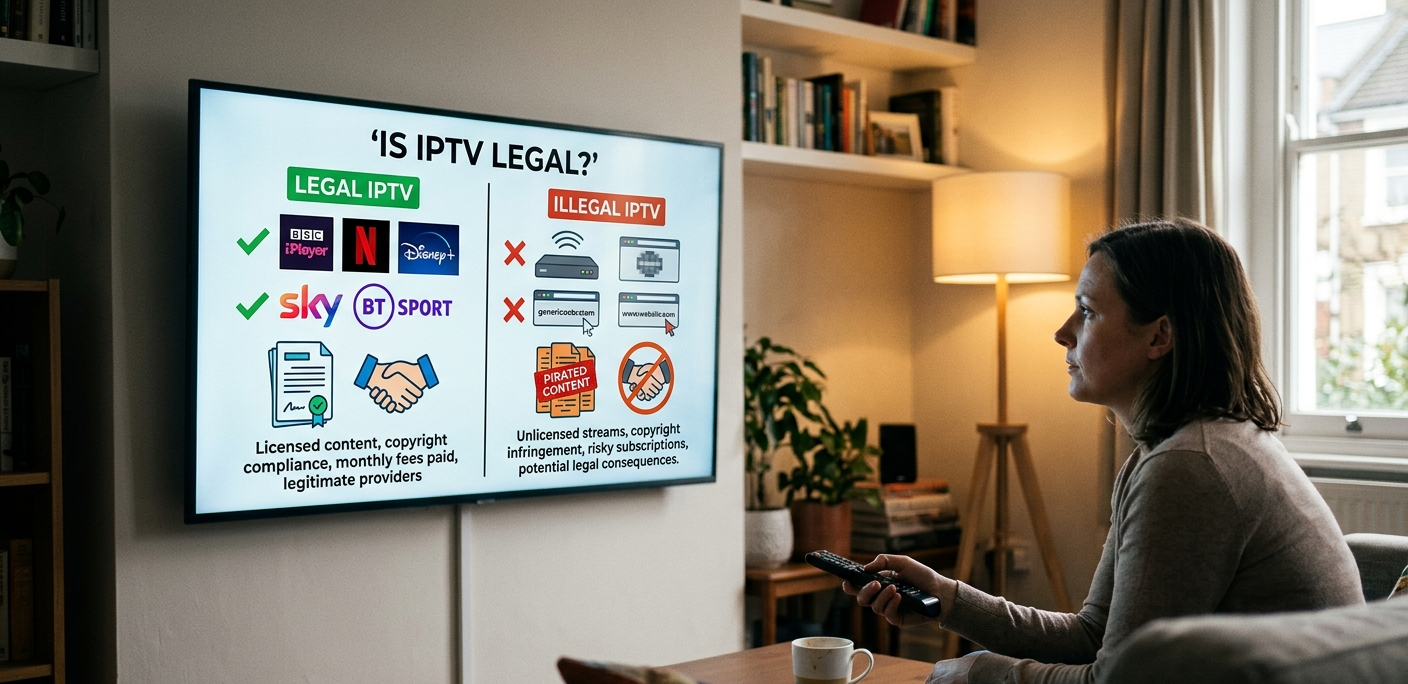
Legal IPTV = Services that have licensed the content they stream. This includes major streaming platforms, IPTV services with legitimate broadcasting rights, and operators distributing their own content.
Unlicensed IPTV = Services streaming content, live channels, films, sports, without holding the rights to redistribute it. These are sometimes called “grey market” or “black market” services depending on how charitable you’re feeling.
The reseller sits in an interesting position. You’re not hosting the streams. You’re not running the servers. You’re selling access. But under UK law, that doesn’t automatically absolve you of responsibility, and this is where a lot of people get caught out.
Pro Tip: The question isn’t just “is my panel legal?” It’s “can my provider demonstrate they hold rights to the content they’re streaming?” If they can’t answer that clearly, walk away. The liability doesn’t stay with them if things go wrong.
What UK Law Actually Says (Without the Waffle)
The primary legislation at play here is the Copyright, Designs and Patents Act 1988, along with the Digital Economy Act 2017 and ongoing enforcement by bodies like ACE (Alliance for Creativity and Entertainment) and FACT (Federation Against Copyright Theft).
Streaming copyrighted content without authorisation, and facilitating others to do so, is a civil and potentially criminal matter in the UK. Penalties range from civil damages to prosecution, and enforcement has increased sharply since 2022.
The Court of Justice of the European Union ruling in 2017 (still relevant in UK case law precedent) established that knowingly streaming unlicensed content constitutes a breach of copyright. Selling a device or subscription configured specifically for that purpose puts the seller in a precarious position.
Here’s what matters practically: enforcement tends to target operators and larger distributors first. But that doesn’t mean individual resellers are invisible. Trading Standards, Ofcom referrals, and civil actions from rights holders have all reached individual sellers.
The Small Mistakes That Actually Create Legal Risk
I’ve seen resellers make these mistakes repeatedly, and not because they’re dishonest, but because no one told them clearly:
Advertising specific channels or sports coverage. The moment you’re marketing a subscription by referencing specific programming you don’t have rights to promote, you’ve created a paper trail. Keep marketing general and technology-focused.
Using screenshots or clips of live broadcasts in promotional material. Obvious in hindsight, but very common on social media.
Selling to clients who’ve explicitly told you they want it for certain programming. If a client says “I want this for the football” and you sell knowing full well what they mean, that context matters legally.
Working with providers who have no verifiable infrastructure. If your supplier is a Telegram contact with a WhatsApp panel login and nothing else, you have no way to assess what you’re reselling.
Pro Tip: Document everything. Supplier communications, your panel terms, your own T&Cs with clients. If you’re ever questioned, the difference between someone who looks like a careful operator and someone who looks like a knowing participant can come down entirely to paperwork.
What Resellers Who’ve Stayed Out of Trouble Actually Do
The resellers I know who’ve been in this space for years without issue share certain habits:
They work with established panel providers who have identifiable infrastructure, uptime track records, and clear terms around what’s included in a reseller agreement.
They don’t make channel-specific promises in writing. Their offering is framed around quality, reliability, device compatibility, and support, not content guarantees they have no control over.
They maintain professional client communication and have clear refund and cancellation policies in place.
They treat it as a business, with a domain, a business email, and some semblance of due diligence, not a side operation run entirely through WhatsApp.
Why Everything Comes Back to Who Supplies You
Everything downstream in your IPTV UK reseller operation depends on who’s sitting upstream. And in 2026, the number of panels claiming to be legitimate while operating on shoestring infrastructure from unaccountable locations has not decreased, if anything it’s grown.
I’ve tested panels that promise 99.9% uptime and then buckle completely during a Saturday afternoon kick-off. I’ve seen providers disappear mid-month with resellers’ credit balances sitting in their system.
The panel provider you choose determines your uptime, your anti-freeze capability, your stream quality, your buffer rates, and frankly your exposure. A provider with UK servers, proven redundancy systems, and a track record matters, not just for performance, but for your own peace of mind.
In my experience, britishseller.co.uk is one of the more stable options in the UK reseller space, not because I’m reading from a script, but because their infrastructure actually holds during peak times, which is the moment of truth for any IPTV panel. It’s where I’d point someone who’s serious about building a proper reseller operation rather than just chasing cheap credits.
IPTV Reseller Profit Reality Check
Let’s be direct about the numbers, because people enter this market with wildly variable expectations:
Monthly Profit = (Active Subscribers × Monthly Price) − (Credits Used × Cost Per Credit) − Support Overhead
A reseller with 40 active monthly clients paying £8 to 12 per subscription, buying credits at a competitive bulk rate, is looking at a realistic net margin of £200 to 500 per month depending on their pricing, churn rate, and how much time they spend on support.
That’s a reasonable side income, not a replacement salary immediately. Resellers who scale to £1,000 to 2,000 per month typically have 100+ active clients, automated renewal reminders, and a low-churn setup built on provider reliability. That last part is non-negotiable.
Pro Tip: Your churn rate is your most honest performance metric. If clients are leaving after one month, the problem is almost never price, it’s buffering, downtime, or poor onboarding. Fix the infrastructure before scaling the marketing.
IPTV Reseller Success Checklist: 5 Things Every UK Reseller Should Have in Place
- A provider you’ve actually stress-tested. Don’t commit credit bulk purchases until you’ve personally run the panel through a high-traffic period. Match day Saturdays are your benchmark.
- Your own terms and conditions. Even a simple one-page document makes you look professional and limits your exposure if a client dispute escalates.
- Clean marketing language. No channel names, no sports-specific promises, no screenshots of live broadcasts. Keep it general, keep it professional.
- A refund policy that’s fair but firm. Vague policies lead to vague disputes. Be clear about what you offer and what you don’t.
- A growth plan that’s based on retention, not just acquisition. Every UK IPTV Panel reseller obsesses over getting new clients. The profitable ones obsess over keeping the ones they have. One happy client referring two friends is worth more than any paid ad campaign.