Building a Profitable British IPTV Reseller Business: What It Actually Takes
Building a profitable IPTV reseller business in the British market comes down to three things: UK-optimised infrastructure that survives the Saturday 3pm demand spike, pricing that reflects reliability rather than chasing the cheapest rate, and support that responds fast during peak hours. Get those right and retention follows. Skip them and you’re firefighting every match day.
It was the last Saturday of the Premier League season. One of those match days where everything matters, relegation battles, title implications, European spots still being decided. I had 94 active subscribers at the time, spread across Birmingham, Leeds, and a surprisingly loyal cluster in Cardiff. My phone was quiet. Streams were clean. Renewals were ticking in automatically.
Then a reseller friend called me from what sounded like a warzone. His provider had gone dark two hours before kickoff. No panel access, no streams, no response on Telegram. Sixty-three subscribers. All offline. All messaging him simultaneously.
“How are yours running?” he asked, already knowing the answer from the silence on my end.
The British IPTV market is one of the most demanding streaming environments on the planet. High subscriber expectations, intense peak demand, a fiercely competitive landscape, and an audience that has zero patience for buffering on match day. Building a profitable reseller business in this market requires understanding it properly, not just picking a panel and hoping for the best.
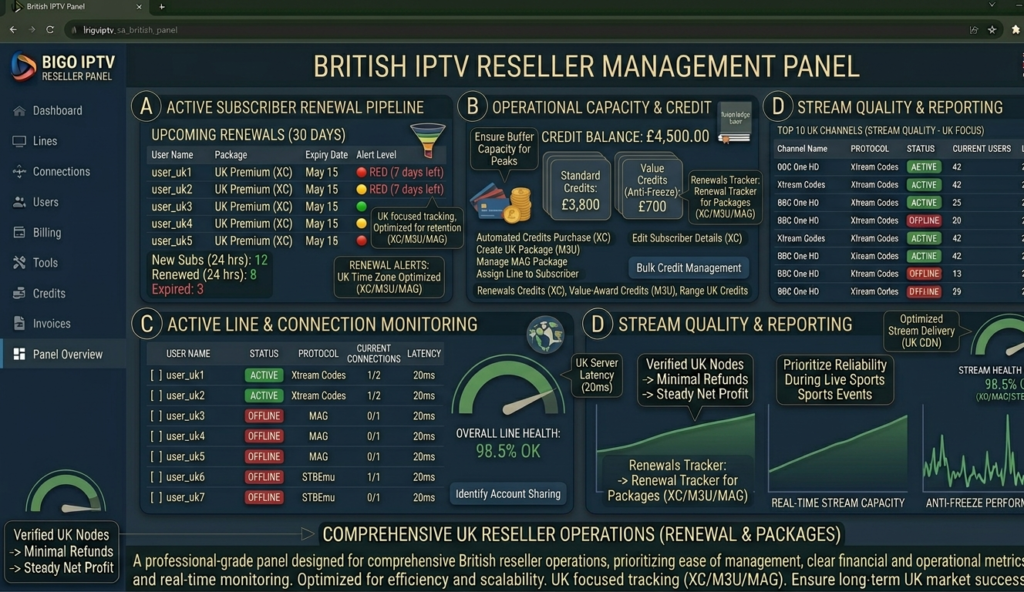
British IPTV reseller panel dashboard showing active UK subscriber lines, credit balance, stream monitoring, and renewal pipeline for a UK-based reseller operation
Why the British IPTV Market Is Unlike Any Other
Spend any time in international IPTV reseller communities and you’ll quickly notice that British resellers talk differently about their business. There’s a particular intensity to it. The conversations about Saturday afternoon infrastructure, about 3pm blackout workarounds, about simultaneous viewership spikes during top-flight football, these are distinctly British problems that resellers in other markets simply don’t face at the same scale or frequency.
The British IPTV market sits at a unique intersection of factors that make it simultaneously one of the most lucrative and most technically demanding markets to operate in.
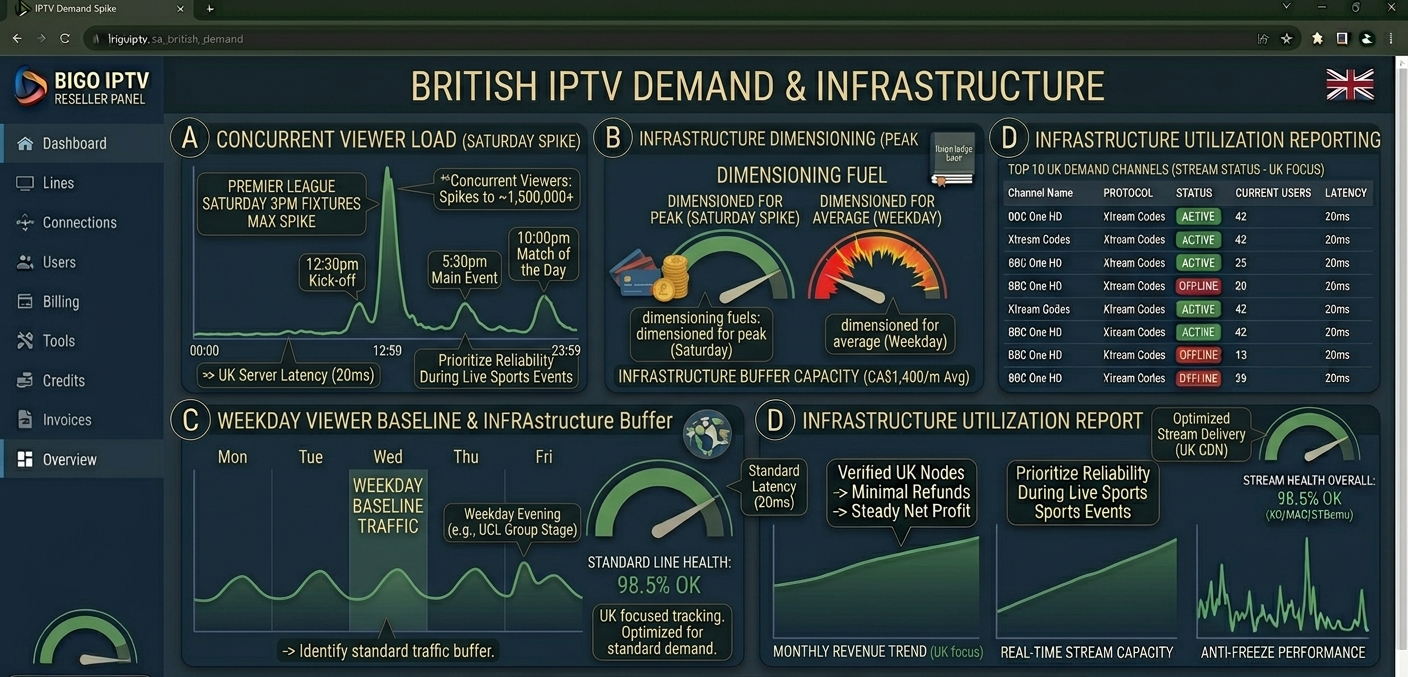
First, the demand profile. The UK has one of the world’s most concentrated live sports viewership cultures. Football alone, Premier League, Championship, international fixtures, cup competitions, creates predictable, massive simultaneous demand spikes that are unlike almost anything in other streaming markets. The 3pm Saturday window is a phenomenon specific to British broadcasting regulation, creating a sharp demand peak that tests IPTV infrastructure in ways that midweek viewing never does.
Second, subscriber expectations. British consumers are accustomed to high-quality broadcast infrastructure from decades of strong terrestrial and satellite television. They don’t grade IPTV on a curve. When streams buffer during a crucial match moment, they don’t think “well, it’s IPTV,” they think “this service is poor” and they act accordingly, usually by finding an alternative before their next renewal.
Third, the competitive landscape. The British IPTV reseller market has matured significantly. Subscribers have options, have been burned by unreliable services before, and are increasingly selective about who they trust with their viewing. New resellers entering the market in 2026 are competing against established operators with track records, not just each other.
Pro Tip: The best acquisition strategy for a new British IPTV reseller is not competing on price, it’s competing on reliability. UK subscribers who’ve experienced buffering during match day from a cheaper service will pay a modest premium for a reseller who can honestly say “my streams held clean last Saturday.” Reliability is your most powerful selling point and costs nothing beyond choosing the right panel.
What British Subscribers Actually Expect
Understanding your market is the foundation of serving it well. British IPTV subscribers in 2026 have a specific set of expectations that differ meaningfully from subscribers in other markets.
Live sport without compromise is the non-negotiable. Football drives the majority of British IPTV demand, but rugby, cricket, boxing, and Formula 1 all contribute significant viewership spikes at specific calendar points. A subscriber who experiences buffering during a Champions League knockout tie or a Test match decider is a subscriber who starts looking elsewhere that same evening.
EPG accuracy matters more to British subscribers than the general IPTV community tends to acknowledge. UK viewers are accustomed to precise programme scheduling from decades of broadcast television. An EPG that shows the wrong start time for a live event, even by fifteen minutes, feels unprofessional in a way that erodes subscriber confidence gradually but consistently.
Device flexibility is increasingly expected. The British subscriber base uses a genuinely diverse device ecosystem. MAG boxes remain popular among older subscribers. Android TV sticks, Fire TV and equivalent, dominate mid-market. Smart TV apps, STBEmu on tablets, and TiviMate on Android phones all feature in a typical reseller’s subscriber device spread. Your panel needs to support all of them cleanly.
Catch-up functionality has moved from bonus feature to baseline expectation. British subscribers are accustomed to robust catch-up from terrestrial broadcast services. An IPTV service without reliable catch-up feels incomplete in the UK market in a way it might not elsewhere.
Responsive support, particularly around match days, is the expectation that separates resellers who retain subscribers from those who don’t. A subscriber who messages about a stream issue at 2:50pm on Saturday and receives a response three hours later has already missed what they were watching for. Response speed during peak demand windows is the support metric that actually matters to British subscribers.
The Infrastructure That British IPTV Demands
The technical demands of the British IPTV market are specific enough that generic international panel infrastructure frequently struggles to meet them. Here’s what the UK market specifically requires.
UK-Optimised CDN Architecture
British fibre broadband is fast. FTTP connections at 100 to 1000Mbps are increasingly common across UK urban areas, and even FTTC connections typically deliver 30 to 80Mbps reliably. This means British subscribers can receive high-bitrate streams without connection-side limitations, but it also means any buffering is immediately and correctly identified as a server-side or routing problem, not a subscriber-end issue.
An IPTV panel serving British subscribers needs UK or EU edge CDN nodes that deliver streams with low latency to British broadband connections. A panel routing all streams through a single overseas server, even a capable one, introduces routing inefficiency that manifests as higher latency and increased buffering risk under concurrent load.
Anti-Freeze for Simultaneous British Peak Demand
The Premier League Saturday 3pm window is the infrastructure stress test that defines British IPTV infrastructure quality. During this period, a significant proportion of a UK reseller’s entire subscriber base is simultaneously active, all watching live sport, all demanding consistent high-quality streams, all having zero tolerance for interruption.
Anti-freeze technology in a British IPTV context needs to be dimensioned for this specific scenario. Adaptive bitrate management that smooths over individual connection fluctuations. Multi-source redundancy that routes around upstream degradation automatically. Failover speed measured in seconds, not minutes. These aren’t premium features for the British market, they’re operational necessities.
Uptime Standards That Match British Expectations
In my experience operating in the British market, the acceptable uptime threshold is meaningfully higher than in other markets, because the cost of downtime is higher. A four-hour outage on a quiet Tuesday costs you some subscriber goodwill. A four-hour outage on a Premier League Saturday costs you subscribers, full stop.
British IPTV infrastructure should target 99.7% or above monthly uptime, and critically, that uptime figure should hold on weekends as well as weekdays. A panel with 99.9% weekday uptime and 97% weekend uptime is not a 99.5% uptime panel for British IPTV reseller purposes. It’s a panel with a weekend reliability problem.
Pro Tip: When evaluating a panel for British IPTV use, ask the provider for their uptime data broken down by day of week over the previous two months. Any credible provider running genuine UK-focused infrastructure tracks this data. If they can only give you a monthly aggregate, they either don’t track it granularly, which is a monitoring problem, or the weekend numbers aren’t flattering enough to share, which is an infrastructure problem.
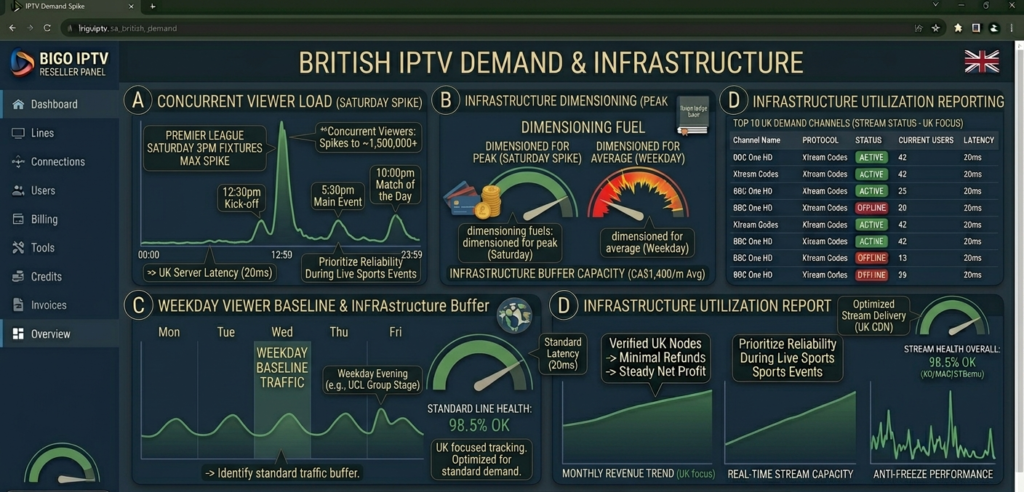
UK IPTV demand spike graph showing concurrent viewer load during Premier League Saturday fixtures versus weekday baseline — illustrating why British IPTV infrastructure must be dimensioned for peak, not average, demand
What to Prioritise When Picking a UK Panel
Panel selection for British IPTV reselling requires applying UK-specific criteria alongside the standard evaluation framework. Here’s what to prioritise.
UK market track record: has the panel been used by British resellers through at least one full Premier League season? Community evidence from UK operators who’ve experienced the panel under real British demand conditions is worth more than any trial period or sales conversation.
British English content management: EPG data, VOD metadata, category labels, and interface text should use British English conventions. A VOD catalogue with Americanised titles and descriptions signals a panel not specifically maintained for UK use.
BST-aware scheduling: British Summer Time affects EPG accuracy from late March through late October. A panel that doesn’t correctly apply the BST offset delivers EPG schedules an hour out for seven months of the year. Test this specifically during the relevant period, it’s a more common failure than providers typically acknowledge.
Saturday afternoon performance documentation: a credible panel for the British market should be able to speak specifically to their Saturday afternoon performance. Vague reassurances about “great infrastructure” are not evidence. Uptime data, CDN specifications, and reseller testimonials from busy match days are evidence.
Support availability during British peak hours: the 2pm to 6pm Saturday window is when your subscribers are most active and most likely to contact you about issues. Your panel’s support team needs to be operational and responsive during this window, not just during standard business hours.
How to Price for the British Market
The British IPTV market supports pricing that reflects the value of reliable service, but only if the reliability is genuinely delivered. Pricing above the market rate for an unreliable service accelerates churn. Pricing at market rate for a reliable service builds the retention that makes the business viable.
The current British market pricing range for IPTV subscriptions sits broadly between £6 and £12 per month for a single connection. The upper end of this range is defensible with reliable service and responsive support. The lower end typically signals a race-to-the-bottom competitive positioning that produces thin margins and financially stressed operations.
The credit economics that underpin sustainable British IPTV reselling work like this: monthly net profit equals subscribers multiplied by retail price, multiplied by one minus the refund rate, minus the credit cost multiplied by subscribers, minus overheads.
At 80 subscribers, £8 retail, £2.40 credit cost, 4% refund rate, £30 overheads: that’s (80 × £8) × 0.96, minus (£2.40 × 80), minus £30, which works out to £614.40 minus £192 minus £30, giving a monthly net profit of £392.40.
At 150 subscribers, same parameters with £2.20 credit cost (volume tier): that’s (150 × £8) × 0.96, minus (£2.20 × 150), minus £30, which works out to £1,152 minus £330 minus £30, giving a monthly net profit of £792.
The volume tier credit cost reduction at 150 subscribers, combined with the fixed overhead staying constant, produces a meaningfully better margin percentage than at 80. This is the scaling mechanic that makes British IPTV reselling genuinely interesting above 100 subscribers.
Here’s how the numbers scale across subscriber tiers:
| Subscribers | Retail price | Credit cost | Refund rate | Monthly net |
|---|---|---|---|---|
| 40 | £8.00 | £2.50 | 4% | £179 |
| 80 | £8.00 | £2.40 | 4% | £392 |
| 150 | £8.00 | £2.20 | 4% | £792 |
| 250 | £8.00 | £2.00 | 4% | £1,390 |
Growing and Keeping Your UK Subscriber Base
Acquisition and retention are different challenges that require different strategies in the British market.
Acquisition: Where British Subscribers Come From
The most effective acquisition channel for British IPTV resellers, consistently, across the operators I’ve spoken to, is personal network and word of mouth. A subscriber in your existing social circle who has a reliable experience becomes a referral source that no paid advertising can replicate in terms of trust transfer.
Beyond personal network, the channels that consistently produce UK subscribers are Facebook groups with local or interest-based focus, sports supporter groups, local community groups, tech and streaming communities. The approach that works is genuine participation and helpfulness, not promotional posting. British Facebook communities respond poorly to obvious sales activity and well to demonstrated expertise.
Localised SEO: a simple landing page targeting “IPTV subscription [your city]” or “IPTV reseller UK” captures organic search traffic from subscribers actively looking for exactly what you offer. It takes time to produce results but generates acquisition that costs nothing per subscriber once established.
Retention: Keeping British Subscribers Beyond Month Three
The first three months of a subscriber relationship are where British IPTV churn concentrates. Subscribers acquired through personal recommendation churn less than cold-acquired subscribers, and subscribers who’ve experienced reliable service through at least one major sporting event churn far less than those who’ve only experienced quieter viewing periods.
The retention practices that make a measurable difference in the British market:
Proactive communication before major sporting events: a brief message to subscribers ahead of a significant fixture weekend, confirming the service is prepared for the load. It takes three minutes per message and generates disproportionate goodwill.
Transparent communication during outages: when something goes wrong, message your subscribers before they message you. Acknowledge the issue, give a realistic timeframe, and follow up when resolved. This approach retains subscribers who would otherwise quietly not renew.
Renewal process friction reduction: make renewing as easy as possible. A clear payment link, a simple process, and a thank-you message on receipt. The more friction in your renewal process, the more passive churn you’ll experience from subscribers who intended to renew but found the process unclear.
Pro Tip: Send a personalised check-in message to every subscriber after their first month, not a renewal prompt, just a genuine “how’s the service working for you?” Most won’t respond, but those who do will either give you valuable feedback or confirm their satisfaction in a way that cements the relationship. The few who flag a minor issue you can quickly resolve become your most loyal long-term subscribers.
The Legal and Operational Landscape in 2026
I’m not going to pretend this section doesn’t exist, because resellers who operate without understanding the landscape do so at their own risk.
The British IPTV reseller business model involves selling subscription access to a panel management platform, not hosting or distributing content directly. This distinction matters operationally and commercially. Your terms of service, your subscriber communications, and your business positioning should accurately reflect what you’re actually providing.
UK regulatory attention toward IPTV services has increased over recent years, with ISP-level enforcement activity expanding. Operating with clear, accurate terms, maintaining appropriate subscriber data handling under UK GDPR, and ensuring your provider’s infrastructure is structured transparently are all basic operational hygiene that reduces exposure.
This isn’t legal advice, consult a professional for that. But operating with your eyes open about the regulatory environment is simply responsible business practice in 2026.
Common Mistakes British IPTV Resellers Make
Choosing a panel based on Telegram recommendations without verification. The British IPTV Telegram community contains a mixture of genuine operators, affiliate marketers, and people who’ve been using their current panel for three weeks and haven’t yet experienced a busy Saturday. Filter accordingly.
Underpricing to compete with established resellers. Competing on price in the British market is a losing strategy unless you have structural cost advantages. Compete on reliability and support quality instead.
Ignoring Saturday afternoon as a distinct operational challenge. The 3pm Saturday window is not a routine demand period, it’s the stress test that defines your service quality for British subscribers. Treat it accordingly in how you monitor, prepare, and communicate.
Building on a single panel with no backup. Provider failures happen. Credit balances disappear. Having a tested backup panel with a small credit reserve is basic operational insurance that costs very little relative to the protection it provides.
Not collecting subscriber data properly from day one. Name, contact details, subscription start date, device type, referral source, these should be captured for every subscriber from the first line created. The business decisions you’ll make in month twelve will be significantly better informed if you’ve been collecting data since month one.
Honest Recommendation for Getting Started
The British IPTV market rewards resellers who take infrastructure seriously, communicate honestly with subscribers, and build operational foundations that can sustain growth rather than just accommodate it.
For UK IPTV Panel resellers who want to start on the right foundation, with a panel that’s been verified by British operators through real Premier League seasons, transparent credit economics, and management tools that support genuine business operations, britishseller.co.uk is the starting point I consistently recommend. It’s a practical choice, not a promotional one. The operators I know who’ve built sustainable British IPTV businesses on solid panel foundations don’t spend their Saturday afternoons firefighting. That’s the goal, and it starts with the right platform.
British IPTV Reseller Success Checklist
- Verify Saturday afternoon performance specifically before committing to any panel: request trial lines and test them between 2:45pm and 5:30pm on a match day Saturday. Stream quality during this window is the single most predictive indicator of how the panel will serve your British subscribers long-term.
- Price for reliability, not competition: set your retail price at a level that delivers healthy margin and allows you to absorb occasional credit extensions or refunds without damaging your operation. In the British market, a reseller known for reliability can charge £8 to £10 comfortably; a reseller known for buffering cannot justify £6.
- Build your renewal communication sequence before your first subscriber: automated renewal alerts at seven days, three days, and one day before expiry. Configure this infrastructure early, before the volume makes manual chasing unmanageable, and it will pay dividends for as long as you operate.
- Communicate proactively around major sporting events: a brief subscriber message ahead of significant fixture weekends positions you as attentive and professional, differentiates you from most competing resellers, and builds the kind of relationship that produces word-of-mouth referrals without you having to ask for them.
- Maintain a tested backup panel from month one: the cost of a small credit balance with a secondary provider is trivial relative to the protection it provides when your primary panel experiences issues during a critical demand period. Every reseller who’s never needed their backup panel thinks it’s unnecessary, until the Saturday they do need it.